An electricity bill can be one of those documents you receive every month, check the total, forward to Finance, and move on.
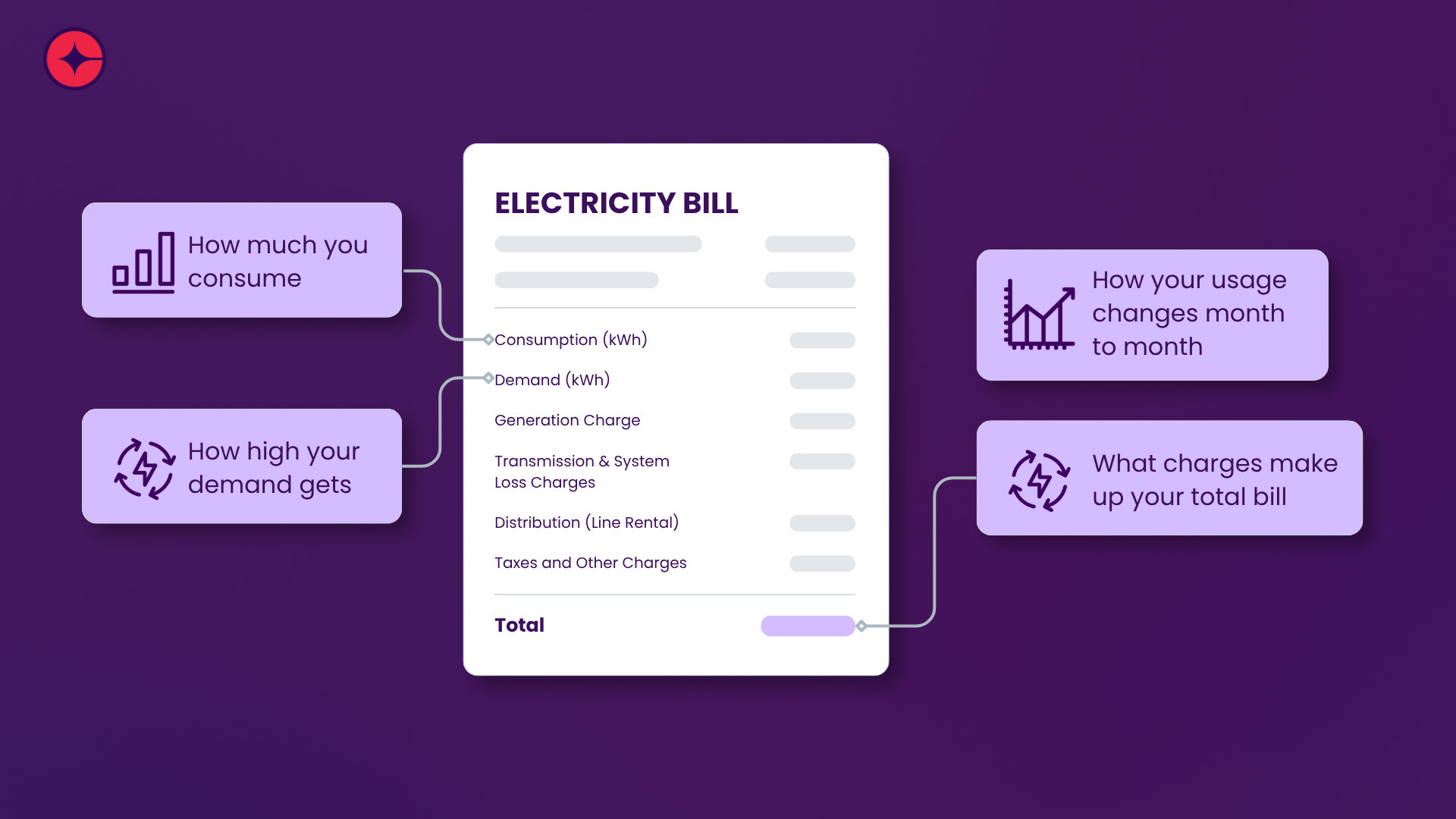
But if your business is considering choosing a retail electricity supplier, that same bill suddenly becomes much more useful.
It can show how much electricity your business consumes, how high your demand gets, how your usage changes month to month, and whether your consumption profile suits a different electricity arrangement.
In other words, before asking, “Can we get a better electricity rate?” it helps to understand what your current bill is already telling you.
Here are the key numbers to look for before speaking with a retail electricity supplier in the Philippines.
They look almost identical on paper, but kilowatts (kW) and kilowatt-hours (kWh) tell you two different things.
kW measures power or demand. This is how much electricity your facility needs at a particular point in time.
kWh measures energy consumption. It tells you how much electricity your business actually used over a period of time.
Think of it this way: kW tells you how much electricity you need at a given moment, while kWh tells you how much you consumed over time.
For a factory, for example, several large machines operating simultaneously can push demand higher. For a hotel, demand may rise when air-conditioning, elevators, kitchens, laundry equipment, and other systems are all operating at once.
That distinction matters because businesses do not all use electricity the same way. Two facilities can consume a similar number of kWh over a month while having very different demand patterns. Those patterns become important when evaluating electricity for business.
One number deserves particular attention: peak demand. Peak demand reflects the highest level of electricity demand recorded during the applicable billing or measurement period. For businesses exploring Retail Competition and Open Access (RCOA), this figure has become especially relevant.
As of June 26, 2026, the Energy Regulatory Commission (ERC) lowered the contestability threshold for RCOA and the Retail Aggregation Program (RAP) from 500 kW to 100 kW average monthly peak demand. This means more medium-sized commercial and industrial electricity users can potentially choose their preferred RES.
So, if your business previously assumed it was too small to participate in the contestable market, it may be worth checking again.
A facility's demand information is not just an eligibility question, either. It gives a prospective energy provider a better picture of how your operations actually use power.
One electricity bill is useful. Several months are much better. Suppose your consumption looks like this:
January: Relatively high
February: Lower
March: Moderate
April: Significantly higher
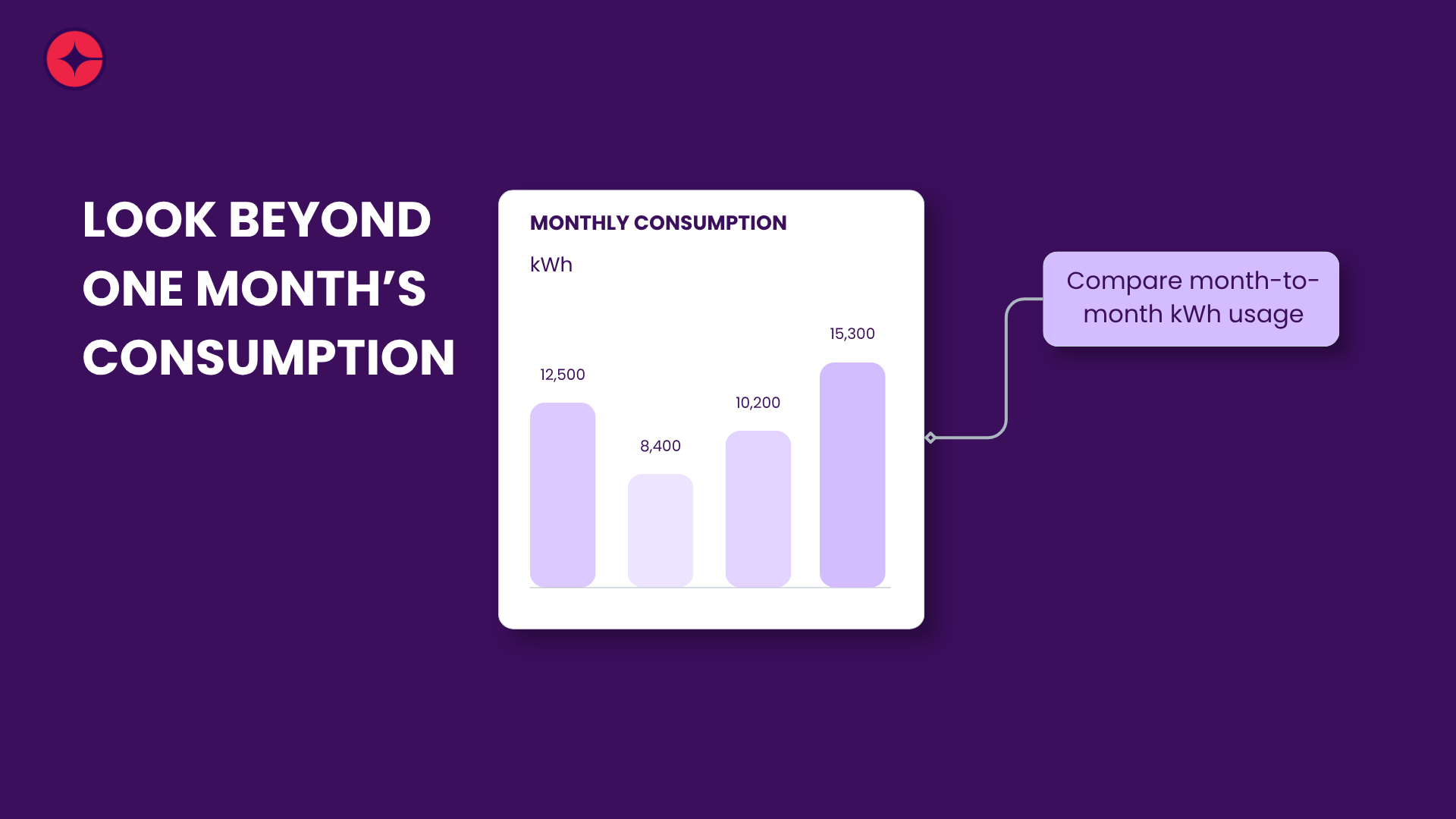
The next question should be: Why? Maybe production increased. Perhaps April was particularly hot and cooling equipment worked harder.
A hotel could have experienced higher occupancy. A cold-storage facility may have expanded capacity. A retailer might have opened longer during a busy period.
These changes form your usage history, and that history can help an RES understand whether your electricity requirements are stable, seasonal, growing, or highly variable.
For businesses seriously considering switching electricity suppliers in the Philippines, it is useful to have multiple recent bills available rather than relying on a single month.
In fact, recent electricity bills form part of the information needed during the switching process. The more COREnergy knows about these factors, the better price they can usually offer. Better knowledge means less risk, and the goal is not simply to find your average consumption; it is to understand the story behind it.
Your monthly kWh tells you how much electricity you consumed. It does not necessarily tell the whole story of when you consumed it.
Consider two businesses with similar monthly consumption. One operates mainly from 8:00 AM to 5:00 PM. The other runs equipment around the clock.
Their total consumption may look similar on paper, but their operating profiles are very different. That distinction can matter when comparing electricity suppliers and rate structures.
Some electricity arrangements prioritize price predictability, while others may suit businesses that can manage when they consume electricity. The right fit therefore depends on more than finding the lowest-looking number on a proposal.
Operating hours, load patterns, demand, budget requirements, and appetite for price fluctuations all need to be considered together. That is why your bill should be the beginning of the conversation, not the entire conversation.
Your total electricity bill is not simply one charge for electricity. It can contain several cost components associated with the different parts of delivering electricity to your facility. These may include generation, transmission, distribution, system loss, taxes, universal charges, and other applicable items.
This is particularly important when comparing energy companies in the Philippines or reviewing an RES proposal.
Under RCOA, choosing an RES does not mean your business disconnects from the existing electricity network. The physical flow of electricity still uses the transmission and distribution infrastructure.
RCOA changes who your business contracts with for its competitive electricity supply. The ERC's competitive retail market rules also govern the interactions among customers, RES providers, distribution utilities, and other market participants.
IEMOP, meanwhile, serves as the Central Registration Body for RCOA and facilitates registration, customer switching, and information exchange among retail market participants.
Understanding that distinction makes it easier to compare offers properly. A lower quoted rate does not automatically mean every line on your electricity bill disappears.
You do not need to become an electrical engineer before speaking with an RES. You just need enough information to give the supplier a realistic picture of your operations. Before your consultation, it helps to prepare:
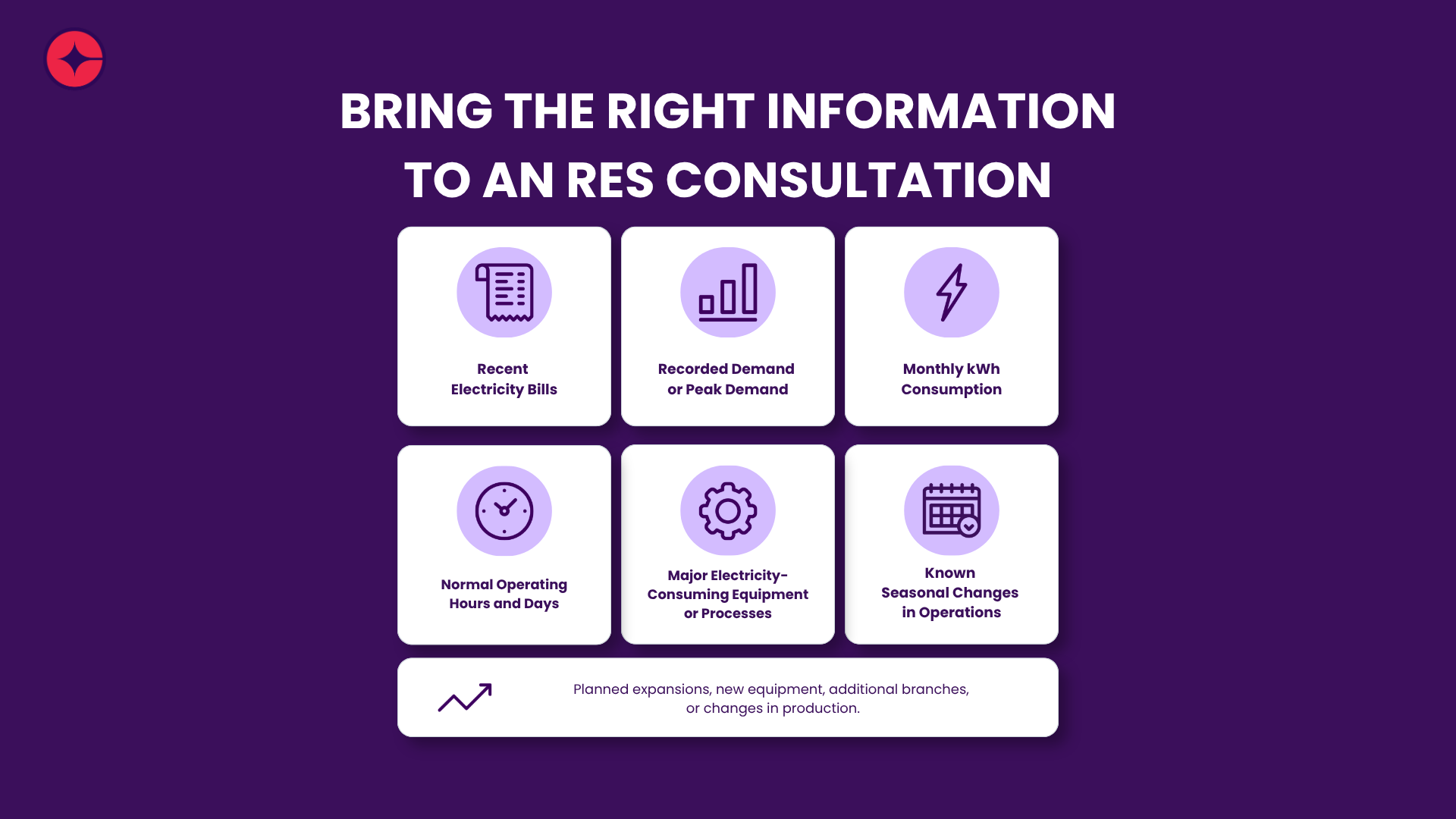
For businesses moving forward with a switch, additional documentation will eventually be required. Customer information used in retail-market registration can include billing and service addresses, account and meter information, contact details, and meter specifications.
The good thing is that you do not have to arrive at your first conversation with everything perfectly organized. A good RES should help you understand what information is needed and why.
Reading your electricity bill differently can change the questions you ask. Instead of simply asking, “How much did we pay this month?” you can start asking:
When are we using the most electricity? Why does our demand rise during certain periods? Is our consumption predictable? Could our operating schedule work better with a different rate structure? Are we already eligible to choose our electricity supplier?
Those are much more useful questions. They can also help businesses compare power companies in the Philippines and electricity suppliers based on how well an offer fits actual operations, not simply on whichever proposal appears cheapest at first glance.
With the RCOA and RAP threshold now at 100 kW average monthly peak demand, more businesses have reason to take a closer look at those numbers.
At COREnergy Philippines, we believe energy decisions should be easier to understand. COREnergy works with commercial and industrial customers to understand their consumption patterns, operating requirements, and business priorities before recommending an electricity arrangement.
The goal is not to force every business into the same plan. It is to find an arrangement that makes sense for how your business actually operates.
If you decide to proceed with switching electricity suppliers in the Philippines, you do not have to navigate the process alone. COREnergy supports customers throughout the switch, including the documentation and coordination involved in moving into the contestable market.
Your electricity bill already contains valuable information about your business. You just need to know where to look. Ready to understand what your electricity bill could mean for your options? Talk to COREnergy and let us help you explore the right electricity arrangement for your business.