
For many businesses exploring a retail electricity supplier in the Philippines, one question comes up almost immediately: How long will switching take?
It is a fair question. Electricity keeps your business moving. Whether you run a factory, commercial building, hotel, warehouse, or retail operation, you do not want a transition that feels uncertain or disrupts the work your team needs to do.
The good news is that switching electricity suppliers in the Philippines follows a defined process under Retail Competition and Open Access, or RCOA.
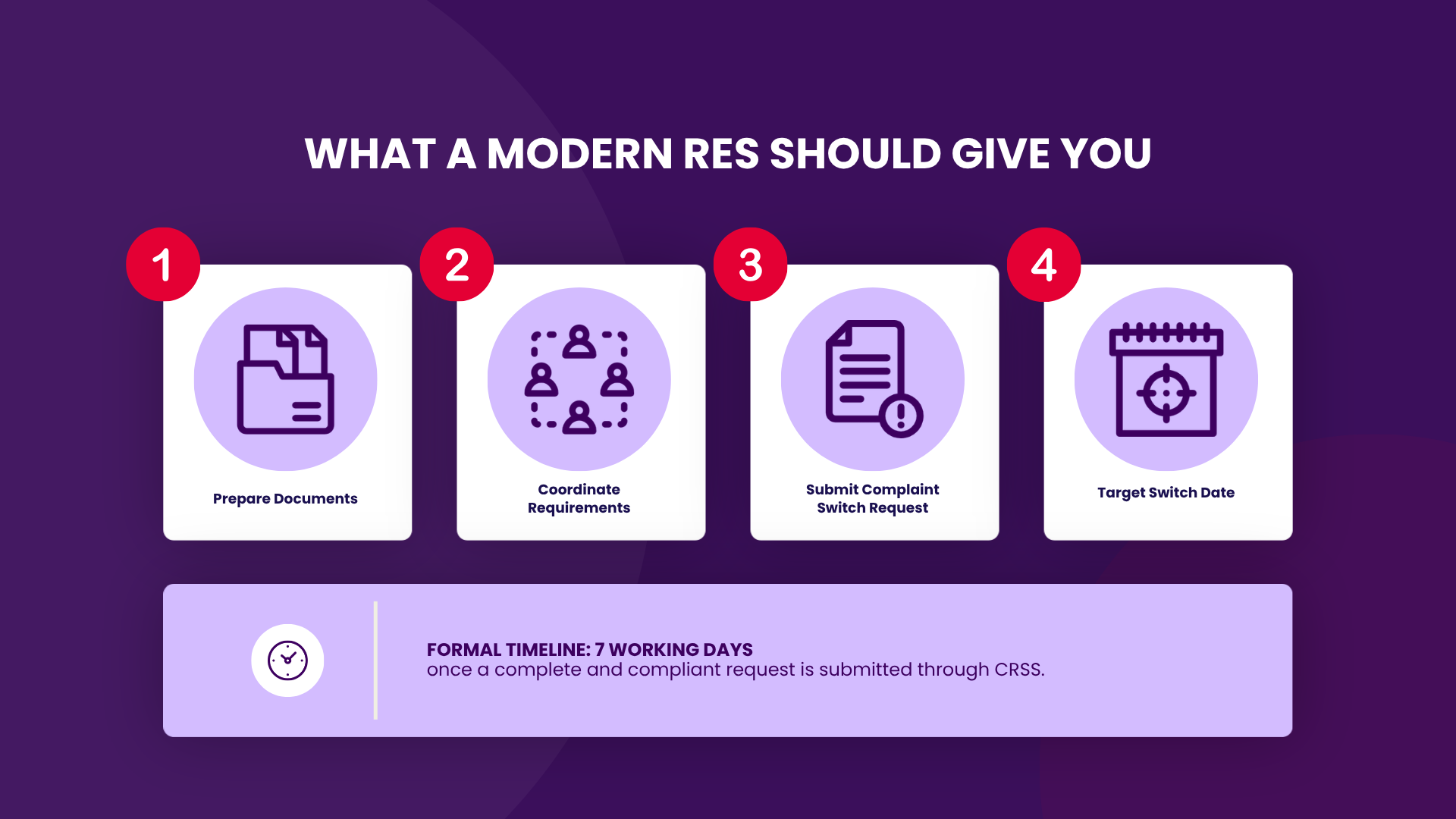
Under the updated customer choice procedures, the formal switching timeline is seven working days once a complete and compliant switch request has been submitted through the Central Registration and Settlement System (CRSS).
But here is the practical part businesses should know: getting ready for submission can take longer, especially when you are switching from your Distribution Utility arrangement to an RES for the first time.
That is why the right energy provider matters. A dependable partner does not simply wait for your documents. It helps your business prepare, coordinate, and move toward the target switch date with fewer surprises.
Under RCOA, qualified businesses can choose a licensed Retail Electricity Supplier (RES) for their electricity supply instead of relying only on the default supply arrangement in their local distribution area.
Currently, businesses with an average monthly peak demand of at least 100 kW in the preceding 12 months may qualify as contestable customers under RCOA.
The Independent Electricity Market Operator of the Philippines (IEMOP) provides official customer information guidance for contestable end users through its Customer Information Requirements for the Central Registration Body page.
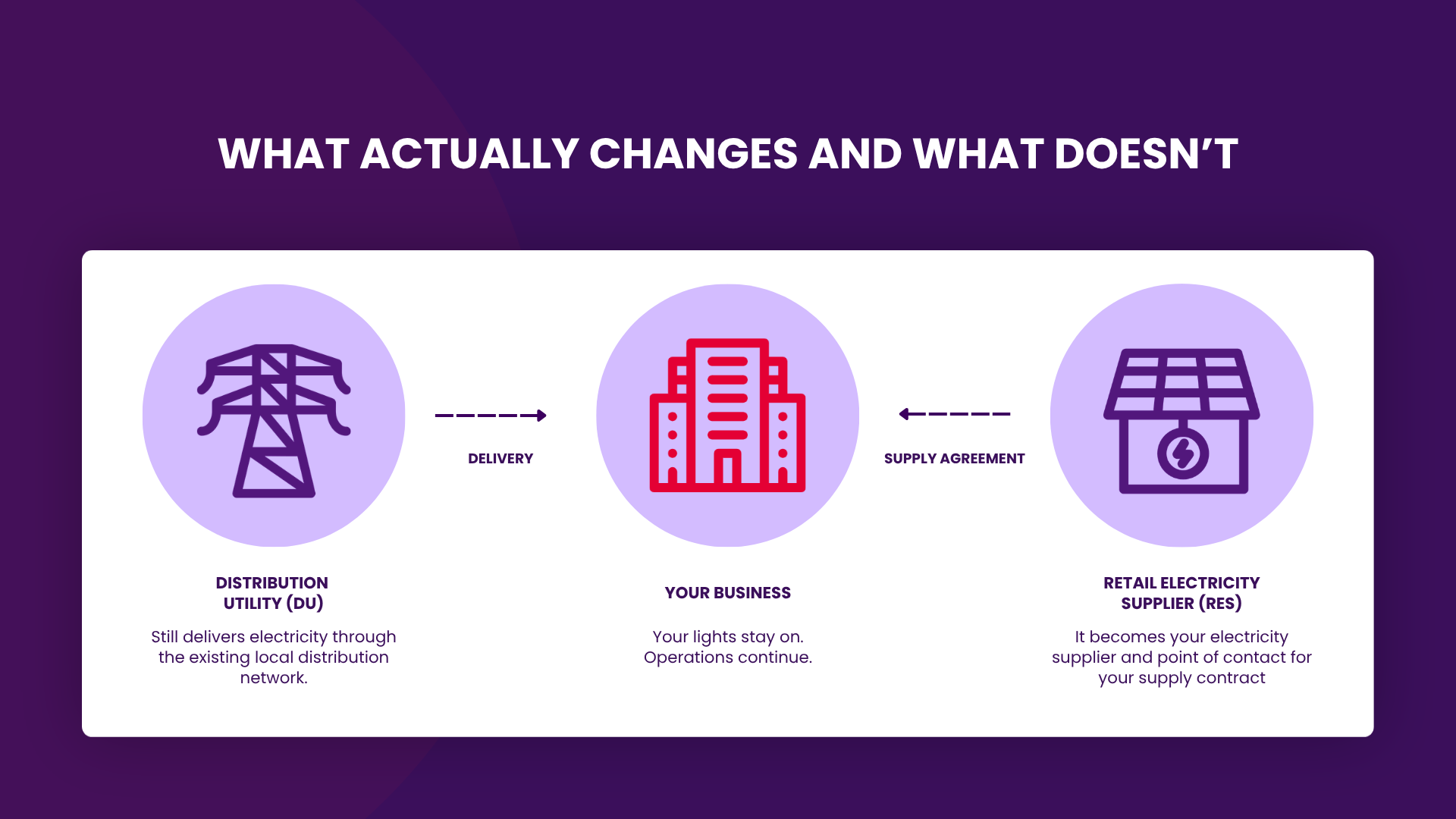
Switching changes your supply arrangement and contract. It does not mean your business needs new power lines. Your Distribution Utility or DU remains involved in delivering electricity through the existing local distribution network and in applicable metering or connection requirements.
In other words, your lights do not suddenly turn off while one provider steps away and another walks in. The transition is a coordinated commercial and regulatory process.
According to IEMOP Retail Market Bulletin No. 2, the updated customer choice rules adopted a seven working day switching timeline for RCOA and related retail market programs. However, the customer is legally required to serve a formal Notice of Intention to Switch to their Network Service Provider (NSP) or their Distribution Utility (DU) at least 90 calendar days before the actual switch. Even if a business has the completed, fully-signed documents ready by the first day, they still have to wait out that statutory 90 days.
The important phrase is this: complete and compliant documents. Day 1 of the seven-working-day timeline begins only when the switch request has been properly submitted through the CRSS with all required documents, authorizations, attestations, prudential requirements, and applicable metering requirements complete and consistent.
IEMOP also states that any deficiencies identified in a switch request must be corrected within five working days. If required corrections are not completed within that period, the request may be disapproved, and a new request may need to be submitted.
So while the regulatory processing window is clear, your real business timeline depends heavily on preparation.
Before comparing electric suppliers, your business needs to confirm whether it qualifies to participate in RCOA.
This usually starts with reviewing your recent electricity bills and demand history. Your operating profile also matters. A business that uses power steadily throughout the day may have different pricing priorities from a company with more flexible hours or seasonal demand.
At this point, you are not only asking, “Can we switch?” You are also asking, “What type of electricity plan makes sense for our operations?”
A customer-focused RES should help you review your consumption pattern and understand what options may suit your budget and operational requirements.
Once your business confirms eligibility, the next step is choosing a retail electricity supplier.
This is where many decision makers naturally start comparing rates. That is important, but it should not be the only deciding factor. Among the many energy companies in the Philippines and power companies in the Philippines, look for an RES partner that can clearly explain:
The Energy Regulatory Commission or ERC maintains the rules governing customer choice programs in the retail market, including Resolution No. 13, Series of 2024, which adopted the Omnibus Rules for Customer Choice Programs.
Choosing a retail electricity supplier should therefore include checking that the provider is properly licensed and prepared to guide your business through the regulated process.
This is often the portion that affects how quickly your business can proceed.
Requirements may involve recent electricity billing records, business registration documents, proof of authority for authorized representatives, supply contract documents, applicable financial or prudential requirements, and metering-related documentation.
For a business switching for the first time, there may also be more coordination needed with the DU or retail metering service provider, especially if technical or metering requirements must be confirmed.
A simple but useful tip: identify your internal point persons early. Finance, legal, procurement, facilities, and authorized signatories may all need to provide inputs or approvals. A missing signature can delay a switch just as easily as a missing technical requirement.
Once the requirements are complete and the parties are aligned, the primary retail supplier submits the switch request through CRSS. This is the point when the official seven-working-day processing timeline begins.
IEMOP’s bulletin requires the switch request to be submitted at least seven working days before the intended effective date. It also emphasizes that information across documents must be consistent, including company details, signatories, contract effectivity dates, facility details, and applicable metering information.
This is why hands-on support matters. Your RES should help check for completeness before submission, rather than letting avoidable errors consume valuable time.
Once the switch is processed and takes effect, your business begins its retail supply arrangement with its chosen RES.
Your local DU remains responsible for the delivery infrastructure, while your RES becomes your partner for the electricity supply contract, billing support, plan discussions, and ongoing account care.
With COREnergy Philippines, customers can explore flexible energy plan structures depending on business needs, including fixed and flat rates, market-based options, time-based structures, and custom arrangements. You can review these options on the COREnergy Energy Plans page.
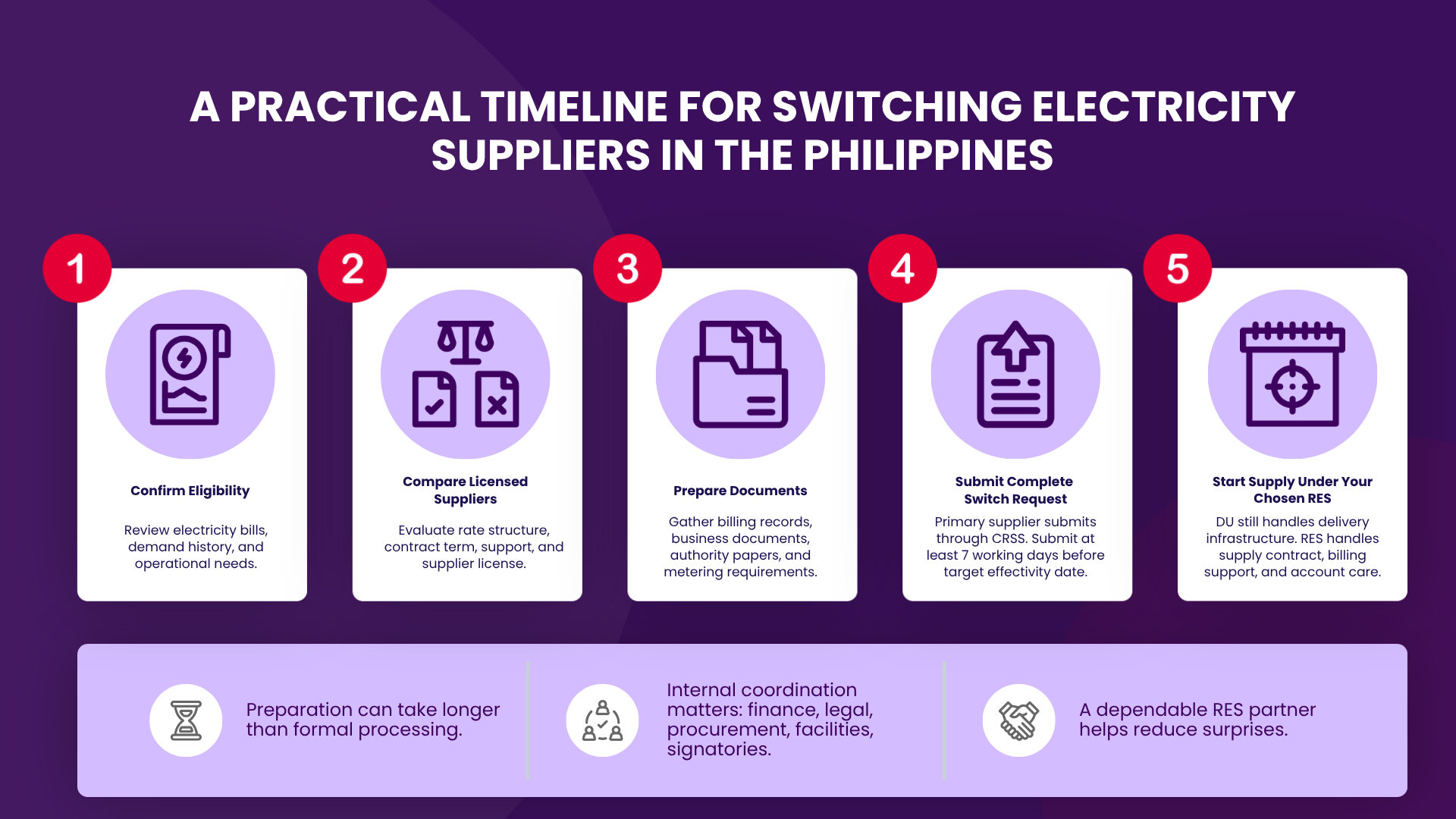
The formal switching process may take seven working days, but the total journey can take longer when readiness items are still incomplete.
Common factors that may affect timing include incomplete documentary requirements, delayed internal approvals, incorrect or inconsistent company information, pending metering requirements, financial requirement coordination, or questions around the intended switch date.
This does not mean switching has to be difficult. It means the process works best when your business prepares early and has an RES partner that keeps the steps clear. The best time to ask questions is before submission, not when the target switch date is already close.
An energy audit is not the same as the regulatory switch request. Switching to an RES is about moving into a chosen retail supply arrangement, while an energy audit helps a business evaluate how electricity is being used within its facilities.
For businesses that want a fuller view of energy performance, COREnergy also provides energy services such as power quality studies, thermal scan tests, medium voltage electrical equipment testing, and Energy Audit Levels 1, 2, and 3. These services can be explored through COREnergy Energy Services.
An audit can help strengthen your energy decisions, but your RES partner should clearly explain which activities are required for switching and which are additional opportunities to improve efficiency or operational understanding.
Switching electricity suppliers in the Philippines should not feel like a maze of forms, acronyms, and unanswered questions.
The regulated processing timeline is now clearer: once a complete and compliant switch request is submitted, the formal process follows a seven-working-day timeline.
What makes the experience smooth is everything that comes before it: confirming eligibility, reviewing your energy needs, preparing documents correctly, coordinating with the right parties, and choosing a supplier that stays hands-on from start to finish.
COREnergy helps eligible Philippine businesses move through the switching process with practical guidance, flexible energy plans, and a customer-first approach built around clarity and support.
Ready to explore how to switch retail electricity suppliers in the Philippines? Connect with COREnergy to check your eligibility, understand your timeline, and find an energy plan that fits the way your business operates.
Start your switch with a greater understanding of what your business needs. Explore COREnergy Energy Plans or request a quote for your business today.