
If you run a power-hungry business in the Philippines, the Retail Competition and Open Access (RCOA) market just became a lot more relevant to you.
A new Energy Regulatory Commission (ERC) resolution has lowered the eligibility threshold for both RCOA and the retail aggregation program to 100 kW average monthly peak demand, opening the door to smaller sites and multi-site businesses that previously didn’t qualify.
This article breaks down what changed, who qualifies, and how the new RCOA threshold eligibility actually works in real life, in simple terms, and from the perspective of a retail electricity supplier in the Philippines that helps businesses switch every day.
Under Retail Competition and Open Access (RCOA), certain businesses — called contestable customers — are allowed to choose their Retail Electricity Supplier (RES) instead of being locked into their local distribution utility or electric cooperative.
Contestable customers in the Philippines are end-users that meet a minimum demand threshold set by the ERC. Retail Electricity Suppliers in the Philippines (like COREnergy), on the other hand, are licensed companies that buy power from generators and sell it to contestable customers under customized supply contracts.
The Retail Aggregation Program (RAP) is designed for businesses that don’t individually hit the threshold, but do so collectively. In RAP, several end-users combine their demand and are treated as a single aggregated customer under one Retail Aggregated Group (RAG).
Previously, only customers (or aggregated groups) with at least 500 kW average monthly peak demand for the last 12 months could join RCOA.
Under ERC Resolution No. 22, Series of 2025, the demand threshold for eligibility to the competitive retail electricity market (CREM/RCOA) and the Retail Aggregation Program will be 100 kW average monthly peak demand. This new 100 kW threshold takes effect on 26 June 2026.
That means that any single site that averages 100 kW or more in monthly peak demand can qualify as a contestable customer. Moreover, any group of sites or businesses whose combined average monthly peak demand reaches 100 kW can qualify under the retail aggregation program in the Philippines.
The ERC estimates there are over 12,000 end-users in the 100–499 kW band nationwide, all of whom can now take advantage of this new RCOA threshold.
You may qualify directly for RCOA (without aggregation) if your facility’s average monthly peak demand is at least 100 kW for the last 12 months, and you are within an area where the Wholesale Electricity Spot Market (WESM) and RCOA are already operating (Luzon, Visayas, and Mindanao).
This is ideal for:
These businesses can switch to a retail electricity supplier and negotiate a customized contract instead of relying on standard distribution utility (DU) rates.
You may qualify as aggregated contestable customers under RAP if each site is below 100 kW on its own, but your combined average monthly peak demand is at least 100 kW, and your meters are under the same network service provider (your DU or EC), as required under the Omnibus Rules.
This is perfect for:
In the eyes of the ERC, this aggregated demand is what qualifies your group under the retail aggregation program.
The resolution doesn’t just lower the threshold; it also sets clear timelines so everyone can prepare. Below are some points for end-users and aggregated groups:
Any licensed retail electricity supplier in the Philippines like COREnergy may start marketing to future qualifying customers and forming Aggregated Groups in the 100–499 kW band even before June 2026.
If your business or Aggregated Group wants to switch exactly on 26 June 2026, your LOI to your Network Service Provider (NSP / DU / EC) must be submitted on or before 30 January 2026.
If you miss that date, you can still file an LOI from 31 January 2026 onward, but your target switch date must be at least 90 days after 26 June 2026 (or 90 days from receipt of your LOI, whichever applies).
Your DU or EC, acting as Retail Metering Service Provider (RMSP), must install or upgrade your metering facilities so they can record interval data and communicate it to the Central Registration Body. These must be in place at least 30 days before your switch date.
Physically, you still receive electricity through the same distribution wires; the big change is who supplies your power and how your contract is structured.
In summary, start discussions with your RES in 2025–early 2026 if you want to be among the first wave of businesses switching under the new threshold.
To make the Retail Aggregation Program (RAP) easier to picture under RCOA’s new 100 kW eligibility threshold, here are realistic setups we often see when helping customers transition to a Retail Electricity Supplier (RES). The numbers are illustrative, but the situations are common.
A single light-manufacturing facility operates one meter and regularly peaks at 105 kW.
Under the new 100 kW threshold, it can qualify as a solo contestable customer and move to an RES without needing to aggregate.
Benefits:
A hotel (single metered account) runs HVAC, laundry, kitchen equipment, and elevators—peaking at 100–115 kW depending on occupancy. With the updated threshold, the site may now qualify on its own.
Benefits:
A business owner has 5 convenience store branches.
Each store peaks at 20 kW, so individually they don’t hit 100 kW. Combined, they reach ~100 kW for the RCOA RAP eligibility.
Benefits:
Note: Aggregation qualification depends on the RAP rules (e.g., metering and grouping requirements). The point is that sites that are “too small alone” can now realistically cross the line together.
A logistics firm operates:
As an aggregated contestable customer group, they can join RAP and negotiate one supply contract with an RES instead of treating each site as a separate, non-contestable account.
Benefits:
A private school has multiple metered buildings: admin, classrooms, dorms, and a small data center.
Individually, each meter is under 100 kW, but combined, they exceed it.
Benefits:
COREnergy’s view is simple: energy is the lifeblood of any industry. Whether you’re in manufacturing, logistics, real estate, retail, or services, you rely on electricity to operate, compete, and grow. Without it, even the most efficient operations grind to a halt.
Moreover, why do we need to save electricity and save energy? Because electricity is one of your highest controllable costs, and small changes can compound into significant savings over thousands of kilowatt-hours.
A typical Philippine bill shows that generation charges alone make up more than half of your total bill, over 50% in some breakdowns.
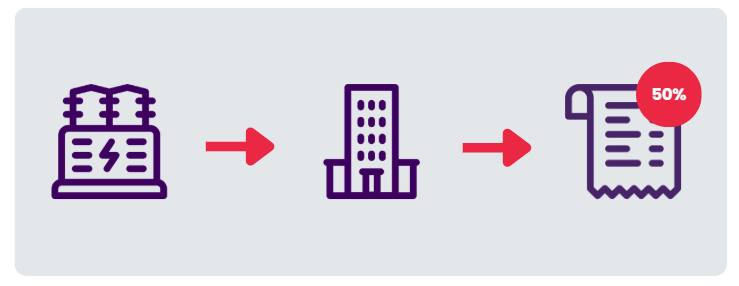
That’s why the RCOA reforms are such a potential energy solution. They give contestable customers a way to pay less for the generation component of their bill. They also let you shape your tariff around your operations instead of accepting a one-size-fits-all rate.
Pairing this with engineering services, energy audits, and sensible measures like energy-efficient lighting solutions gives you both sides of the equation: Use energy smarter, and pay less for the energy you still need.
As a Philippines-based retail electricity supplier, who focuses on commercial and industrial customers, COREnergy's sees it's role as more than just your energy vendor — it aims to be a partner that powers your success.
Our approach is built on:
If you’re considering whether to switch to a retail electricity supplier or explore the retail aggregation program for your branches, warehouses, or campuses, now is the right time to start planning.
Gather your last 12 months of electricity bills, list down all your sites, and talk to a RES like COREnergy. We’ll help you check if you meet the 100 kW threshold and understand your options under RCOA.
We will also help you build a practical roadmap so that by June 2026 and beyond so your energy supply is smarter, more transparent, and more cost-efficient for your business.