
Choosing a retail electricity supplier is not the kind of decision a business should rush. The rate matters, of course. No finance team will ignore a lower number on a proposal.
However, electricity contracts are not like buying office supplies, where the cheapest quote usually wins the day. A retail electricity contract affects budgeting, operations, risk exposure, reporting, and the way your team manages one of the company’s major monthly costs.
For eligible businesses, Retail Competition and Open Access allow qualified end-users to choose their Retail Electricity Supplier for their electricity requirements. IEMOP describes RCOA as a mechanism that gives qualified end-users the ability to choose their RES on a voluntary basis, while IEMOP serves as the Central Registration Body for RCOA.
So yes, the power to choose is real. The next question is whether your business knows what to ask before making that choice.
Here are the practical questions to bring into the conversation when comparing energy companies in the Philippines, reviewing power companies in the Philippines, or deciding whether switching electricity suppliers in the Philippines makes sense for your business.
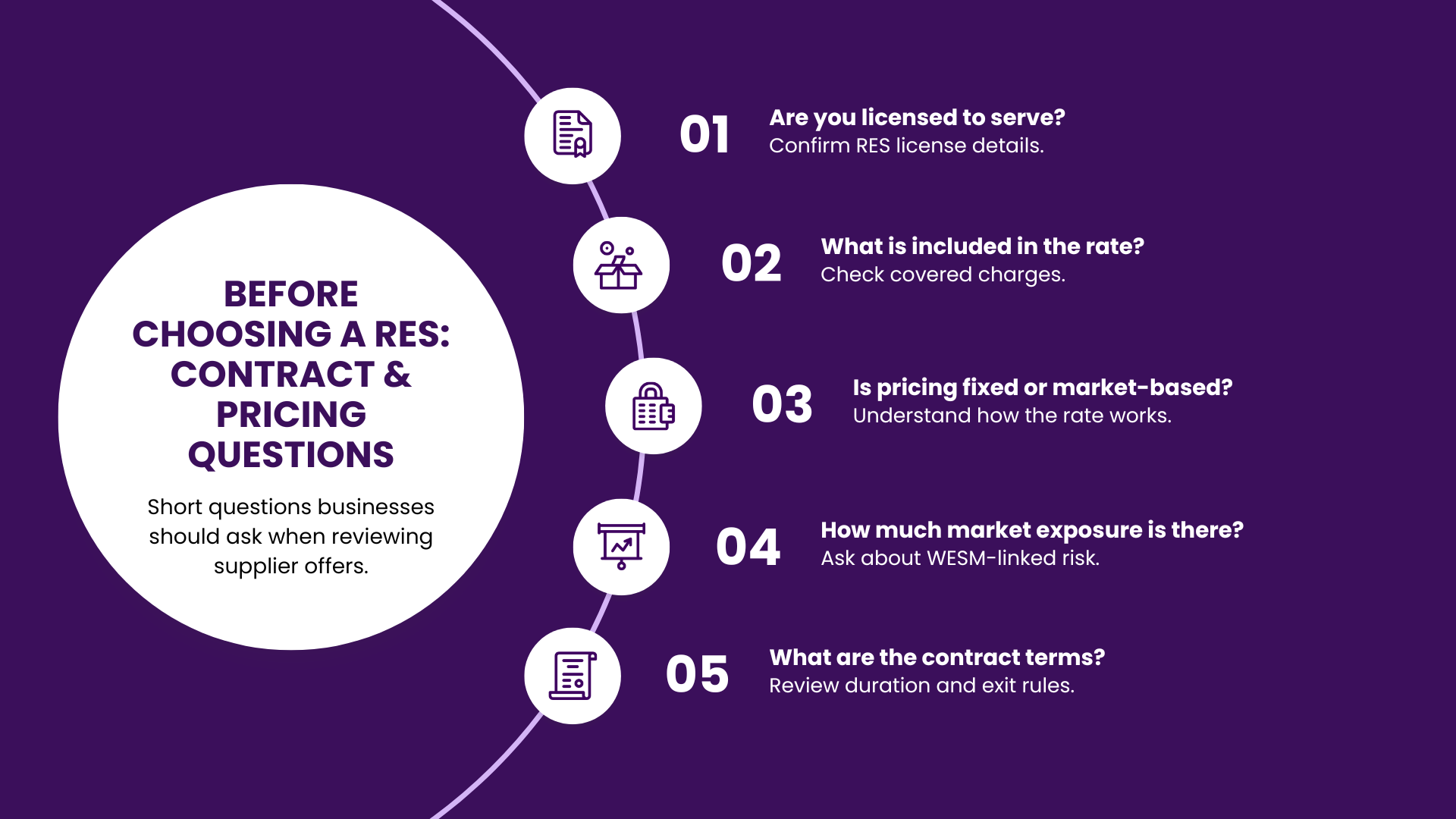
Start with the basics. Before comparing offers, confirm that the supplier is properly licensed.
A retail electricity supplier in the Philippines must be authorized to serve contestable customers. The Energy Regulatory Commission’s guidelines state that the ERC issues licenses to qualified RES applicants that comply with applicable requirements.
This is not just a technicality. Licensing is part of what separates legitimate electric suppliers from vague “energy solution” offers that may not actually be able to serve your supply needs. Ask for the company’s RES license details. A credible supplier should have no problem providing them.
A low headline rate can look attractive, but it should never be viewed in isolation. Ask what the quoted rate covers.
Is it only the generation or supply component? Are there pass-through charges? What happens to transmission, distribution, taxes, system loss, universal charges, or other regulated items? Which charges are fixed, which are variable, and which may change depending on market conditions?
This is where many businesses get surprised. They compare one number from one proposal against another number from a different proposal, only to find later that the inclusions are not the same.
A good supplier should walk you through the bill impact clearly. Not in a “just trust us” way, but in a way your finance team can actually verify.
Not all RES pricing structures work the same way.
Some contracts offer a fixed price for the supply portion, giving businesses more predictability over the contract period. Others may be linked to the Wholesale Electricity Spot Market, or WESM, which means the price may move depending on market conditions.
Some arrangements may combine fixed and variable components. Others may use time-of-use structures or customized terms based on the customer’s load profile. None of these options is automatically “best.” It depends on your business.
A cold storage facility with steady demand may have different needs from a restaurant group with peak dinner operations. A school may have seasonal consumption patterns. A factory with production flexibility may be able to shift some operations better than a hospital or 24/7 facility.
Ask your prospective energy provider to explain the pricing structure in plain language. Then ask this follow-up: “What risks are we taking under this structure?” That one question can reveal a lot.
Market-linked pricing can create opportunities, but it also introduces exposure.
WESM prices can move depending on supply, demand, outages, fuel conditions, and other market factors. IEMOP serves as the Market Operator of WESM and the Central Registration Body for RCOA, making it a key institution in the retail electricity market.
If the offer has market exposure, ask for scenarios. What happens if prices rise? What happens if prices fall? Is there a cap? Is there a pass-through formula? How often does the rate adjust? How will the adjustment appear on the bill?
Contract length matters because energy needs change.
A business may expand, reduce operations, open new branches, add equipment, or change operating hours. A contract that works today may need review later. Before signing, ask about the contract period, renewal terms, termination rules, security deposit requirements, and penalties for early exit.
Also ask what happens if your business moves sites, adds meters, or changes ownership structure. For multi-site businesses, this is especially important. You do not want to discover too late that your contract does not reflect how your company actually operates.
The right RES should not make the contract feel like a trap. It should feel like a framework both sides understand.
This is one of the most practical questions, and it is often overlooked.
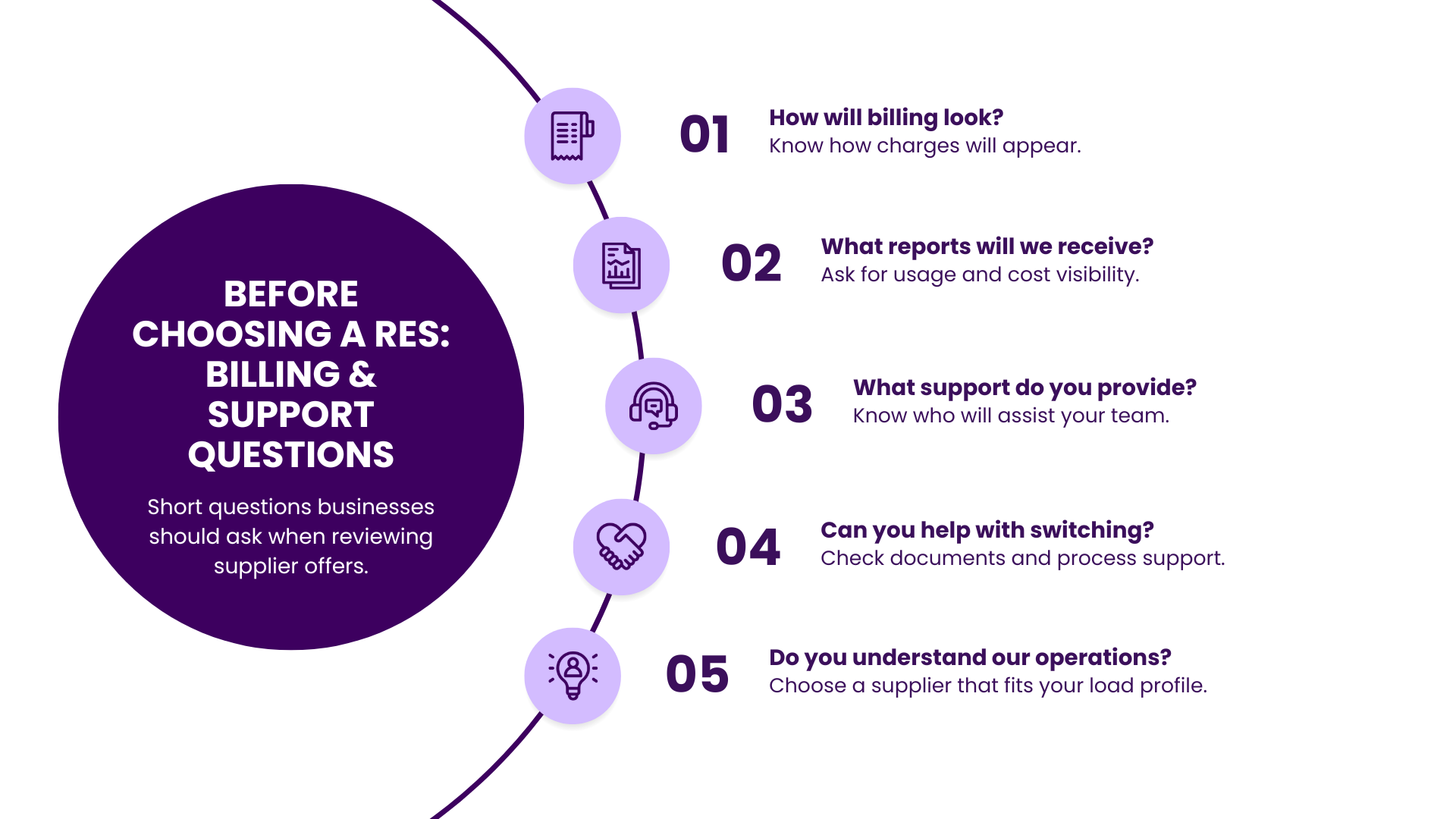
Ask whether you will receive one bill or multiple bills. Ask which charges will appear from the RES and which will still come through the distribution utility or other parties. Ask when bills are issued, what supporting data is provided, and who your team should contact for clarifications.
For businesses with finance teams, billing clarity is not a small thing. It affects accruals, approvals, payment cycles, reporting, and internal cost allocation. If you operate several branches, ask whether the supplier can help you understand usage across locations.
A transparent billing process can save your team from long email threads later.
A modern electricity partner should do more than send an invoice.
Ask what type of consumption data, billing summaries, savings reports, demand insights, or account updates will be provided. Can your team see month-on-month usage? Can reports help identify unusual spikes? Can the supplier explain changes in consumption or cost?
This is especially useful for electricity for business because decision-makers need visibility. Finance wants cost control. Operations wants performance insights. Management wants a clear story behind the numbers.
If your supplier can help you understand your energy use better, the relationship becomes more valuable than a monthly bill.
When something is unclear, who picks up the phone?
That question may sound simple, but it matters. Energy contracts involve commercial, technical, and regulatory details. Your team may need help understanding bills, coordinating documents, reviewing demand changes, or planning for contract renewal.
Ask whether you will have a dedicated account manager. Ask how issues are escalated. Ask how quickly the team responds. Ask whether support continues after the switch, not just during the sales process.
Good customer support is easy to promise before signing. The better question is: “What does support look like after we are already a customer?”
The retail electricity market has become more accessible. The ERC announced that the contestability threshold has been lowered to 100 kW, expanding the power of choice to more Filipino consumers under RCOA and the Retail Aggregation Program.
That means more businesses may now be able to explore supplier choice, including some with multiple meters or aggregated demand. Still, eligibility and switching requirements should be checked carefully.
For companies asking how to switch retail electricity suppliers in the Philippines, the process usually starts with bill review, demand validation, document preparation, and coordination with the relevant market and utility parties. Ask the supplier what your team needs to prepare, how long the process may take, and what parts they will help manage.
Switching should be technical in the background, not confusing for the customer.
This may be the most important question of all.
A supplier can offer an attractive rate, but if they do not understand your load profile, operating hours, seasonal demand, expansion plans, or risk appetite, the contract may not be the best fit.
Ask how they evaluate your consumption pattern. Ask whether an energy audit or technical review would help. Ask how the proposed contract supports your actual business, not just a generic customer profile.
A supermarket, manufacturing plant, clinic network, school, hotel, and logistics hub all use electricity differently. A strong RES partner should be able to speak to those differences.
A lower supply rate can look good on paper, but the final amount your business pays may depend on how the contract and bill are structured.
Before choosing a RES, ask what other line items may appear on the bill and how they affect the total monthly cost. Are there pass-through charges? Administrative fees? Market-related adjustments? Capacity-related charges? Billing charges? Imbalance charges? Are certain items fixed, variable, or dependent on market conditions?
This is where transparency matters. Two suppliers may offer similar rates, but the final bill can still look different depending on what is included, excluded, or passed through to the customer.
Ask the RES to walk you through a sample bill, not just the proposal rate. Better yet, ask them to explain how the bill may change under different consumption or market scenarios.
The goal is not simply to find the lowest number at the start. It is to understand the full cost structure, so your finance team knows what to expect and your business can make a decision with fewer surprises later.
Choosing a RES is not only about finding a lower price. It is about choosing a partner that helps your business manage energy with more confidence.
The best conversations should leave your team with clearer answers: what you are paying for, what risks you are taking, what support you can expect, and how the contract fits your operations.
COREnergy Philippines works with businesses that want more than a proposal with numbers on a page. It helps customers review their electricity needs, understand their options, and explore retail electricity solutions built around cost control, transparency, reliability, and practical support.
When the questions are clearer, the choice becomes easier. For businesses comparing suppliers, that clarity can make all the difference.