
For years, many Philippine businesses assumed they had little choice when it came to electricity supply. They paid the monthly bill, adjusted budgets around rising operating costs, and focused on saving energy where they could. For more businesses, however, that picture is changing.
Through Retail Competition and Open Access, or RCOA, qualified customers can choose a retail electricity supplier in the Philippines instead of relying only on the default supply arrangement in their area.
The key question is not simply how much electricity your business uses. It is whether your electricity demand, measured in kilowatts or kW, meets the eligibility threshold.
This matters even more in June 2026. Under Energy Regulatory Commission Resolution No. 22, Series of 2025, the eligibility threshold for RCOA and the Retail Aggregation Program, or RAP, will be lowered from 500 kW to 100 kW average monthly peak demand, effective June 26, 2026.
For many medium-sized businesses, that is a significant development. Your business may be closer to supplier choice than you think.
When people read an electricity bill, they often focus on total monthly consumption or total peso amount. Those are important, but RCOA eligibility is based on a different measure: average monthly peak demand.
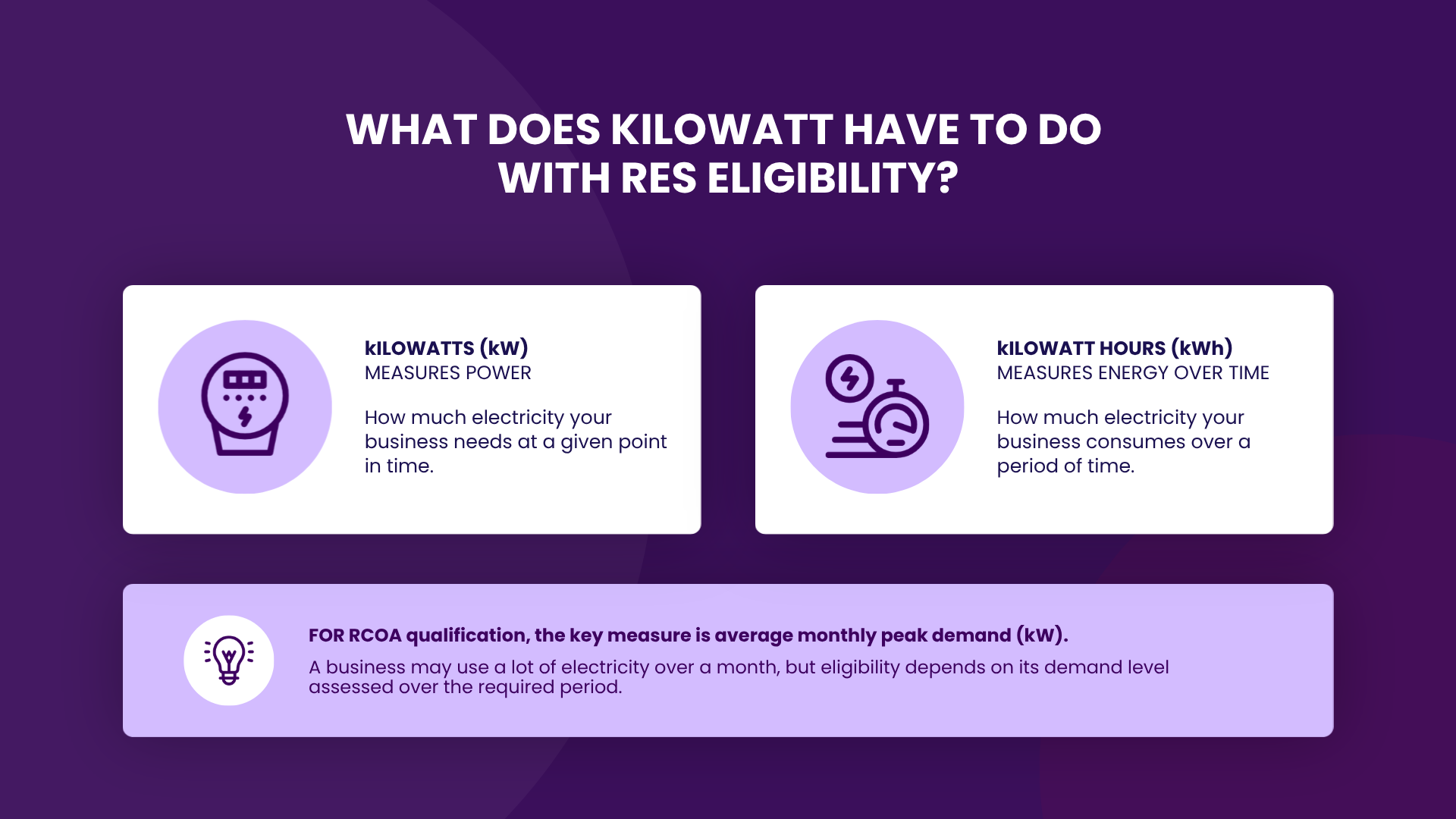
Put simply, kilowatts or kW measure how much electricity your business needs at a given point in time. Think of it as the level of power your operations call for when equipment, lighting, cooling systems, machinery, or other electrical loads are running.
Kilowatt hours or kWh, on the other hand, measure how much electricity you consume over time. A simple way to picture it is this: A business may use a large volume of electricity across an entire month, but its peak demand may remain moderate if its operations are spread out evenly.
Another business may operate fewer hours but require high levels of power at the same time because multiple machines, chillers, or production lines run together.
For the RCOA qualification, it is that demand level, assessed over the required period, that determines whether a business can choose its supplier.
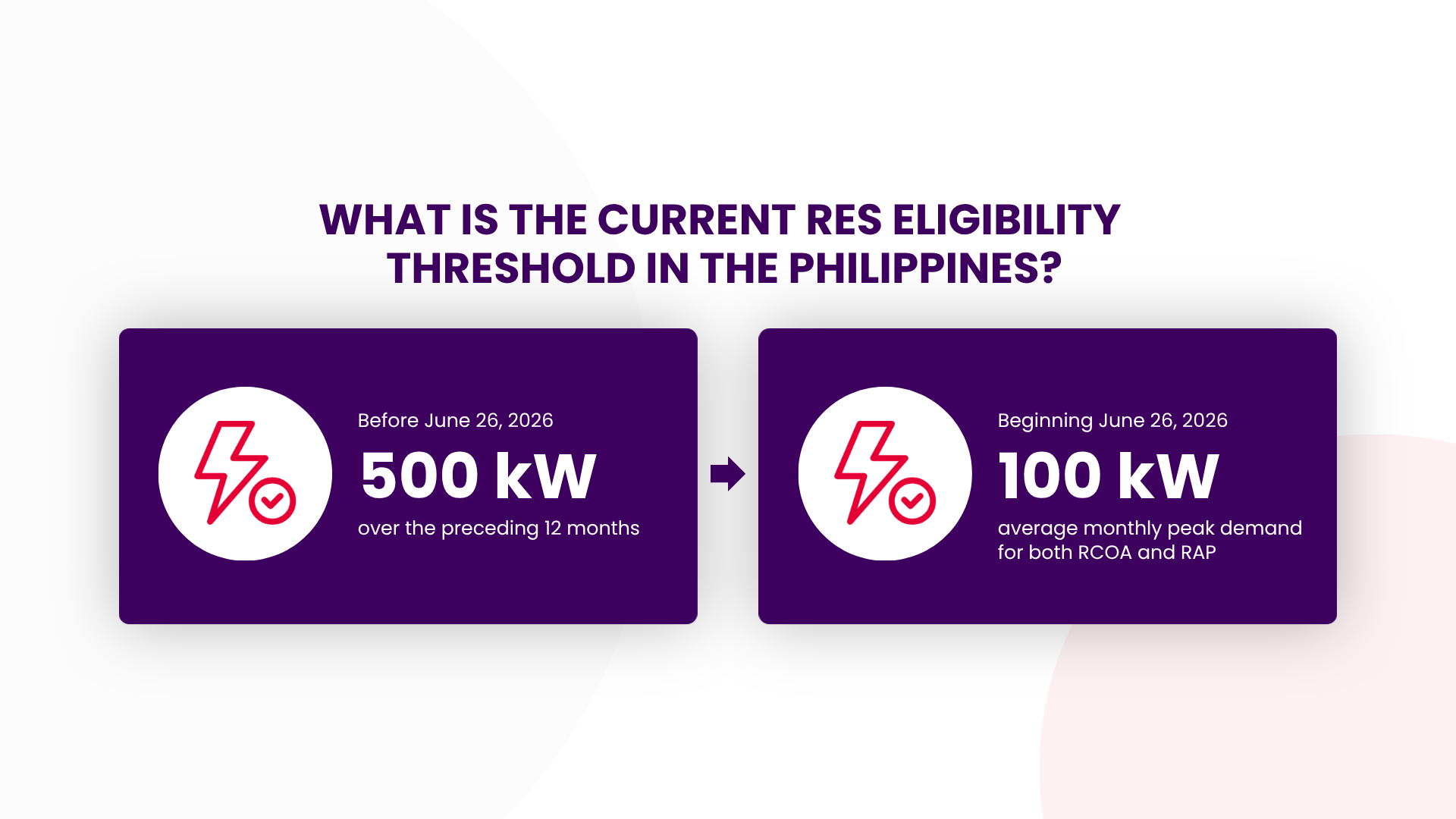
Before June 26, 2026, businesses participating directly in RCOA generally need an average monthly peak demand of at least 500 kW over the preceding 12 months.
Beginning June 26, 2026, the ERC-approved threshold will be lowered to 100 kW average monthly peak demand for both RCOA and RAP. The ERC announced that this expansion is intended to allow more medium-sized enterprises and institutions to directly choose electricity suppliers or combine their demand through aggregation.
This opens the door to a broader range of businesses, including commercial buildings, supermarkets, hotels, schools, offices, warehouses, cold storage operations, food processors, and growing manufacturing facilities.
The Independent Electricity Market Operator of the Philippines (IEMOP), which serves as the Central Registration Body for RCOA, identifies end users based on the applicable demand thresholds and works with Distribution Utilities and other network service providers in handling customer information required for retail market participation.
In practical terms, your electricity bill is no longer just an operating expense record. It may also help show whether your business is now eligible to consider a different energy provider.
The shift from 500 kW to 100 kW is more than a technical update. It changes who gets to participate in supplier choice.
Previously, RCOA was often associated with very large facilities: major factories, large malls, large office complexes, and other heavy electricity users. A 100 kW threshold brings the opportunity closer to businesses that may be substantial energy users but are not among the largest industrial customers in the country.
For a growing business, this creates a new reason to look closely at electricity costs and contract options.
Instead of asking, “Are we too small to choose a supplier?” the better question becomes, “What has our average monthly peak demand been over the past 12 months?”
If your business meets the threshold, you may be able to compare offers from licensed electric suppliers, review pricing arrangements that better match your operating pattern, and choose a supplier relationship built around clearer service and support.
That does not mean every eligible company should immediately switch. It means more companies now have the opportunity to explore whether switching makes business sense.
Some businesses have multiple locations, each with its own meter and electricity account. A single branch may not meet the threshold alone, but several qualified sites may be able to participate together through the Retail Aggregation Program.
However, it is important to note that if an individual site is already qualified on its own, it is legally barred by the ERC from participating in RAP. The Retail Aggregation Program is strictly reserved for smaller sites that don't meet the single-site threshold but aggregate together to reach the 100kW threshold.
RAP allows multiple electricity end users to consolidate their demand and participate as an aggregated group, subject to the applicable rules and requirements.
IEMOP explains that retail aggregation is intended to extend supplier choice to smaller end users that may not individually meet the demand threshold. You can learn more through its overview of the Philippine Electricity Market.
This can be relevant for businesses such as:
Aggregation is not automatic. Your sites and arrangements still need to meet applicable rules, including network service provider requirements. But for businesses with several operating locations, it is worth asking whether your combined demand may provide a path to supplier choice.
You do not need to begin with a complicated technical study. A practical eligibility review usually begins with your electricity records.
Start by collecting your bills for the preceding 12 months and identifying the demand readings shown on your account. Your facilities or engineering team may already monitor these figures, especially if your business operates equipment with a significant electrical load.
From there, a prospective RES partner can help you understand whether:
It is also helpful to involve your finance and operations teams early. Finance understands the impact of energy costs on budgets, while operations understands when and why demand rises. Together, they can better evaluate what type of electricity supply arrangement makes sense for the business.
An energy audit can be valuable, but it is not what determines RCOA eligibility. Eligibility is based on the applicable demand threshold and required validation process. An energy audit serves a different purpose: it helps your business understand how electricity is being used and where efficiency improvements may be possible.
Under the Energy Efficiency and Conservation Act or Republic Act No. 11285, designated establishments have reporting and energy management obligations depending on their level of annual energy consumption.
For businesses reviewing electricity for business decisions, the two activities can work well together. Eligibility tells you whether you can choose a supplier. Energy analysis helps you better understand your operational use of power.
COREnergy offers energy services including energy audits, power quality studies, thermal scanning, and medium voltage testing and preventive maintenance. These may support businesses that want to examine energy performance more closely alongside their retail electricity options.
Eligibility is the first door. After that comes the decision. Businesses considering switching electricity suppliers in the Philippines should compare not only rates, but also contract structure, billing clarity, customer support, switching assistance, and the supplier’s ability to explain options in plain language.
COREnergy Philippines is a licensed Retail Electricity Supplier that helps eligible businesses navigate their electricity supply options with flexible plans and hands-on support.
Whether your business values price predictability, a structure suited to consumption patterns, or guided assistance through the switching process, choosing a retail electricity supplier should begin with a clear understanding of your needs.
You can review available plan structures through COREnergy Energy Plans or learn more about supporting technical services through COREnergy Energy Services.
Electricity demand may look like just another number on a monthly bill. But under RCOA, it can determine whether your business has the power to choose a different supplier.
With the 100 kW threshold taking effect on June 26, 2026, more Philippine businesses will have the opportunity to evaluate licensed retail electricity suppliers, compare contract options, and take a more active role in managing energy costs.
The next step is simple: check your demand history, confirm your eligibility, and talk to a partner who can help make the process clear.
See whether your business qualifies for supplier choice. Connect with COREnergy Philippines for an eligibility review and explore an electricity plan built around the way your business operates.