
This question is one of the first that businesses ask when they start exploring the retail electricity market in the Philippines, and honestly, it is a fair one. Saving on electricity costs sounds great. Having more flexibility sounds great, too.
However, the moment the word “switching” comes up, many decision-makers start thinking the same thing: Will our power supply become less reliable if we move to a retail electricity supplier?
The short answer is no, switching to a Retail Electricity Supplier, or RES, does not affect power reliability. Under the Philippines’ Retail Competition and Open Access framework, switching changes your commercial supply arrangement while your facility remains connected to the same power system and distribution network.
EPIRA specifically provides for retail competition and open access on distribution wires, while IEMOP explains that RCOA allows qualified end-users to choose their RES and that IEMOP, as Central Registration Body, facilitates registration and customer switching.
In simpler terms, your supplier may change, but your wires do not suddenly pack their bags and leave.
When a business switches to a RES, it is changing who supplies the electricity commercially. It is not changing the physical infrastructure that delivers electricity to the site.
The local Distribution Utility, or DU, still operates within its franchise area, and EPIRA’s implementing rules continue to treat electricity distribution and supply as separate roles within the industry structure.
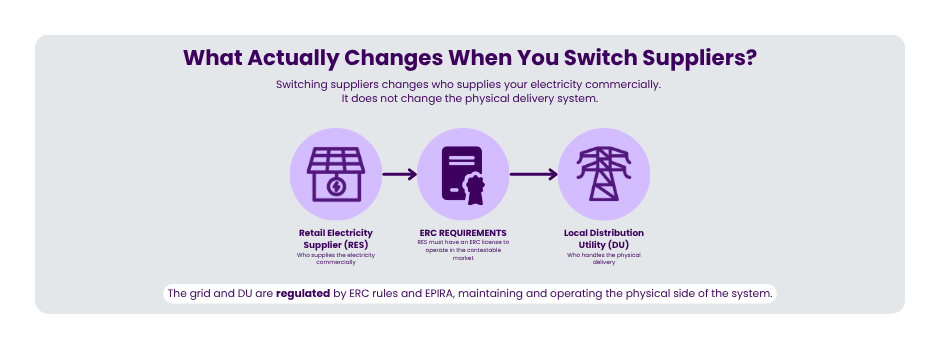
The ERC’s supply sector pages also make clear that suppliers to the contestable market require a license from the ERC. That distinction matters.
A RES handles the electricity supply contract and related commercial arrangements. The DU or network service provider continues to play the key role in the physical delivery side, including the distribution system your facility is connected to.
DOE planning documents likewise show that DUs remain mandated to prepare and submit Distribution Development Plans, underscoring their ongoing role in maintaining and developing the distribution system.
So if your concern is, “Will switching suppliers weaken the lines serving my facility?” the answer is “no”, because those lines are still under the relevant network operator’s responsibility.
This concern usually comes from a reasonable misunderstanding: people hear “new supplier” and assume it means “new delivery system.” But in the Philippine retail market, those are not the same thing.
Think of it like changing your mobile plan without rebuilding the cell towers yourself. The commercial relationship changes. The network structure does not suddenly become a DIY project.
The reliability of your electricity service still depends on the broader system: generation availability, transmission conditions, distribution network performance, maintenance, outages, and grid constraints.
The Philippine Distribution Code sets technical and performance standards for all users of the distribution system, while IEMOP’s industry assessment notes that reliability and security of supply remain broader industry concerns tied to system conditions, not to who holds the retail contract.
That is why asking whether switching suppliers affects reliability is a little like asking whether changing your accountant affects the weather. It changes something important, yes, but not that particular thing.
A few important things stay the same, and these are usually the points businesses find most reassuring.
First, your facility remains connected to the same physical distribution system unless there is a separate technical change being made for another reason. EPIRA and related rules preserve open access on distribution wires rather than replacing the distribution network itself.
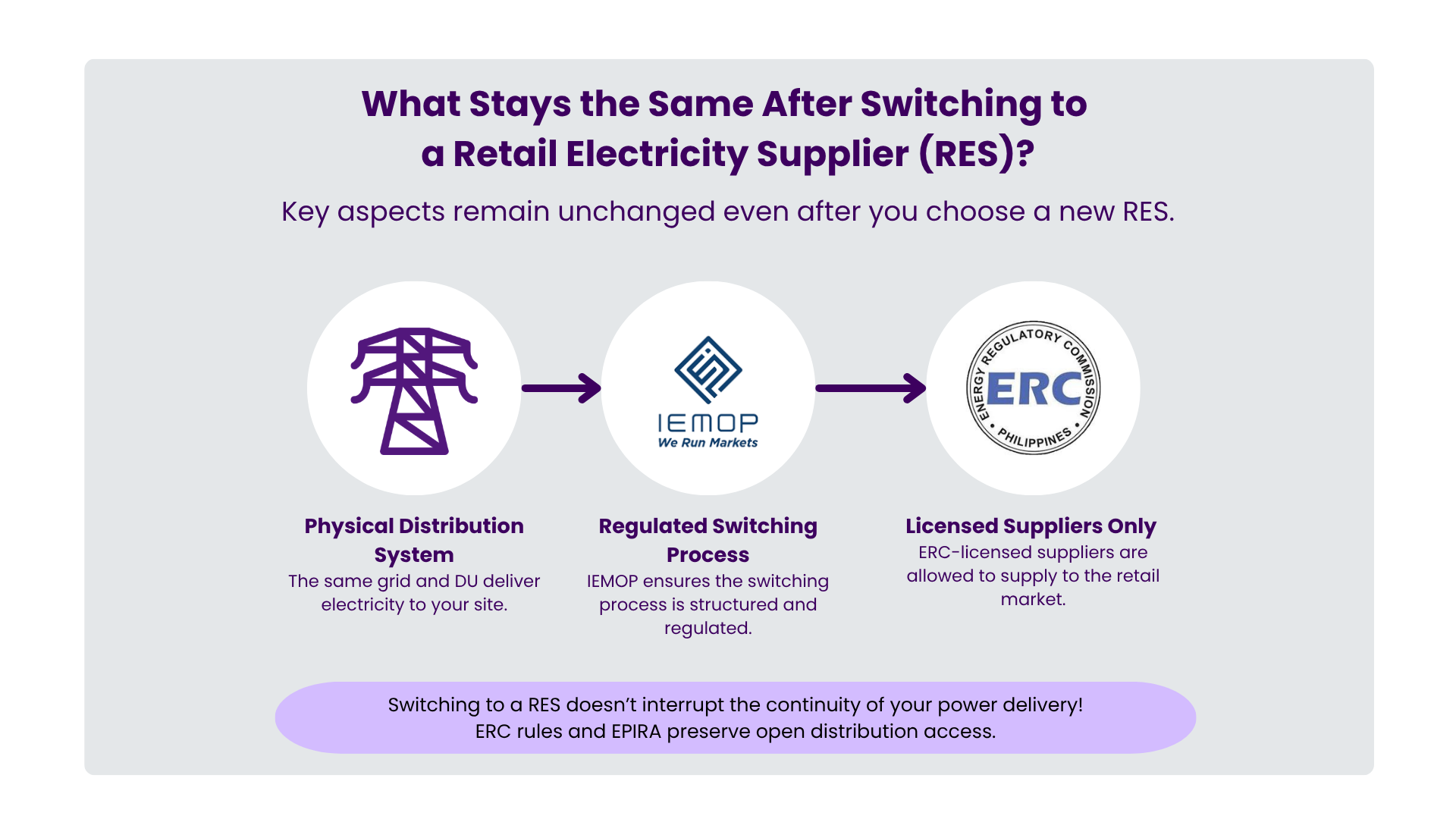
Second, customer switching is structured and regulated. IEMOP serves as the Central Registration Body for the retail market and facilitates the switching process and exchange of information among retail market participants. That means this is not an informal handshake arrangement done in the dark. It runs through a defined market process.
Third, only licensed suppliers are allowed to supply electricity to the contestable market. The ERC’s supply sector pages and licensing guidelines make that point clear.
So when businesses look at a list of electricity suppliers in the Philippines or compare a possible electricity provider in the Philippines, one of the first filters should be whether the supplier is duly licensed by the ERC.
While switching does not inherently reduce power reliability, it can change your overall experience in other ways.
Your billing arrangement may change. IEMOP’s 2024 retail market bulletin says only single billing will be implemented in the retail market, with customers under dual billing required to adopt single billing upon regular switching to a new retail supplier or upon expiry of existing dual-billing agreements.
Your contract structure may also change. Your tariff options, billing support, account management, and responsiveness from your supplier can all be different. In other words, the reliability of the electrical network is one thing, while the reliability of the service experience from your supplier is another.
That second part matters more than some businesses expect. A supplier may not control the poles and wires, but it absolutely influences how clearly your account is handled.
It also changes how transparently charges are explained, how proactively issues are coordinated, and how smoothly switching and ongoing administration are managed. For many companies, that kind of reliability is also part of the decision.
It can, but usually because of process and preparation, not because switching is inherently risky.
Customer switching in the Philippines follows timelines and procedures. IEMOP’s retail market bulletin notes that end-users intending to switch must notify their network service provider at least 90 calendar days before the intended switch date.
The switching process also involves defined timelines within the Central Registration Body stage. That means poor coordination, incomplete documentation, or unrealistic timelines can create stress for the customer.
That is different from saying the switch itself makes the supply less reliable. It means the process should be handled properly by a supplier that knows how to guide customers through it.
This is why the better question is often not just, “Will switching affect reliability?” but also, “Is the supplier organized, transparent, and capable of handling the switch well?” That is a much more useful question, because it gets closer to the part of the experience that actually changes.
In broad terms, the RES is responsible for the retail supply arrangement and your commercial relationship as a contestable customer, while the DU or network operator remains central to the physical delivery side within its franchise area.
The legal and regulatory structure under EPIRA and its implementing rules separates these functions, while the retail market framework provides the switching mechanism for customers who qualify.
That separation is exactly why switching electricity supplier Philippines does not automatically mean reduced power reliability after switching suppliers.
You are not swapping out the grid. You are choosing a different supplier within the same regulated market structure.
So, does switching electricity suppliers affect reliability? In the usual sense, people mean it, no. Switching to a RES does not inherently make your electricity less reliable, because it does not replace the physical distribution network serving your business.
What changes is the retail supply arrangement, not the basic delivery infrastructure. What businesses should focus on instead is whether the supplier is licensed, credible, transparent, and experienced in managing the switching process well.
That is where the real quality difference tends to show up, not in whether the lights suddenly forget how to turn on.
For companies choosing a retail electricity supplier or learning how to switch retail electricity suppliers in the Philippines, COREnergy can help make that process easier to understand.
COREnergy works with businesses through the switching journey with a more hands-on and transparent approach, helping customers understand what changes, what stays the same, and which electricity setup best fits their operations.
If your business is reviewing its options, COREnergy can help you explore a supply arrangement that supports both cost management and day-to-day confidence.