
For many businesses, the idea of switching electricity suppliers sounds expensive before the conversation even starts. There is a common worry that moving from a Distribution Utility to a Retail Electricity Supplier means paying a large transfer fee, installing a completely new power setup, or going through a costly technical change. Understandably, finance teams ask: “How much will this switch cost us?”
Here is the reassuring part: The RES switching process itself is mostly free. When an eligible business switches electricity supplier from its DU setup to COREnergy, the switch is not treated like buying a new machine, replacing your facility’s electrical system, or paying a big migration charge just to move accounts.
That said, “free” does not mean “zero paperwork.” Some documents may require normal third-party costs, such as notarization, bank-related requirements, government or corporate documents, or settlement of any unpaid DU balance.
But the act of switching to COREnergy as your Retail Electricity Supplier is designed to be clear, guided, and cost-light. Let’s break it down in plain language.
Under Retail Competition and Open Access, or RCOA, qualified businesses can choose a Retail Electricity Supplier instead of being limited to the default supply arrangement in their area.
PEMC explains that RCOA allows qualified electricity end users to choose their supplier, with eligibility based on demand thresholds set by the Energy Regulatory Commission.
When you switch to a Retail Electricity Supplier, your physical power delivery does not suddenly change. Your local Distribution Utility still delivers electricity through the same network. So, what changes in your supply arrangement?

COREnergy’s own switching guide also explains that under RCOA, the DU still delivers electricity while the chosen RES handles the retail supply contract, onboarding support, and account care.
So, no, switching does not mean your business is “disconnecting” from the grid. It means you are choosing who supplies your electricity commercially.
The concern is understandable. In business, almost every transition has a cost. New software? Setup fee. New equipment? Installation fee. New vendor? Onboarding fee.
Electricity supplier switching sounds like it should follow the same pattern. But RES switching is different. For eligible contestable customers, the main work involves coordination, documentation, validation, and registration.
COREnergy positions the switch as a guided process, with a free quote, paperwork assistance, and provider coordination as part of its customer journey.
That is important because many businesses delay switching, not because they are uninterested, but because they assume it will be expensive or complicated. In reality, the bigger “cost” is often internal time: collecting documents, reviewing contracts, getting authorized signatures, and coordinating with the DU.
The switching process from your DU setup to COREnergy is mostly free in the sense that COREnergy does not require your business to pay a large transfer or migration fee just to start the switch.
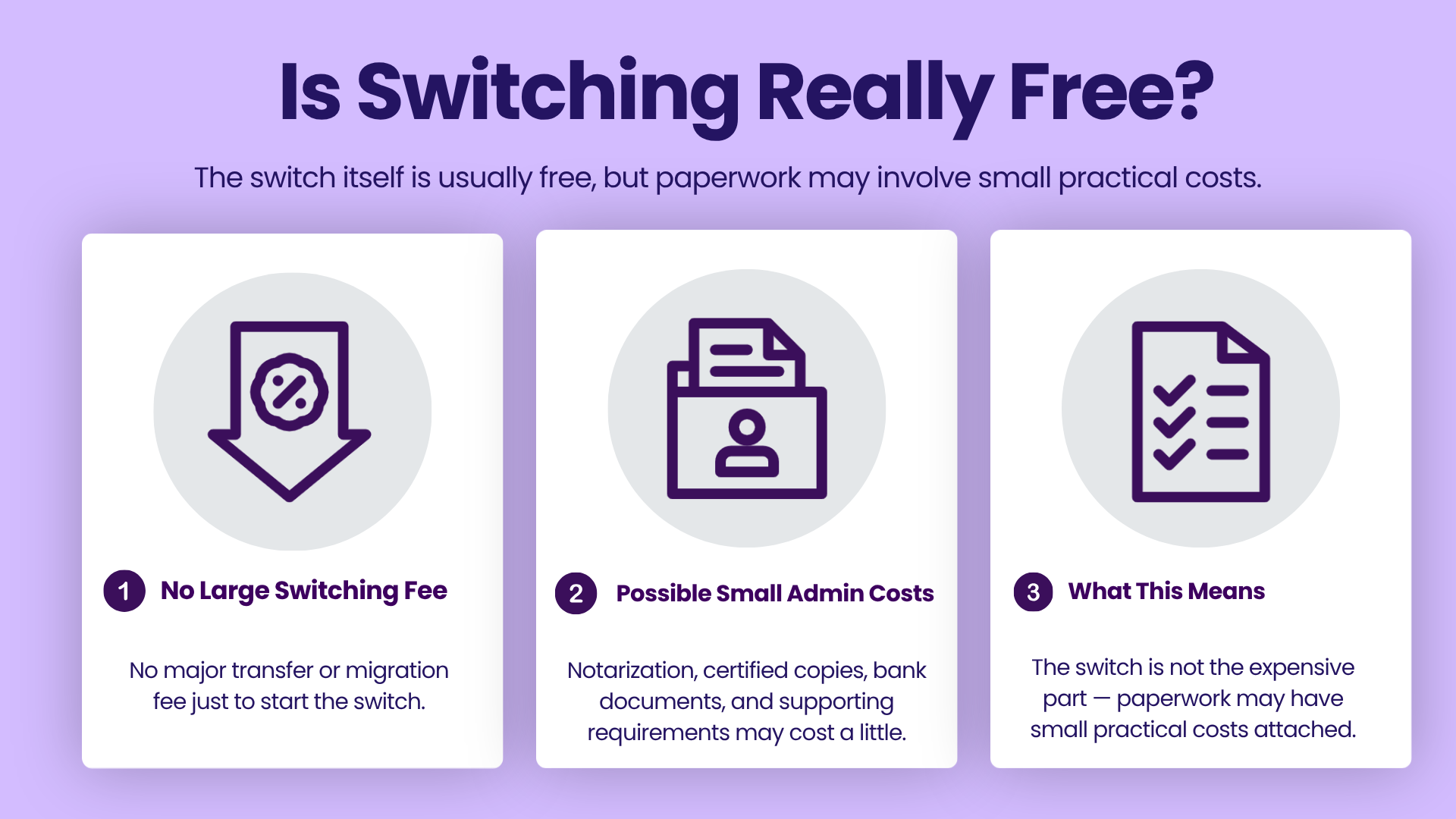
What your team should prepare for are possible third-party or administrative costs tied to supporting documents and compliance steps.
These are not the same as a “switching fee.” They are normal requirements that may apply depending on your company structure, DU process, banking arrangement, and documentation status.
Think of it like renewing business paperwork. The application may be straightforward, but you may still pay for notarization, certified copies, bank documents, or other supporting requirements.
That distinction matters. The switch is not the expensive part. The paperwork may have small, practical costs attached.
Here are the most common areas where businesses may need to prepare.
1. Notarization fees
Some switching documents, agreements, certifications, or attestations may need to be notarized. IEMOP’s Retail Market Bulletin states that switch request attachments, such as certifications, nominations, or verifications, must be duly signed and notarized, as applicable.
Notarization fees are usually paid to a notary public or legal office, not to COREnergy as a switching charge.
2. Corporate documents
Your business may need documents showing signatory authority, company registration details, or internal approvals. COREnergy’s document guide notes that businesses may need items such as authorized signatory details, board resolution, or secretary’s certificate if required by company policy, and company details for onboarding.
If your company already has these documents ready, there may be no added cost. If you need updated copies or certified documents, small administrative fees may apply.
3. Settlement of outstanding DU balance
If you are switching from captive to contestable status, outstanding balances with the DU should be settled before the switch.
IEMOP notes that for an initial switch, the retail customer or members of the retail aggregated group should have no outstanding balance with the Network Service Provider, or should have an agreed payment arrangement to be settled before the switch date.
This is not a switching fee. It is simply settling what is already owed.
4. Metering or DU-related requirements
Some customers may need metering coordination, DU agreements, or related forms depending on their setup. IEMOP’s switching bulletin identifies metering requirements for initial switch and notes that metering documents should contain consistent customer details and include the appropriate metering installation registration form, as applicable.
In some cases, DU or metering-related requirements may involve deposits, documentation, or coordination steps. Your RES can help clarify what applies to your business before you commit to a target switch date.
5. Bank or security-related requirements
Some contracts may require prudential or security arrangements, such as a Standby Letter of Credit or similar setup. Any bank fees would depend on the bank and arrangement involved, not on COREnergy charging a “switching fee.”
One reason businesses hesitate is that RES switching can sound like a maze of acronyms: RCOA, RES, DU, CRB, RSC, DWSA, and more.
COREnergy helps simplify that process by assisting with coordination and paperwork. Its Energy Plans page outlines a three-step switch: request a free quote, let COREnergy assist with paperwork and provider coordination, then enjoy the benefits of the chosen plan.
That support matters, especially for businesses switching for the first time. The customer still provides documents, reviews contracts, signs requirements, and coordinates internally. But you are not expected to figure out every step alone.
COREnergy’s Energy Services also support customers beyond the switch, including the MyPower Platform for tracking energy use, power quality studies, thermal scan tests, medium voltage electrical equipment testing, and energy audits.
In short, the goal is not just to switch you over. The goal is to help you manage energy better after the switch.
To keep the process smooth, prepare early. Start by gathering recent electric bills, company registration documents, authorized signatory details, and internal approvals.
Confirm whether your business has any unpaid DU balances. Assign one internal point person from Finance, Facilities, or Operations to coordinate with COREnergy.
It also helps to clarify your decision criteria. Are you switching mainly for cost savings? Better billing transparency? More hands-on support? A rate plan that fits your operations better?
COREnergy offers several energy plan structures for businesses, including fixed rate options for budget stability, WESM-linked pricing for businesses with more flexibility, and custom rates for specific operational patterns. The more clearly your team understands your consumption and goals, the easier it is to choose the right setup.
Switching to RES Philippines options does not have to feel risky or expensive. For eligible businesses, electricity supplier switching is mainly a guided commercial and regulatory process, not a major capital project.
Yes, there may be normal document-related costs, notarization fees, bank charges, or DU-related requirements depending on your situation. But those are separate from the actual switch to COREnergy.
The important takeaway is this: your business does not need to avoid switching just because you assume the process is costly.
With COREnergy Philippines, you can start with a free quote, get guidance on requirements, understand what may or may not involve third-party fees, and move through the process with clearer expectations.
Thinking about switching electricity supplier? Connect with COREnergy to check your eligibility, review your requirements, and explore a zero-cost switching path built around your business.