
For many businesses, kW vs kWh is one of those topics that sounds technical until the bill arrives and suddenly becomes very personal.
The two are related, but they do not mean the same thing, and mixing them up can make it harder to understand what is really driving your electricity costs. In business billing, both can matter. The bigger question is how they matter on your specific account. So let us clear it up in plain language.
A kilowatt, or kW, measures power. Think of it as the speed at which electricity is being used at a given moment. A kilowatt-hour, or kWh, measures energy consumed over time. One kW used for one hour equals one kWh. That is the basic relationship.
A simple way to picture it is this: kW is how hard your equipment is working right now, while kWh is how much electricity you used over the day, week, or month. A 10 kW load running for 5 hours uses 50 kWh. So if kW is the rate, kWh is the accumulated total.
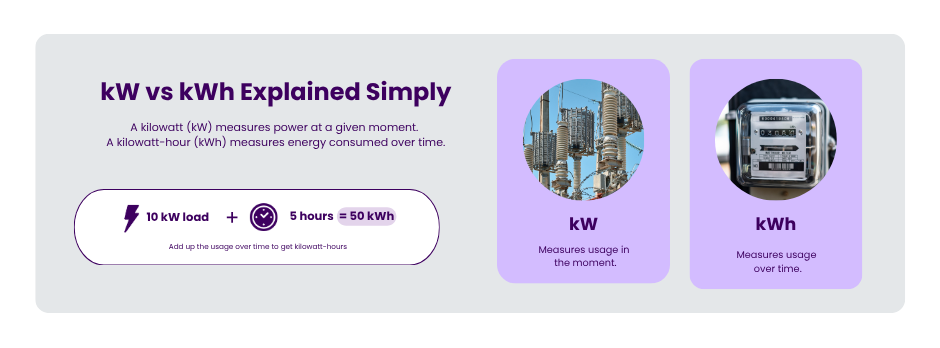
The difference between kW and kWh becomes clearer when you connect it to operations. If your facility switches on several large machines at the same time, your kW demand can jump.
If those same machines keep running for many hours, your kWh consumption builds up. One measures the intensity of use. The other measures the volume of use over time.
This is why the answer to “what affects your electricity costs more?” is not always one or the other. For many businesses, kWh drives the biggest visible portion of monthly energy charges, because the bill reflects how much electricity was consumed during the billing period.
For businesses on demand-based rates, kW can also hit hard because peak demand may trigger a separate demand charge or affect how certain charges are computed. On that note, the RCOA threshold for RES eligibility is based on kW.
When people ask about their electricity bill, they usually think about kWh first. That makes sense because kWh is the unit most closely tied to how much electricity your business actually used over the billing period.
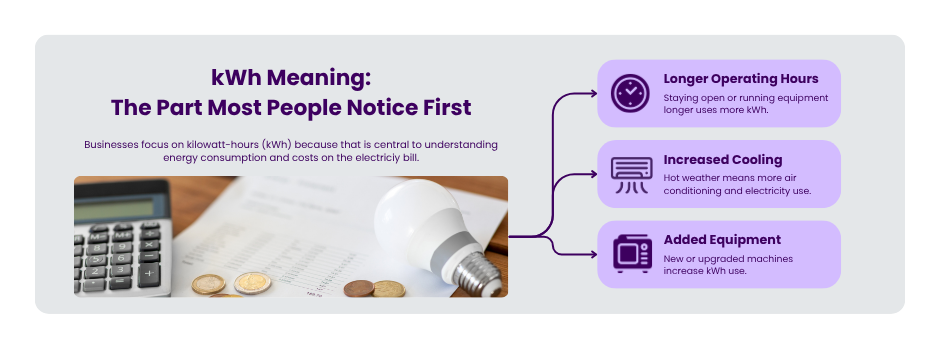
The effective peso-per-kWh rate on the business bill is computed by dividing the total bill amount by actual consumption in kWh. In other words, kWh is central to understanding how much energy your site consumes and what that consumption costs for the month.
If your store, warehouse, office, or plant operates longer hours, adds equipment, or ramps up cooling during hot months, your kWh can rise simply because more electricity is being used over more time. That makes kWh a major cost driver for many accounts.
Now, for the kW meaning, which is where things get interesting. kW reflects your load at a given moment, and in many commercial and industrial setups, that matters because utilities may bill based on peak demand.
If a business reaches peak demand within the billing period above the minimum billing demand, actual demand may be used as the basis for the demand charge. Business bills may show actual demand against minimum billing demand, which helps customers see whether they are optimizing their electrical facilities.
That means a short period of high simultaneous usage can matter even if your total monthly kWh is not unusually high. A facility that turns on chillers, compressors, pumps, and process equipment all at once may create a demand spike. And yes, that one intense moment can show up on the bill later like an unwanted surprise guest.
If you are trying to understand kW and kWh in an electricity bill, the practical answer is this:
kWh usually explains how much energy you used overall.
kW helps explain how sharply you used it.
For many businesses, the energy charge tied to kWh is the easiest part to spot because it rises as total consumption rises. But for some commercial accounts, demand charges tied to kW can also be meaningful, especially when operations create large peaks.
That is why a business can reduce total kWh a bit and still feel disappointed if its peak kW behavior remains expensive. So, which affects your electricity costs more?
The most accurate answer is: kWh affects more of the bill for many customers, but kW can disproportionately affect costs for demand-billed businesses. If your tariff includes a demand component, ignoring kW is like dieting but pretending weekend buffets do not count.
If you are wondering how to check your electricity bill, start with these three things. First, look at your actual consumption in kWh. This tells you how much energy your business used during the billing period.
Second, check whether your bill shows actual demand in kW, minimum billing demand, or another demand-related item.
Third, review your effective rate per kWh, because rates can move depending on prevailing charges and supply conditions. This is also why two months with similar operations can still produce different bills. Your kWh may change, your kW peak may change, and the effective rate itself may also move.
When businesses talk about the Philippines’ electricity rate concerns, they are usually reacting to more than just their own usage. Electricity rates can change because underlying supply costs change.
The generation charge covers the cost of power purchased from suppliers, including power supply agreements, independent power producers, and the Wholesale Electricity Spot Market. IEMOP, which operates WESM, has also reported that market prices can move significantly depending on supply and demand conditions.
So if you are asking whether kW or kWh matters more, remember there is a third factor in the room: The rate itself. Your bill is shaped by usage, demand behavior, and the price environment behind the electricity you buy.
If kWh is climbing, review runtime, scheduling, cooling loads, lighting, and equipment efficiency. If kW demand is the problem, look at how equipment starts up and whether heavy loads can be staggered instead of stacked all at once.
Understanding load profile data, which tracks active demand in kW and energy consumption in kWh at intervals, is also very important. That kind of visibility helps identify both high total use and costly peaks.
This is where the topic gets practical. You do not always need to use less electricity dramatically to improve costs. Sometimes you need to use it more intelligently, at better times, with fewer spikes, and under a supply arrangement that fits your operating pattern.
So, kW vs kWh: which affects your electricity costs more? If your bill is mostly driven by total energy used across the month, kWh will usually have the bigger visible effect.
If your account includes demand-based billing, kW can become a major cost driver too, especially when your business creates sharp peaks.
The smartest approach is not choosing one to care about and ignoring the other. It is understanding how both show up in your bill and how your operations influence each one.
For businesses reviewing energy costs, this is also a good reminder that choosing the right supply partner matters. If you are exploring choosing a retail electricity supplier or learning how to switch retail electricity suppliers in the Philippines, COREnergy can help you better understand your electricity usage, contract options, and tariff structures.
With a more transparent and hands-on approach, COREnergy helps businesses make sense of the numbers and find an electricity setup that fits how they actually operate.