
Electricity is one of those business expenses that can quietly grow in the background. One month, the bill feels manageable.
Next, it starts eating into margins, budgets, and cash flow. For companies with energy-heavy operations, even a small change in consumption or rate structure can make a noticeable difference.
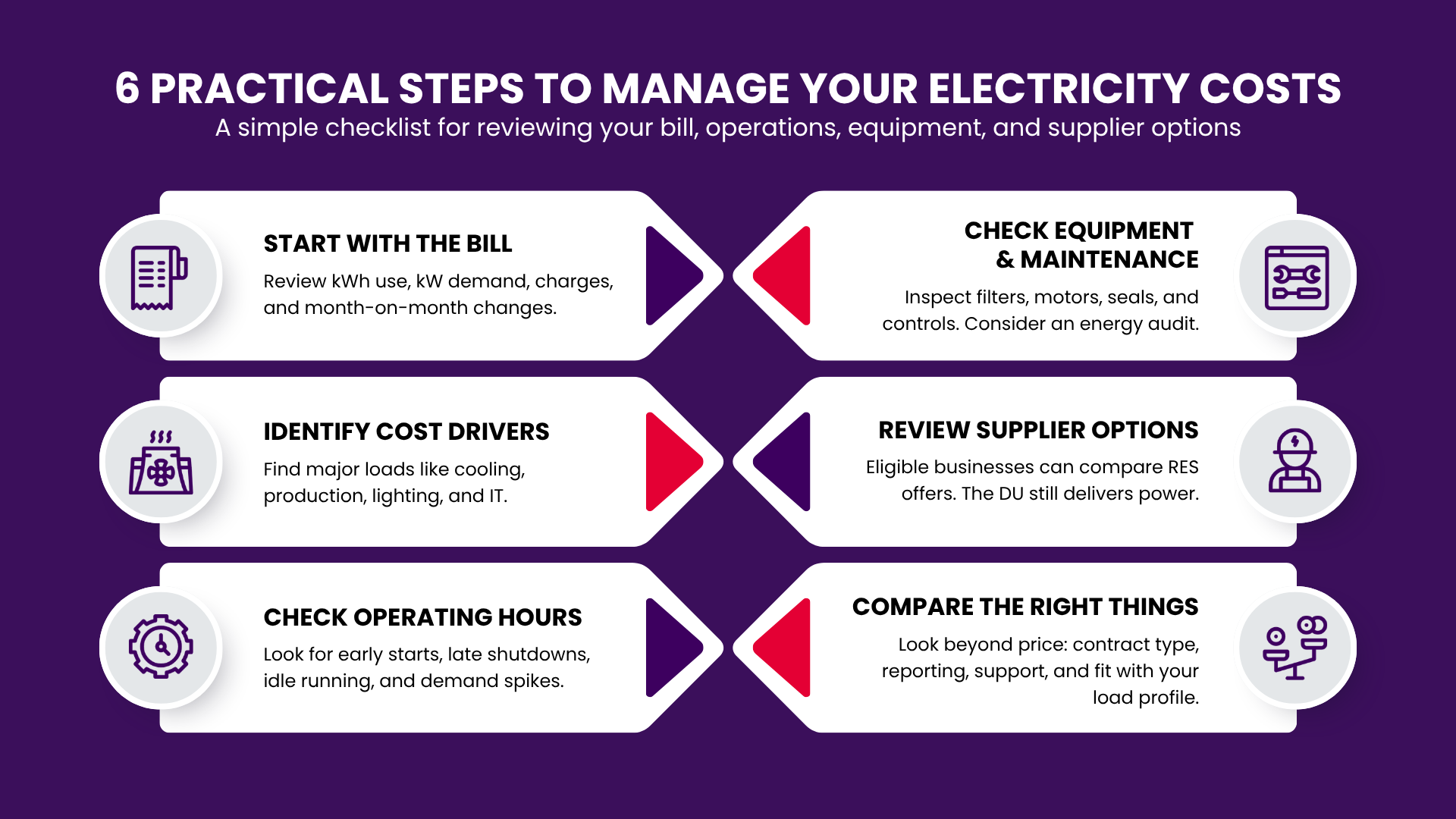
The good news is that reducing electricity costs does not always require a major investment. Before replacing equipment, redesigning facilities, or changing operating models, businesses can start with practical steps: review the bill, understand what drives the cost, check when and how electricity is used, and evaluate whether the current energy provider still fits the company’s needs.
For eligible businesses, working with a retail electricity supplier in the Philippines can also open more room for cost control.
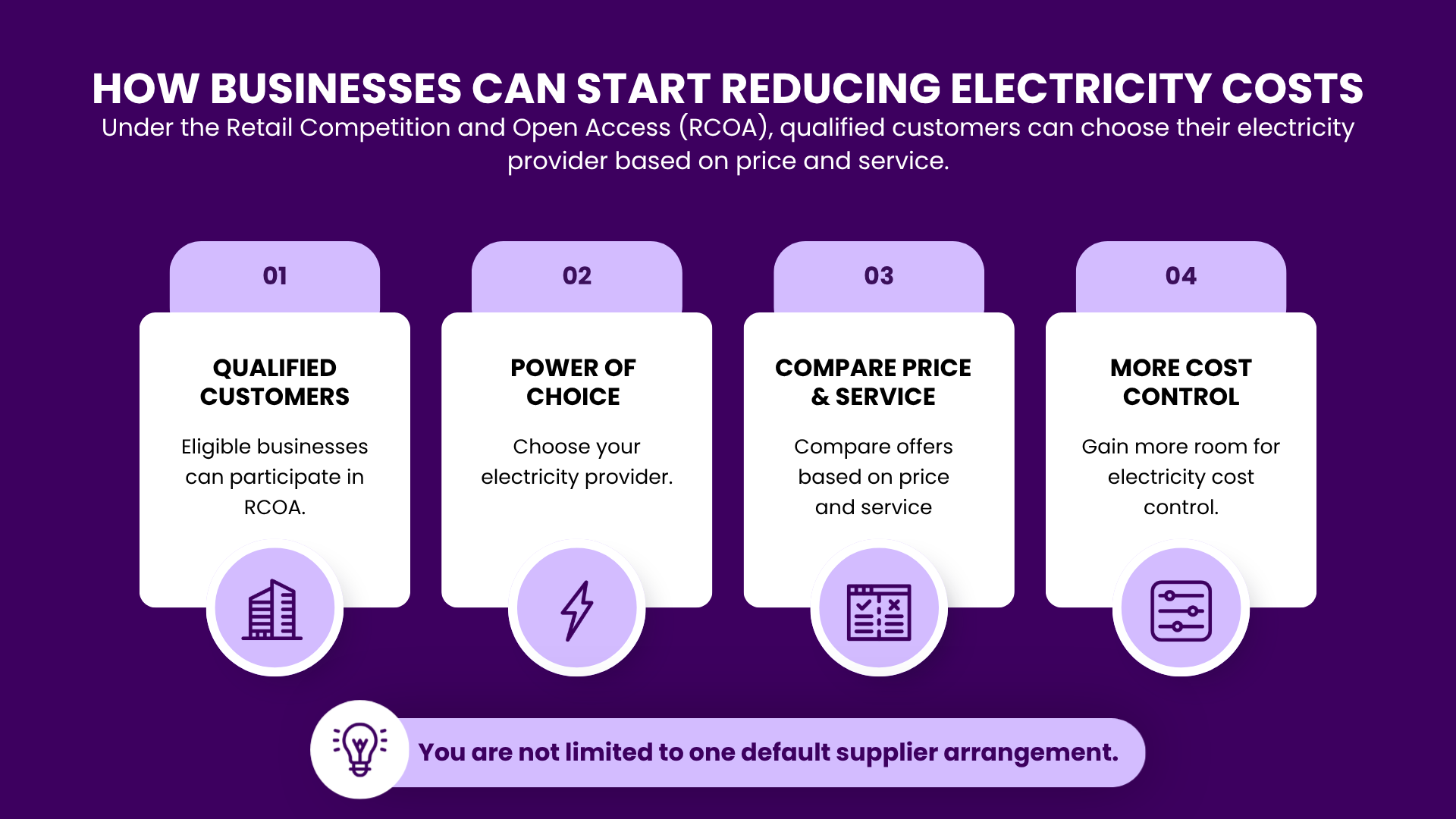
Under Retail Competition and Open Access, qualified customers are given the option to choose their electricity provider based on price and service, instead of being limited to one default supplier. The Department of Energy has described RCOA as a program that allows consumers to select their electricity provider based on preferred price and quality of service.
The first step sounds simple, but many businesses skip it: read the bill closely.
An electricity bill is not just one charge. It is usually made up of several components, including generation, transmission, distribution, system loss, taxes, and other regulated charges.
The exact format may vary depending on the distribution utility, but the key is to understand which parts of the bill are tied to consumption, which are regulated, and which may be affected by supply arrangements.
For example, a bill breakdown may explain that a large portion of the bill consists of pass-through charges, with the generation charge forming a major part of the total bill. This matters because businesses often focus only on the final amount due, when the real insight is in the details behind that amount.
When reviewing your bill, look at:
This gives your finance and operations teams a clearer starting point. Instead of asking, “Why is the bill high?” you can ask a better question: “What exactly changed?”
Once you understand the bill, the next step is to connect it to actual operations.
For many businesses, electricity costs are driven by a few major load sources. These may include air-conditioning systems, chillers, freezers, compressors, pumps, production equipment, elevators, lighting, kitchen equipment, or IT and server infrastructure. In some facilities, one or two systems may account for a large share of daily consumption.
The goal is not to blame the equipment. The goal is to understand usage.
A hotel, for example, may see energy use rise during high occupancy periods. A cold storage facility may have steady consumption because refrigeration runs continuously. A factory may see spikes when several machines start at the same time. A mall tenant or supermarket may consume more during extended operating hours.
Electricity for business is not always about how much power you use in total. It is also about when you use it, how consistently you use it, and whether some loads are avoidable.
Operating hours can quietly shape the electricity bill.
If a business opens early but starts equipment hours before operations actually begin, that early consumption adds up. If lights, air-conditioning, compressors, or production lines stay on after closing, the bill absorbs that waste. If several major systems start at the same time, the facility may create demand spikes that could affect cost.
A simple operating-hours review can include questions like:
Do all systems need to start at once?
Can some non-critical activities be scheduled later?
Are machines left running during breaks?
Are lights and cooling systems still active in unused areas?
Can maintenance or cleaning schedules be adjusted to reduce unnecessary energy use?
These are not glamorous savings measures, but they work because they address everyday habits. Sometimes, the cheapest kilowatt-hour is the one you never have to use.
Old or poorly maintained equipment can consume more electricity than necessary. A motor that works harder because of poor maintenance, a clogged air-conditioning filter, an inefficient compressor, or a freezer with weak insulation can all increase energy use without looking like an obvious problem from the outside.
This is where operations teams can make a real difference.
Regular maintenance, equipment inspection, load balancing, thermal scanning, and power quality checks can help identify hidden issues before they become costly. Even simple actions such as cleaning filters, checking seals, calibrating controls, and shutting down idle equipment can support better energy performance.
Businesses may also consider an energy audit when they need a clearer picture of where electricity is being used and where waste may be reduced. The Philippines’ Energy Efficiency and Conservation Act establishes a national framework for promoting efficient and judicious energy use, including responsibilities for energy-consuming establishments.
An energy audit is not just a compliance exercise. Done well, it becomes a practical business tool. It can help management decide which improvements should be done immediately, which require budget planning, and which may deliver the strongest return over time.
After looking at consumption and operations, businesses should also review the supply side of the bill.
This is where switching electricity suppliers in the Philippines becomes relevant for eligible businesses. Under the contestable market, qualified customers can choose from licensed electric suppliers instead of relying only on the default distribution utility supply arrangement.
This does not mean the physical delivery of electricity changes. Distribution utilities still deliver power through the local network. The changes are in the retail supply contract and the pricing arrangement for the electricity supply portion.
The market is also becoming more accessible. The Energy Regulatory Commission announced that, beginning June 26, 2026, the contestability threshold would be lowered to 100 kW, expanding the power of choice to more consumers under RCOA and the Retail Aggregation Program.
For businesses comparing energy companies in the Philippines or power companies in the Philippines, the lowest rate should not be the only consideration. The right supplier should also provide clarity, support, and a contract structure that fits how your business actually operates.
When choosing a retail electricity supplier, businesses should look beyond the headline price.
Ask about the contract type. Is the rate fixed, market-linked, time-based, or customized? Ask how the supplier explains changes in billing. Ask what reports are provided. Ask what support is available during switching. Ask how the supplier helps you understand your load profile and future energy needs.
Some businesses prefer stable pricing for budgeting. Others may have the flexibility to shift operations based on market conditions. Some need a straightforward arrangement. Others need a more customized structure because their load pattern is unique.
The Wholesale Electricity Spot Market also plays a role in certain supply arrangements. The Independent Electricity Market Operator of the Philippines serves as the Market Operator of WESM and the Central Registration Body for RCOA, making it a key institution in the country’s retail electricity market.
This is why supplier review should be done carefully. A good energy provider should help you understand the risks, opportunities, and practical implications of each option.
For businesses asking how to switch retail electricity suppliers in the Philippines, the process usually begins with an eligibility assessment and bill review.
A supplier will typically look at your historical consumption, demand profile, current billing setup, contract status, and facility requirements. From there, the business can compare offers, review contract terms, prepare documents, and coordinate the switching process with the relevant market and utility parties.
The process may sound technical, but it should not feel like your team is left to figure everything out alone. That is where support matters. The right RES partner should guide you through the requirements, explain the timeline, and help make the transition as smooth as possible.
Reducing electricity costs does not have to start with one big move. It can begin with a bill review, a walk-through of your facility, a conversation with operations, or a fresh look at your supplier options.
For some businesses, the answer may be better scheduling. For others, it may be equipment maintenance, an energy audit, or a more suitable retail electricity contract. Often, the best results come from combining these steps.
COREnergy Philippines helps businesses take a clearer, more practical look at their electricity costs.
From understanding your bill to reviewing supplier options and exploring flexible retail electricity solutions, COREnergy works with businesses that want more control, more transparency, and a partner that helps them make sense of the energy decisions ahead. When electricity is one of your major operating costs, every smart step counts.