
If you have ever opened your monthly statement and wondered why electricity feels complicated, you are not alone. In the Philippines, the power industry has multiple players that each do a specific job.
The good news is this: under Retail Competition and Open Access (RCOA), eligible businesses can choose a retail electricity supplier instead of automatically buying supply from their local Distribution Utility (DU). This is why many companies exploring RCOA in the Philippines start with one question:
Who is who, and who actually affects my costs? This guide breaks down the key players in plain language and includes a simple map you can share internally.
Even when you switch to a retail electricity supplier in the Philippines, the physical path of electricity does not magically change.
RCOA is part of the EPIRA framework and allows contestable customers to choose their supplier rather than remain in the captive market.
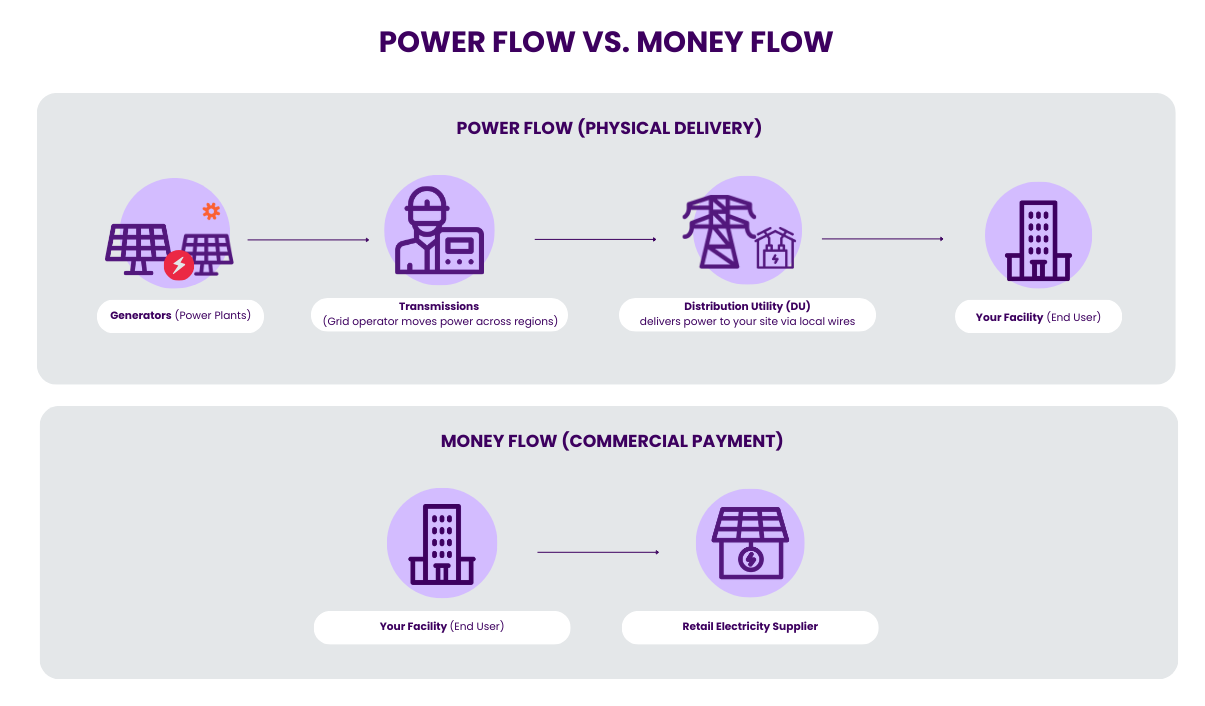
In the Philippines retail electricity market, it helps to separate three things: the physical flow of electricity, the contracts and payments, and the market and regulators working in the background. Under RCOA, switching to a Retail Electricity Supplier (RES) changes who you buy supply from and the terms you agree on, but it does not change the wires that bring electricity to your facility.
Here is the cleanest way to visualize who does what:
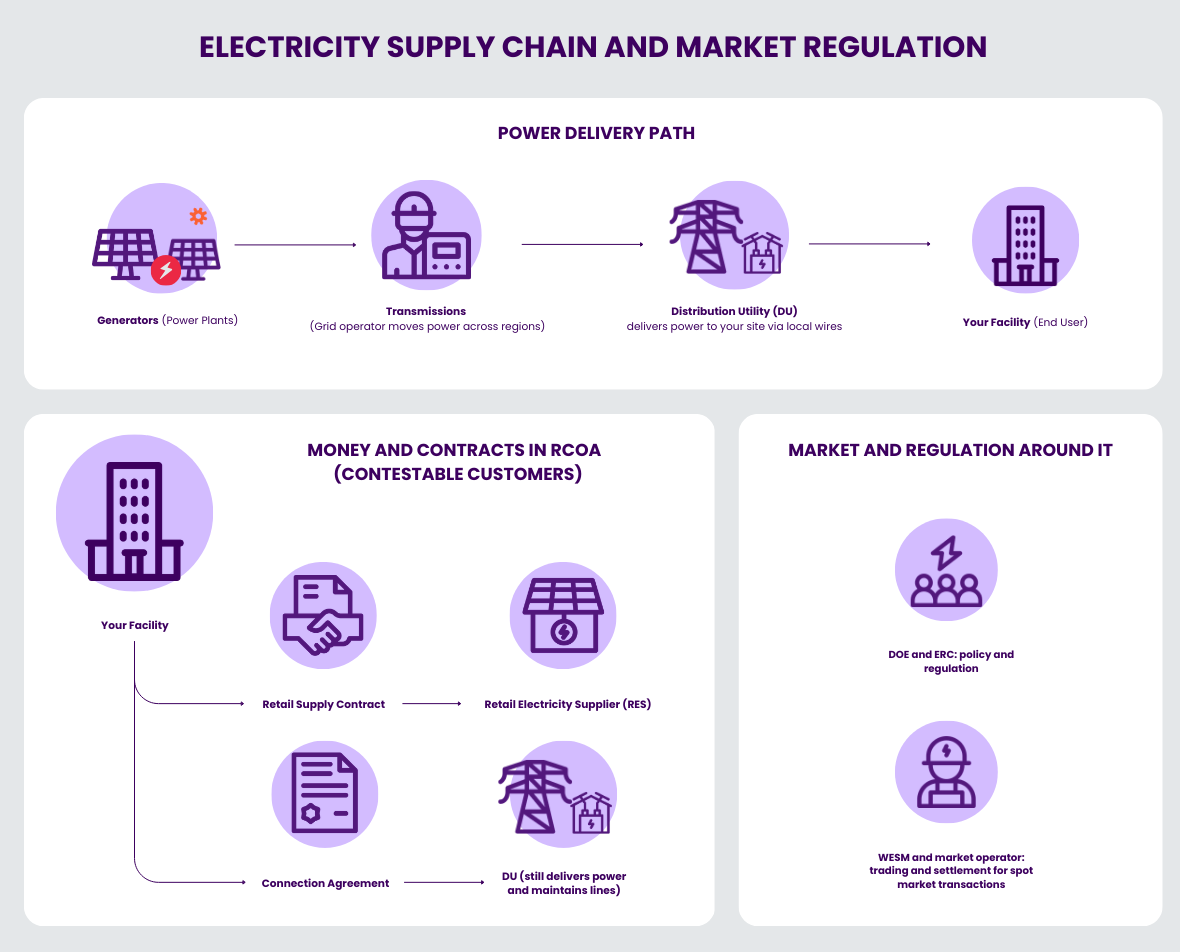
Electricity starts with generators (power plants), then moves through the transmission grid, and finally reaches your site through your local Distribution Utility (DU) network. The DU is the one that delivers power to your meter using its poles, lines, and equipment. This is why your facility remains connected to the DU even after you switch suppliers.
For contestable customers, the key change is contractual. Your facility signs a Retail Supply Contract with a Retail Electricity Supplier (RES) that defines the supply price structure and service terms. At the same time, you keep a Connection Agreement with the DU because they continue to deliver electricity and maintain the distribution network that serves your location.
In simple terms, the RES handles supply and customer support for your retail supply arrangement, while the DU remains responsible for local delivery infrastructure.
The DOE and ERC set policy and rules for how the market operates and how suppliers participate. Meanwhile, WESM and the market operator handle spot market trading and settlements, which can influence pricing structures depending on how a retail supply contract is designed.
Most end users do not transact directly with these entities day to day, but they shape the rules and market conditions that suppliers work within.
In summary, electricity delivery stays on the same path; your supplier choice changes the contract, and regulators and market systems provide the structure around it.
A DU is your local electric utility. They operate and maintain the distribution network in their franchise area and physically deliver electricity to your building.
Under RCOA, the DU still matters because:
RCOA specifically distinguishes contestable customers from captive customers.
A Retail Electricity Supplier is a company licensed by the Energy Regulatory Commission (ERC) that can sell electricity to contestable customers.
In practical terms, your RES is the player who can influence:
ERC rules and licensing frameworks define what a Retail Electricity Supplier is and how licensing applies to territories where retail competition exists.
RCOA is the regime that enables retail choice for qualified customers. It took effect for contestable customers in mid-2013, with thresholds set and adjusted by the ERC over time. If you are looking into RCOA, the important part is what it unlocks:
The ERC is the regulator that sets and enforces rules for the power sector, including:
For example, ERC issuances cover customer choice mechanisms such as aggregation rules and eligibility thresholds.
The DOE sets national energy policy direction and issues circulars to facilitate the implementation of RCOA under EPIRA. If you want the policy backbone beyond summaries, DOE circulars are one of the most legitimate reference points.
The Wholesale Electricity Spot Market (WESM) is a marketplace where electricity is traded as a commodity. It exists under EPIRA and is designed to support a competitive, efficient, transparent market for electricity trading.
Why this matters to a business evaluating suppliers:
Historically, PEMC served as the market operator and governing body of WESM for a period described in PEMC materials. In the current setup, the Independent Electricity Market Operator of the Philippines (IEMOP) explains WESM as the trading venue created under EPIRA.
For most end users, the key takeaway is simple:
Most business readers start here because it determines whether RCOA applies.
RCOA eligibility is tied to the threshold of contestability set by the ERC, historically framed around average peak demand, and updated through ERC issuances and programs such as aggregation mechanisms. If your company has multiple facilities, the ERC rules allow demand aggregation under specific conditions to meet the threshold.
If your search includes choosing a retail electricity supplier because you want lower electricity costs or, at the very least, optimal cost to usage, use this practical checklist:
Do you understand what drives the bill under the proposed structure? If any pricing component is indexed, ask what it is indexed to and how often it resets.
Some businesses prefer predictability. Others can tolerate variability if operations can adjust. Your best fit depends on how stable your load profile is.
Switching is often perceived as complex. A supplier that guides compliance steps and coordination reduces internal workload. This is a major reason many mid-market teams look for a customer-first RES partner.
Ask what reporting you receive, how billing is explained, and what the response process looks like when you have questions. This is where commercial energy solutions are not only about price. They are about execution and partnership.
Every case has details, but the simple, overall flow typically looks like this:
If you want a practical explanation written for business readers, COREnergy also publishes RCOA explainers intended for this purpose.
Moreover, if you and your team are exploring RES and want a clearer way to manage supply costs and reduce internal effort, COREnergy is here to help.
We will walk you through eligibility, explain your options in plain language, and support you end-to-end from assessment to switching to ongoing account care. Reach out to COREnergy to schedule a consultation and see what a customer-first retail electricity supplier partnership looks like.