
Choosing a retail electricity supplier is not just about finding the lowest price on a proposal. For many businesses, the better question is: which electricity rate structure actually fits the way we operate?
That distinction matters. A factory that runs heavy machinery around the clock may need a different setup from an office building with mostly daytime usage. A cold storage facility may prioritize price stability, while a business with flexible operations may be open to market-based pricing if it creates savings opportunities.
In the Philippines, Retail Competition and Open Access, or RCOA, allows qualified electricity end users to choose their Retail Electricity Supplier for their electricity requirements voluntarily.
IEMOP also serves as the Central Registration Body for RCOA, facilitating registration, switching, and information exchange among retail market participants.
So, if your business is exploring switching electricity supplier options, understanding electricity rate structures is a smart first step.
Electricity rate structures are the pricing arrangements that determine how your business is charged for electricity supply. They can be fixed, market-based, time-based, customized, or a combination of several approaches.
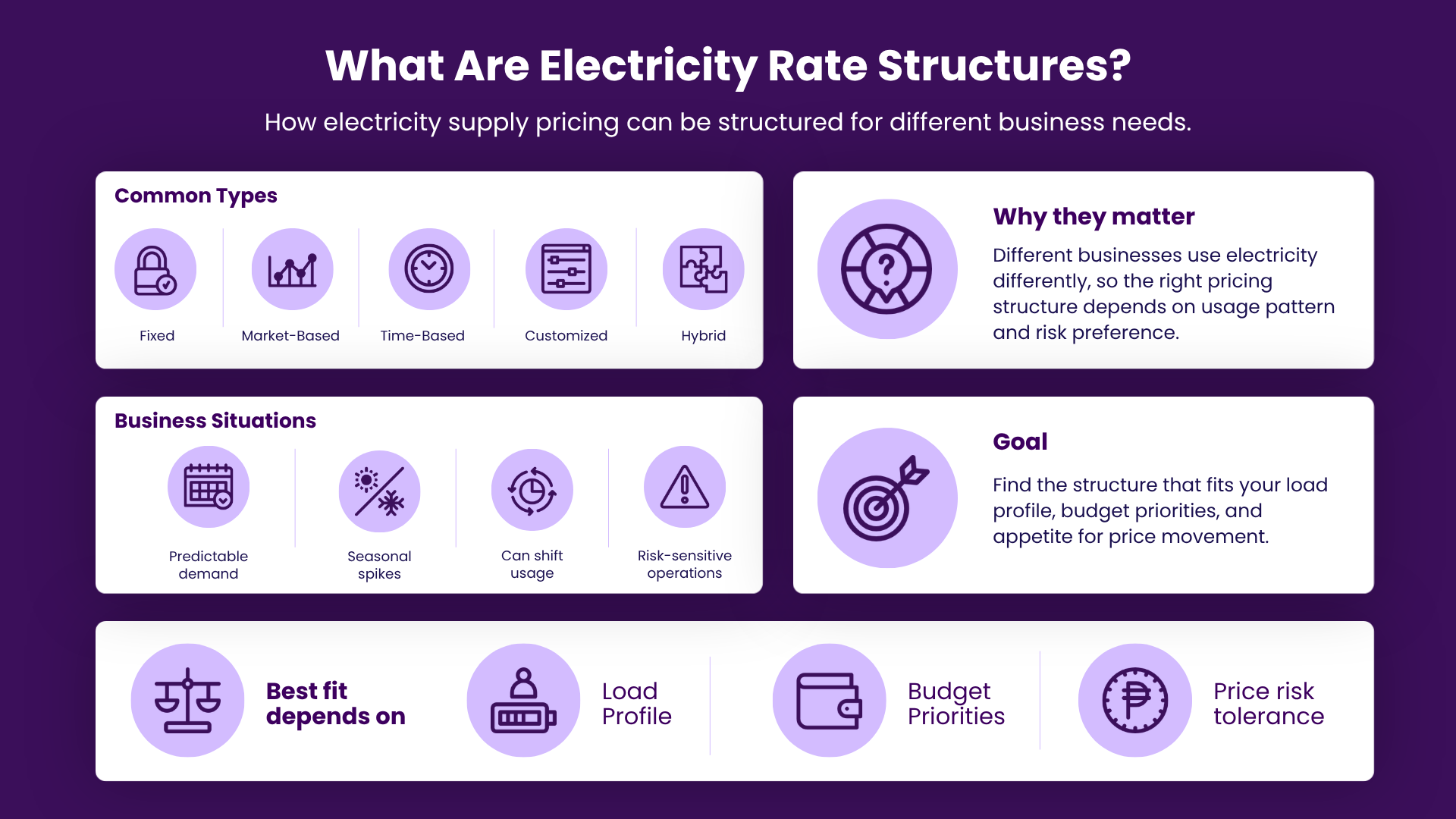
In the retail electricity market, these structures matter because different businesses consume electricity in different ways. Some have a predictable demand every month. Others have seasonal spikes. Some can shift usage to lower-cost hours. Others cannot afford to take price risks because electricity is too central to daily operations.
The goal is not to find the “perfect” plan on paper. The goal is to find the plan that matches your actual load profile, budget priorities, and appetite for price movement.
Business electricity rates are shaped by several factors, including consumption volume, demand patterns, operating hours, market conditions, and contract structure.
For contestable customers, the supply portion of the bill can be negotiated through a Retail Electricity Supplier, while electricity still physically flows through the existing grid and distribution network.
This is why retail electricity supplier pricing should be reviewed carefully. A low headline rate may look attractive, but the real value depends on how that rate behaves across your contract period.
Does it stay steady? Does it move with the market? Does it reward off-peak usage? Does it expose the business to higher costs during tight supply periods?
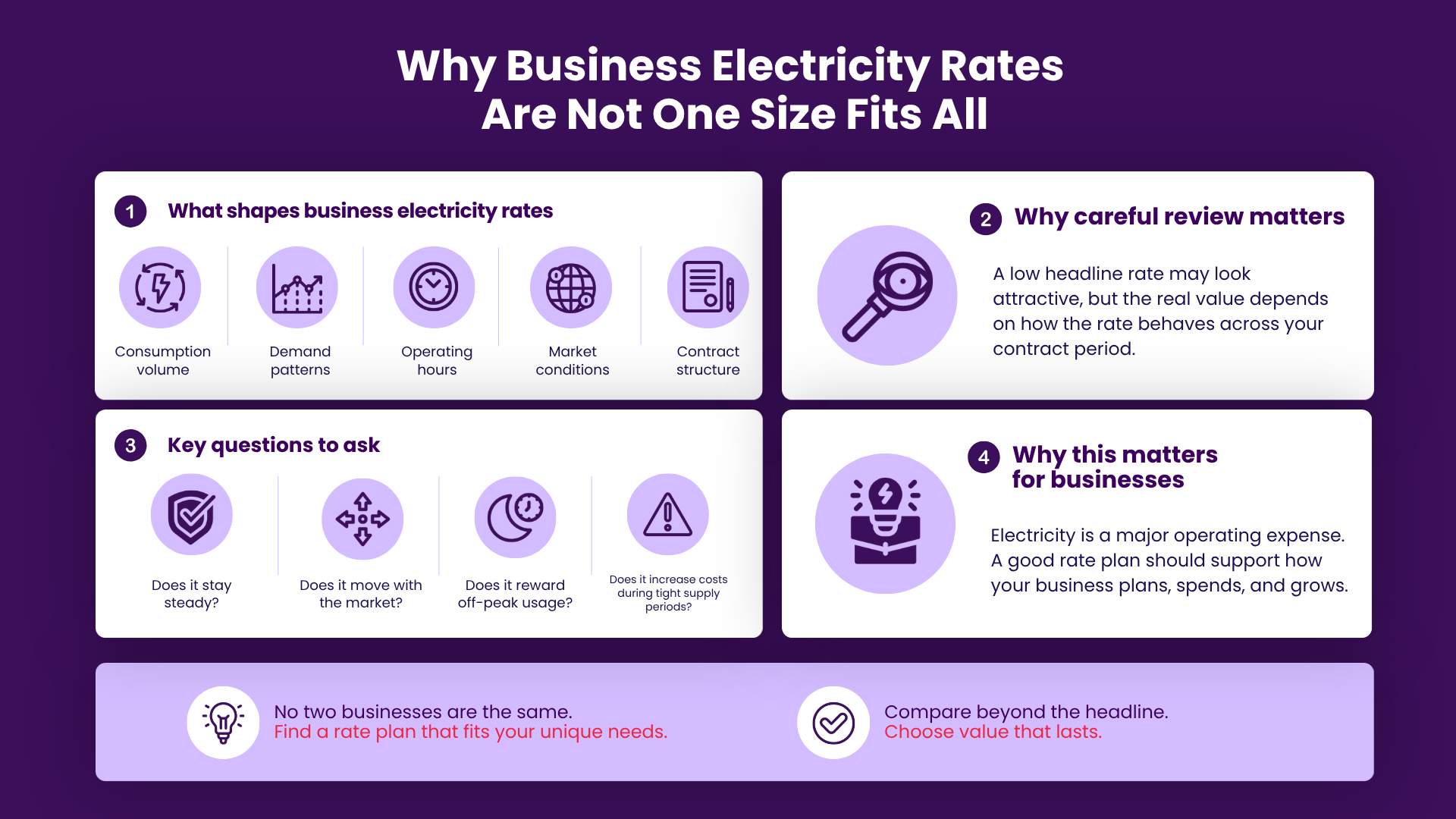
These questions are especially important for commercial and industrial users because electricity is often a major operating expense. A good rate plan should not only look good on day one. It should also support how your business plans, spends, and grows.
A fixed electricity rate is usually the easiest structure to understand. The business locks in a rate for the contract period, giving the finance team more predictability when forecasting monthly electricity costs.
COREnergy’s Fixed and Flat Rate Plan is designed for price certainty and budget stability. It allows businesses to lock in their electricity rate for the entire contract and is positioned for companies that want predictable monthly bills and protection from spot market fluctuations.
This structure may be best for businesses that prefer steady planning over market chasing. Examples may include office buildings, malls, manufacturing facilities, schools, and businesses where electricity demand is relatively consistent.
The benefit is simple: less guesswork. When your generation rate is fixed, your team can plan with more confidence.
The tradeoff is that if market prices fall significantly, a fixed plan may not capture the lowest possible short-term rate. But for many businesses, the value of stability can outweigh the chance of chasing a temporary dip.
Some businesses are more comfortable with market movement. For them, a WESM-based or market-linked structure may be worth considering.
The Wholesale Electricity Spot Market, or WESM, is the venue for trading electricity as a commodity in the Philippines. According to IEMOP, the WESM was created under EPIRA to support a competitive, efficient, transparent, and reliable market where prices are governed by commercial and market forces.
COREnergy’s WESM Plus Plan follows market movement. It allows businesses to pay lower prices when supply is high and demand is low, but rates can also rise during periods of high demand or low supply.
This type of structure may be suitable for companies that can adjust consumption based on market trends. For example, a business with flexible production schedules may be able to shift some operations when market conditions are more favorable.
The keyword here is “flexible.” If your business cannot adjust usage, or if sudden price movement would disrupt your budget, a market-linked plan may feel uncomfortable. It can offer savings opportunities, but it also requires a stronger risk appetite.
Some electricity tariff options are designed around when your business consumes power. COREnergy’s Day / Night Plan features locked-in prices for both peak hours, from 10 AM to 10 PM, and off-peak hours, from 10 PM to 10 AM. It is built for flexible or round-the-clock operations, especially those that can shift usage to off-peak periods.
This can make sense for operations that have some control over scheduling. For example, a facility may be able to run selected processes at night, charge equipment during lower-cost hours, or schedule energy-intensive work outside peak periods.
The benefit is that the business gets a clearer price structure across different time blocks. It can support smarter consumption habits and reward teams that actively manage load.
The consideration is that this plan requires discipline. If most of your consumption still happens during peak hours, the savings opportunity may be limited.
This is where operations, finance, and facilities teams need to work together. The best tariff structure is not only chosen in the boardroom. It is proven in the daily routine of the business.
Some businesses consume most of their electricity during daytime operations. COREnergy’s Sunshine Plan is designed for companies with strong daytime usage, offering locked-in rates during solar hours and flexible spot pricing outside those hours. It is positioned for daytime heavy operations such as offices, schools, and manufacturers.
This type of structure may be attractive for businesses that operate mainly during regular working hours. The fit depends on how much of the company’s consumption falls within the plan’s strongest pricing window.
The important thing is to compare the structure against your actual load data. A daytime heavy business may benefit, while a business with significant evening or overnight usage should review the exposure carefully.
Not every business fits neatly into one category. Some need a blended approach.
COREnergy’s Custom Rate option allows businesses with specific operational patterns to combine fixed rates, WESM pricing, time of use schedules, or price caps. It is designed for companies with predictable consumption patterns that want a tariff built around their operations.
This can be useful for energy-experienced businesses that already understand their load behavior. A custom plan may combine the comfort of fixed pricing with selected market-based exposure, or use price caps to manage risk.
The advantage is flexibility. The consideration is that custom structures work best when the business has reliable usage data. Without good data, customization can become guesswork.
Yes, because the right plan becomes even stronger when your business understands how it consumes electricity.
COREnergy’s Energy Services include the MyPower Platform for tracking energy use, Power Quality Study, Thermal Scan Test, Medium Voltage Electrical Equipment Testing, and Energy Audit Levels 1, 2, and 3.
These services are designed to help businesses spot inefficiencies, protect assets, and identify potential cost-saving opportunities.
This matters because rate structure and usage behavior go hand in hand. A business may choose a time-based plan, but without monitoring usage, it may not fully capture the benefits. Another company may want a fixed plan, but an energy audit might reveal inefficiencies that can reduce total consumption.
In other words, the plan affects what you pay per unit. Energy services help you understand how many units you really need to use.
Start with your operating pattern. Ask when your business uses the most electricity. Is it mostly daytime, round the clock, seasonal, or flexible? Then review your risk appetite. Do you prefer predictable bills, or are you open to market movement in exchange for possible savings?
Next, check your internal capacity. Can your team actively manage consumption? Can operations shift the load? Do you have reliable usage data? Are your facilities ready for a more advanced rate structure?
Finally, work with a retail electricity supplier that explains the options clearly. Switching electricity suppliers should not feel like decoding fine print. The right partner should help you compare the plan, the risks, the billing impact, and the switching process.
Electricity rate structures are not just technical details. They affect budgeting, operations, and long-term cost control.
A fixed electricity rate may be the right fit if your business values predictability. A market-linked plan may work if you have flexibility and risk tolerance. A time-based plan may reward businesses that can shift usage. A custom plan may suit companies with strong load data and specific operational patterns.
COREnergy Philippines helps businesses understand their usage, compare COREnergy rate plans, and choose an electricity structure that makes sense beyond the proposal sheet.
When the right plan fits the way your business actually works, energy becomes easier to manage, easier to plan, and easier to turn into an advantage. Ready to review your electricity options? Connect with COREnergy to explore a rate plan built around your business needs.