
If you’re researching RCOA Philippines and how a retail electricity supplier works, you probably have the same questions we hear every week, usually right after someone says, “Okay… but what does this actually mean for our bill?”

Here are the most common FAQs businesses ask COREnergy Philippines, answered in plain language, no industry maze, no guesswork.
COREnergy is a Retail Electricity Supplier (RES), meaning we supply electricity to eligible businesses under Retail Competition and Open Access (RCOA). We’re not a distribution utility (DU), and we’re not your “wires provider.”
We’re the supplier you can choose once you qualify as a contestable customer under RCOA. RCOA itself is part of the framework established under EPIRA (RA 9136).
Some businesses are, and this is where contestability comes in. Under RCOA Philippines, eligible end-users (called contestable customers) can choose a retail electricity supplier in the Philippines that businesses work with, instead of staying under the default supply arrangement.

The contestable market refers to the group of electricity end-users who are eligible to choose their supplier under RCOA (as determined by the regulator and applicable rules). If you’re contestable, you can shop for supply options. If you’re not, you’re considered part of the captive market.
Eligibility is primarily based on your average monthly peak demand (kW) over a defined period, commonly assessed across the past 12 months. This is different from kWh, which is the total energy consumed.
The ERC approved lowering the eligibility threshold for RCOA and the Retail Aggregation Program from 500 kW to 100 kW, with effectivity on June 26, 2026. Businesses near the 100 kW level often start preparing early, checking demand history, metering readiness, and documentation requirements.
Quick cheat sheet:
RCOA qualification is typically tied to demand (kW). So even if your kWh is high, the key question is: what’s your peak demand profile?
Yes. Switching suppliers doesn’t change the physical delivery network. Your local DU still handles the distribution system (the wires, network operations, and related services in your area). What does change is your supply arrangement, the supplier you contract for electricity supply under RCOA.
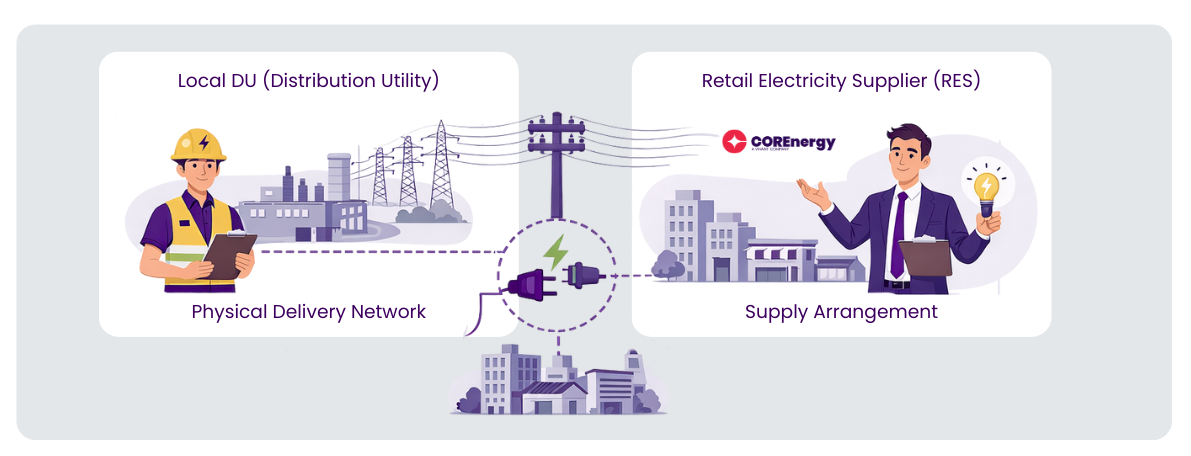
Outages and line issues are still handled through the distribution network operator, your DU, because they manage the physical infrastructure. Your RES supports you on the supply side, which means coordination, account assistance, and guidance, especially when you need clarity fast.
Not automatically, and we’ll always be upfront about that. Your actual outcome depends on things like:
That said, many businesses explore RCOA specifically because it opens the door to more tailored supply options and better alignment with their operating needs, rather than a one-size-fits-all setup.
The exact sequence varies per case, but the typical flow looks like this:
A practical starting point is to review RCOA guidance for business customers and validate your eligibility based on demand history.

RAP allows eligible end-users to aggregate demand, often across multiple sites, to meet the threshold and participate in retail supply choice. This is useful for multi-branch businesses that don’t hit the threshold at a single location.
If you’re a single-site facility already meeting the threshold, you may not need RAP. If you have multiple sites, RAP can be a key pathway, especially with the move toward 100 kW.
Billing arrangements depend on the structure applied under the rules and your setup. Still, it’s common for DU and transmission charges (related to distribution services) to remain part of the overall billing ecosystem.
COREnergy helps you understand what you’re paying for, what changes, and what stays the same, so your finance team isn’t left decoding line items alone.
Even before switching, you can often reduce costs through operational changes and efficiency basics. For example, the DOE-aligned advisories commonly emphasize practical steps like optimizing cooling setpoints, using efficient lighting, and adjusting operating practices that drive peak demand.
If you want quick wins:
These business energy-saving tips work best when paired with a simple habit: track your demand peaks monthly.
If you want to know if your business qualifies under RCOA Philippines, COREnergy is built to make the process feel clear, guided, and worth your time.
We focus on what businesses care about most: transparent explanations, responsive support, and hands-on assistance from eligibility checking through switching coordination, so you’re not stuck stitching together answers from five different parties.
Even after you’ve switched, we stay proactive: helping you understand your profile, your options, and the operational levers that support lower electricity costs over time.