
Reading a retail electricity contract for the first time can feel like opening a document that assumes you already know the ending.
You see terms like RSC, WESM-based rate, security deposit, connection agreement, and contestable customer, and suddenly, what should be a practical business decision starts sounding like a board exam for power lawyers.
But it does not have to be that way. If your company is exploring options in the Philippine retail electricity market, understanding these terms can help you compare offers better, ask sharper questions, and avoid signing a contract you only half understood.
That matters even more now because the country’s Retail Competition and Open Access, or RCOA, continues to expand customer choice in the electricity market. Under EPIRA, qualified end users can choose their own retail electricity supplier instead of simply taking supply under the default setup of their distribution utility.
More recently, the ERC also lowered the eligibility threshold for RCOA and the Retail Aggregation Program from 500 kW to 100 kW average monthly peak demand, opening the market to more businesses. So let us translate the fine print into plain English.
A retail electricity supplier contract is the agreement between a qualified customer and a licensed Retail Electricity Supplier, or RES, for the supply of electricity in the contestable market.
Under RCOA, the physical delivery of electricity still goes through the grid and the local distribution network, but the customer gets the option to choose who supplies the electricity commercially. In other words, the wires stay the same, but the supply arrangement can change.
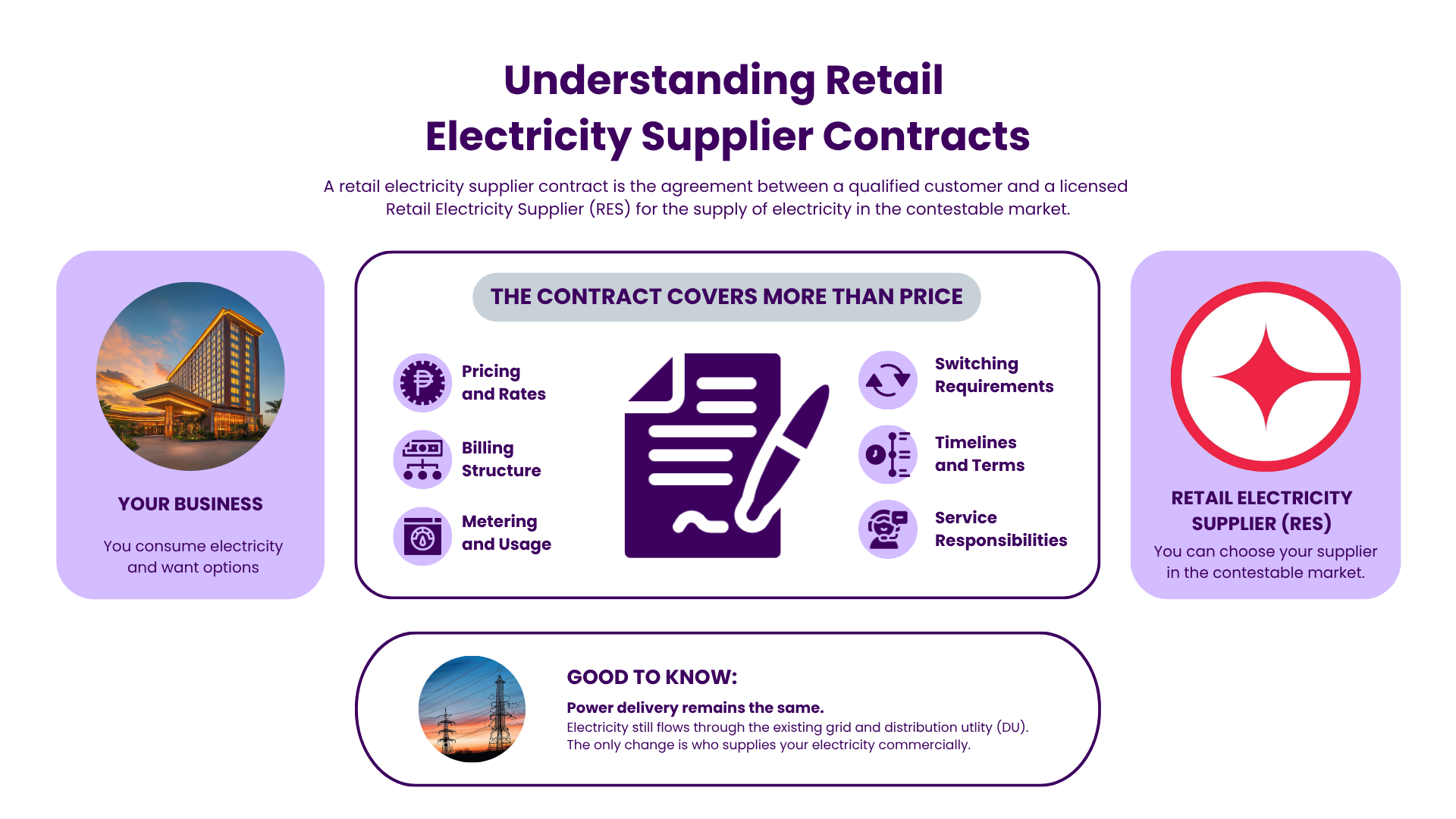
That is why electricity supply contract terms usually cover much more than price. They often include switching requirements, billing structure, metering, payment obligations, timelines, and service responsibilities.
A contestable customer is an end user that qualifies to participate in the retail electricity market and chooses their own supplier. Because the ERC lowered the threshold to 100 kW average monthly peak demand, more medium-sized businesses can now join RCOA directly.
Why it matters: This is the starting point. Before you compare rates or contract offers, you need to know whether your business qualifies.
RCOA is the policy framework that allows qualified electricity users to choose their supplier. It is part of the Electric Power Industry Reform Act of 2001, better known as EPIRA, which restructured the Philippine power industry and introduced retail competition.
Why it matters: Every RES contract sits within this framework, so many of the terms in your agreement are shaped by rules outside the contract itself.
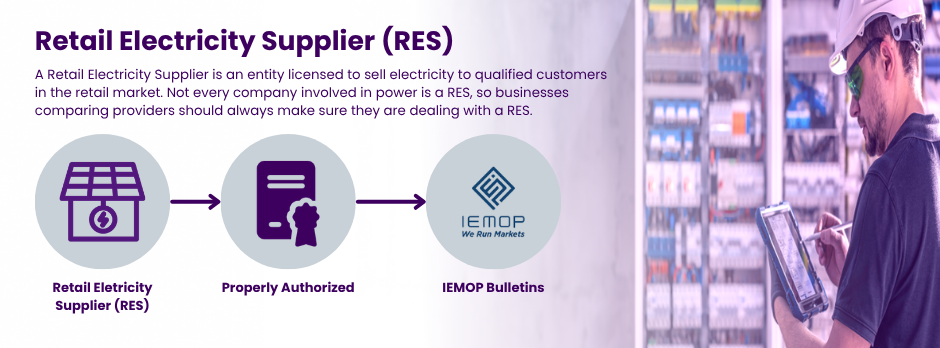
A Retail Electricity Supplier is an entity licensed to sell electricity to qualified customers in the retail market. Not every company involved in power is a RES, so businesses comparing providers should always make sure they are dealing with a properly authorized supplier.
The ERC’s retail market rules and IEMOP’s retail market bulletins both set out roles and processes for retail suppliers in the market.
Why it matters: when businesses search phrases like power companies in the Philippines or list of electrical suppliers in the Philippines, it is easy to lump everyone together. In practice, the role of a RES is specific.
The Retail Supply Contract, or RSC, is the main commercial agreement between the customer and the RES. This is usually the heart of the deal. It is where the contract price, term, billing arrangement, service conditions, and payment obligations are laid out.
Why it matters: if there is one document your legal, finance, and operations teams should all understand, it is this one.
The contract term is the agreed length of the supply contract. Some businesses prefer longer terms for price predictability, while others want shorter terms for flexibility.
Why it matters: A lower rate is not always the better deal if the term does not match your business plans, expansion timeline, or appetite for market movement.
A fixed rate means the electricity price is locked in for the contract period. This usually gives businesses a more predictable basis for budgeting and planning.
Why it matters: If your finance team values stable costs and fewer surprises, this is often easier to manage than a market-linked structure.
A WESM-based rate is linked to the Wholesale Electricity Spot Market. IEMOP operates WESM, where electricity prices can move depending on supply and demand conditions in the market.
Why it matters: This structure can create opportunities when market prices are favorable, but it can also expose the customer to price swings. It is not something to agree to casually just because it sounds sophisticated.
A time-of-use rate applies different pricing depending on the time of day, such as peak and off-peak hours.
Why it matters: For businesses that can shift operations or heavy loads to lower-cost periods, this can be useful. For businesses with fixed operating patterns, it may be less attractive.
A custom rate structure is designed around the customer’s load profile or operational pattern. It may combine fixed and variable elements or include special pricing arrangements.
Why it matters: This is where a contract becomes more tailored, but also where it becomes more important to understand the assumptions behind the pricing.
A security deposit is financial security provided by the customer to support its payment obligations under the contract. Depending on the arrangement, this may be in cash or in another acceptable form.
Why it matters: Many businesses focus only on the headline electricity rate and forget to ask about the cash flow effect of the security requirement.
An SBLC is a bank-issued instrument that may be used instead of a cash deposit, depending on the supplier’s requirements and the agreed setup.
Why it matters: for some businesses, this can be a more practical way to meet security requirements that can tie up just as much capital (depending on the setup), but yields greater returns.
A billing arrangement defines how the customer will be billed. Under IEMOP’s 2024 retail market bulletin, only single billing will be implemented in the retail market, and customers under a dual billing scheme will be required to move to single billing upon a regular switch to a new retail supplier or upon expiry of current dual billing agreements.
Why it matters: Billing is one of the first places where confusion shows up after switching, so this part of the contract should be very clear.
A connection agreement covers the customer’s continued physical connection to the distribution system.
Why it matters: Changing your supplier does not mean leaving the grid. Your supply contract and your network connection are related, but they are not the same thing.
Metering refers to how electricity usage is measured. In retail market participation, the metering setup becomes especially important because the customer’s usage data affects billing, settlement, and sometimes the applicable tariff structure.
Why it matters: If the contract depends on time-based pricing or a detailed load profile, your meter and metering arrangement are doing a lot of heavy lifting behind the scenes.
The switch date is the target date when your supply arrangement with the new RES takes effect.
Why it matters: This is not just a calendar detail. Switching is governed by process timelines. IEMOP’s retail market bulletin notes a seven-working-day switching timeline at the CRB stage, but it also says end users must notify their network service provider of the intention to switch at least ninety calendar days before the intended switch date.
That means businesses should not wait until the last minute and expect everything to magically line up by the next billing cycle.
The Retail Aggregation Program allows multiple electricity end users to combine demand so they can collectively qualify for retail market participation. IEMOP explains that this helps smaller consumers access the benefits of the retail market by pooling their consumption within the same franchise area.
Why it matters: if your business does not meet the threshold on its own, aggregation may still create a path to customer choice.
A contract glossary is helpful, but the real value comes from knowing what to review before the signature page.
Look closely at the pricing structure. Is it fixed, market-linked, or blended? Review the term. Check the billing arrangement. Ask about security deposits and acceptable security instruments. Confirm switching timelines.
Clarify which parts are handled by the supplier and which still require coordination with the DU, electric cooperative, or market operator.
Most of all, do not be shy about asking what a term means in plain language. A good supplier should be able to explain the contract clearly, not hide behind acronyms and hope you stop asking.
The best retail electricity contract is not just the one with the lowest quoted rate. It is the one your business actually understands, can manage, and can operate under with confidence.
That is why learning common retail electricity contract terms, RES contract terms, and the basics of an electricity supply contract is worth the effort. It gives your business a better shot at choosing the right supplier, the right structure, and the right fit for your operations.
When it comes to electricity contracts, clarity is not a bonus. It is part of the deal. For businesses exploring how to switch retail electricity suppliers in the Philippines or choosing a retail electricity supplier, understanding the terms first makes the whole decision much less intimidating and a lot more practical.
If your business is reviewing electricity supply options, COREnergy can help make the process easier to understand.
From explaining contract terms to guiding customers through switching requirements and identifying the most suitable tariff structure, COREnergy takes a more hands-on, transparent, and customer-first approach.
Reach out to COREnergy to explore your options and find a retail electricity setup that works for your business.