
For many businesses in the Philippines, electricity used to feel like a fixed part of operations. The bill arrived, the amount was paid, and there was little room to ask whether another setup could serve the business better.
That started to change with Retail Competition and Open Access, more commonly called RCOA. Under RCOA, qualified businesses can choose their own retail electricity supplier instead of buying electricity supply only from their local distribution utility or electric cooperative.
In simpler terms, eligible businesses now have more say in where their electricity supply comes from, what contract structure they enter, and how much transparency they get in the process. If your company is exploring switching electricity suppliers, the first question is simple: Are you eligible?
This guide breaks down contestable customer eligibility in the Philippines in plain language, so business owners, operations teams, and finance decision makers can better understand what to check before choosing a retail electricity supplier.
A contestable customer is an electricity end user that meets the demand threshold set by regulators and is allowed to choose a licensed retail electricity supplier.
Under RCOA, qualified customers can participate in the competitive retail electricity market. This gives them the option to contract with a Retail Electricity Supplier, or RES, instead of purchasing the supply portion of electricity from the default supplier in their area.
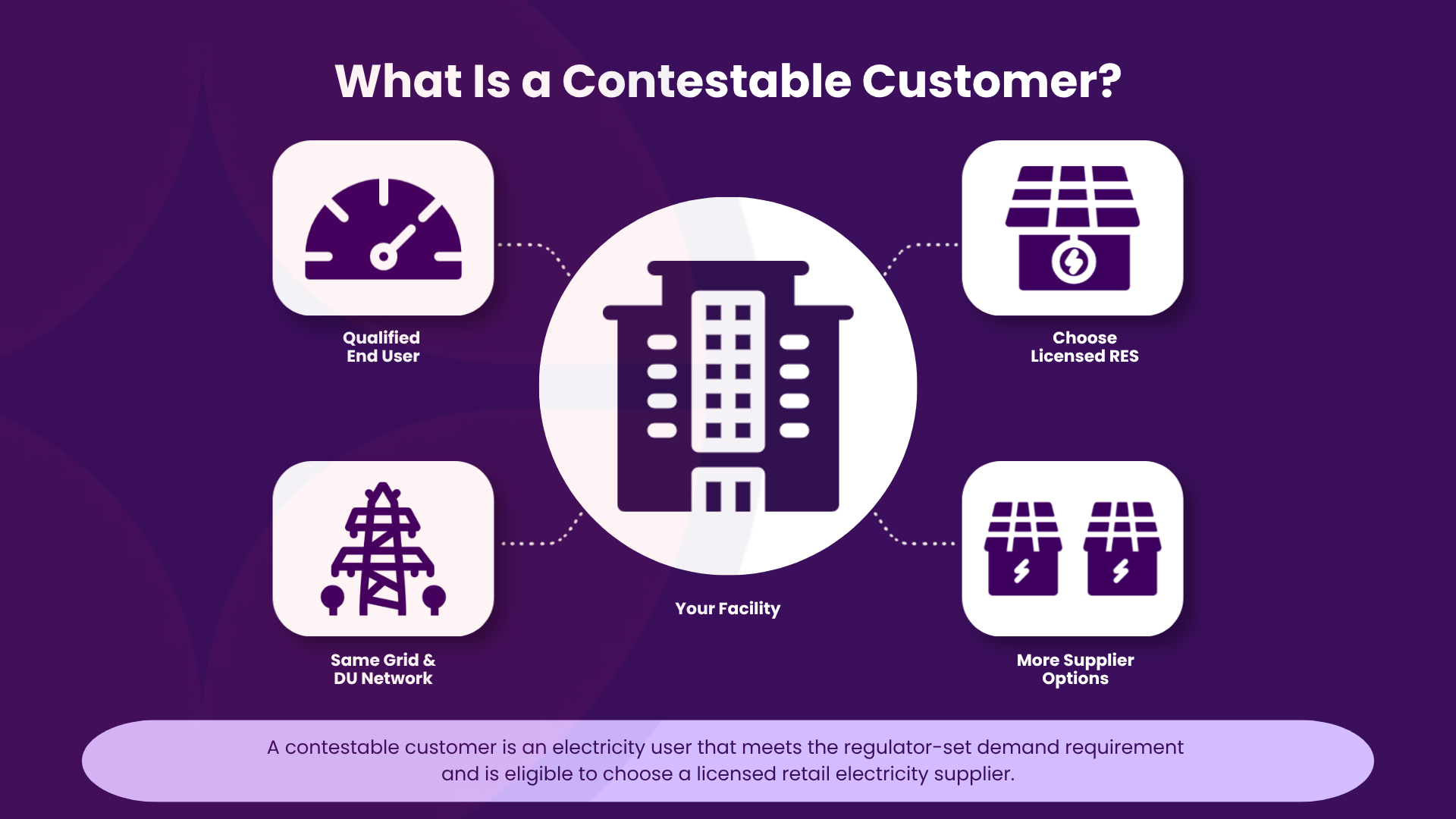
The Philippine Electricity Market Corporation explains that RCOA allows qualified end users to choose their supplier of electricity, with the average demand threshold set by the Energy Regulatory Commission.
This does not mean the entire electricity system changes for your business. The physical flow of power still passes through the grid and the local distribution network. What does change is your electricity supply contract.
Instead of having no practical choice over supply, a qualified business can compare offers from energy companies in the Philippines that are licensed to serve contestable customers. Think of it this way: the wires do not suddenly move, but your options do.
One common search term around this topic is “What is the Energy Regulatory Commission?” and it is an important one to understand.
The Energy Regulatory Commission, or ERC, is the regulator of the Philippine electric power industry. Under EPIRA, the ERC is tasked to promote competition, encourage market development, ensure customer choice, and penalize abuse of market power.
In the context of RCOA, the ERC plays a major role in setting rules for contestability, licensing retail electricity suppliers, and supporting consumer choice in the electricity market. So when a business asks whether it can switch suppliers, the eligibility rules are not just marketing claims from power companies in the Philippines. They are anchored on regulation.
The current standard threshold for RCOA participation is still commonly understood as an average monthly peak demand of at least 500 kW.
This is why many guides and supplier conversations focus on businesses with larger power consumption, such as malls, factories, cold storage facilities, large supermarkets, commercial buildings, hotels, and industrial operations.
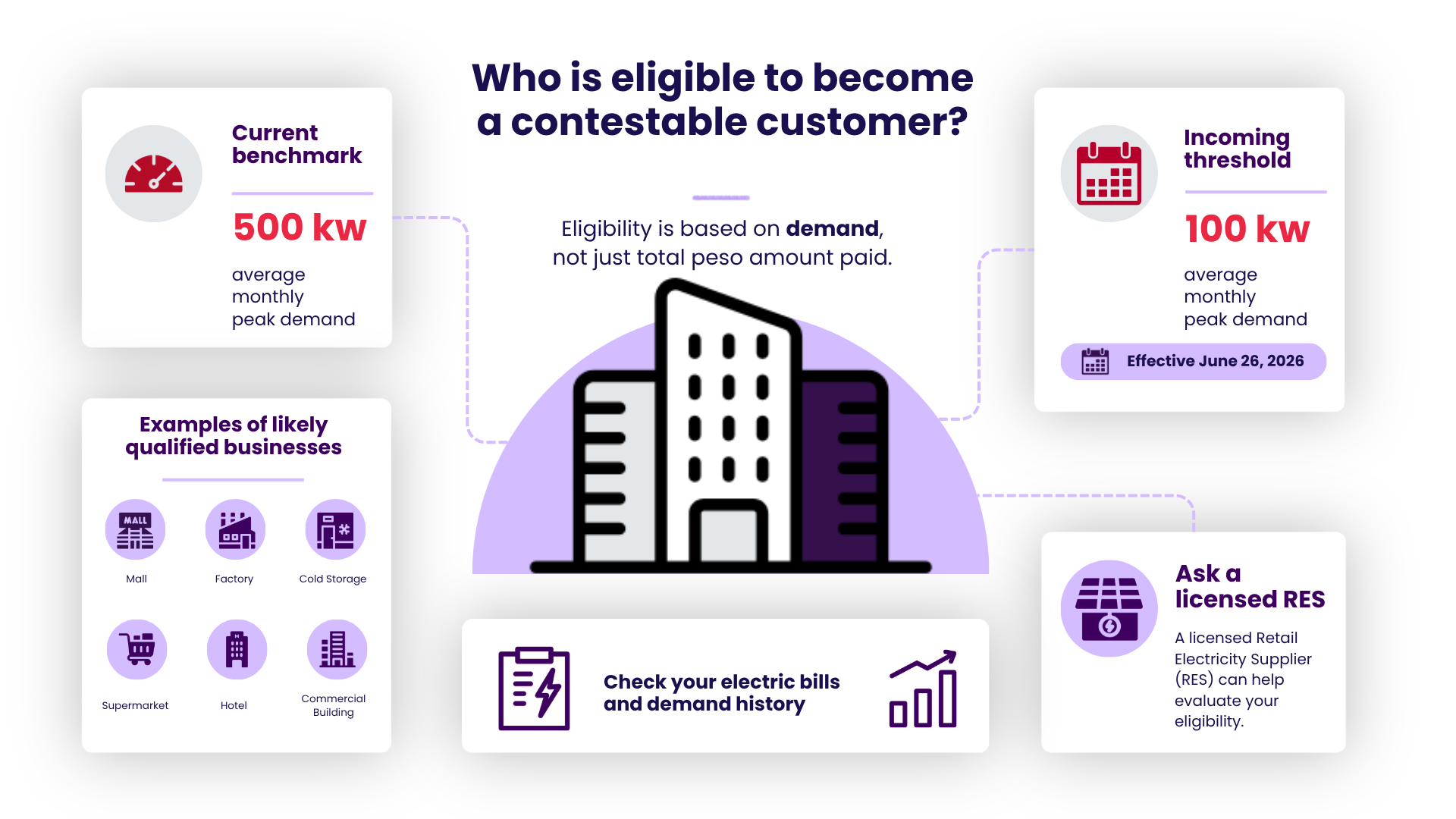
However, an important change is already on the way. The ERC approved Resolution No. 22, Series of 2025, which lowers the eligibility threshold for RCOA and the Retail Aggregation Program. News reports on the ruling state that the threshold will move from 500 kW to 100 kW average monthly peak demand, with the new threshold taking effect on June 26, 2026.
That matters because more medium-sized businesses may soon qualify. Companies that were previously just below the contestability threshold may now have a clearer path to choosing a retail electricity supplier.
For now, businesses should check two things:
First, review your electric bills and demand history. Eligibility is based on demand, not just total peso amount paid.
Second, ask a licensed RES to help evaluate whether your facility qualifies under current or incoming thresholds.
This is where the Retail Aggregation Program, or RAP, becomes relevant. RAP allows multiple electricity end users to combine their demand so they can collectively qualify for the retail electricity market.
IEMOP describes the Retail Aggregation Program as a policy mechanism under RCOA that allows multiple electricity end users to consolidate their electricity demand to collectively qualify for participation in the retail electricity market.
This can be useful for businesses with several branches, sites, or facilities. For example, a company may have multiple stores within the same distribution utility franchise area. Individually, each site may fall below the threshold. Together, the combined demand may qualify.
This is especially relevant for growing businesses in retail, food service, warehousing, hospitality, and light manufacturing. In the past, they may have assumed RCOA was only for very large companies. With aggregation and the incoming lower threshold, that assumption is worth revisiting.
When people search for a distributor of electricity, they are usually referring to distribution utilities or electric cooperatives.
A distribution utility, or DU, owns and operates the local distribution system that brings electricity to customers in its franchise area. An electric cooperative setup serves a similar distribution role in many provinces and communities. These entities remain important even when a business switches to an RES.
Switching to a retail electricity supplier does not remove the DU or the electric cooperative from the picture. Your facility still needs the local distribution network to receive power. Your DU or electric cooperative continues handling the distribution side, such as network connection and distribution-related services.
The main change is on the supply side. Instead of getting the supply component through the default arrangement, an eligible customer can contract with a licensed RES. This distinction is important because many businesses worry that switching suppliers will disrupt their physical power connection.
In reality, RCOA separates the commercial supply choice from the physical delivery of electricity.
The phrase “power companies” can refer to many different players: generators, transmission companies, distribution utilities, electric cooperatives, market operators, and retail electricity suppliers.
A retail electricity supplier is specifically licensed to sell electricity to contestable customers. RES providers compete for customers by offering different pricing structures, contract terms, billing support, and customer service approaches.
This is where choosing a retail electricity supplier becomes a business decision, not just a compliance step. The right RES should help you understand your consumption profile, explain contract options clearly, coordinate switching requirements, and support you after the switch.
COREnergy Philippines, for example, works with eligible businesses that want more control, transparency, and support in managing their electricity supply. For companies that are new to RCOA, that guidance can make the process feel less intimidating.
If your company is considering how to switch retail electricity suppliers in the Philippines, start with a practical eligibility check.
Review your last 12 months of electricity bills and look for demand-related figures, especially peak demand in kilowatts. If you are near or above the threshold, you may be a candidate for RCOA. If you have multiple sites, check whether aggregation may apply.
Next, confirm your location and distribution setup. RCOA participation depends on the applicable market and registration processes, so it is important to check your DU or electric cooperative area.
After that, speak with a licensed RES. A good supplier should be able to help you assess eligibility, explain the switching timeline, and identify the documents needed.
IEMOP’s retail market bulletin outlines switching timelines and procedures, including notice to the Network Service Provider and submission of switch requests through the proper market systems.
This is not something your team has to decode alone. The process has technical and regulatory steps, but with the right partner, it can be organized into a clear sequence.
Contestable customer eligibility is not just a regulatory label. It can affect how your business plans electricity costs.
For power-intensive businesses, electricity can be one of the biggest operating expenses. When you qualify for RCOA, you can compare supplier offers, review contract structures, and explore pricing arrangements that better match your operations.
A business with stable monthly consumption may prefer predictable pricing. A company with flexible operating hours may want to look at structures that reward shifting usage.
A multi-site business may want to explore aggregation. The point is not that every option is right for every company. The point is that eligibility gives you room to choose. In a cost environment where every peso matters, choice is powerful.
If your business has been receiving higher electricity bills but has never explored RCOA, contestable customer eligibility is the best place to start.
Check your demand. Review your sites. Understand whether you qualify today or may qualify once the lower threshold takes effect. Then speak with a licensed retail electricity supplier that can walk you through the process clearly.
COREnergy helps businesses understand their eligibility, compare available supply options, and make the switch with less guesswork. Because choosing a supplier should not feel like navigating a maze. It should feel like gaining a partner that helps your business move with more confidence.
Thinking about switching? Reach out to COREnergy to check your contestability and explore electricity supply options built around your business needs.