A business can look at its monthly electricity bill and know how much energy it used. The harder question is: where did all those kilowatt-hours actually go?
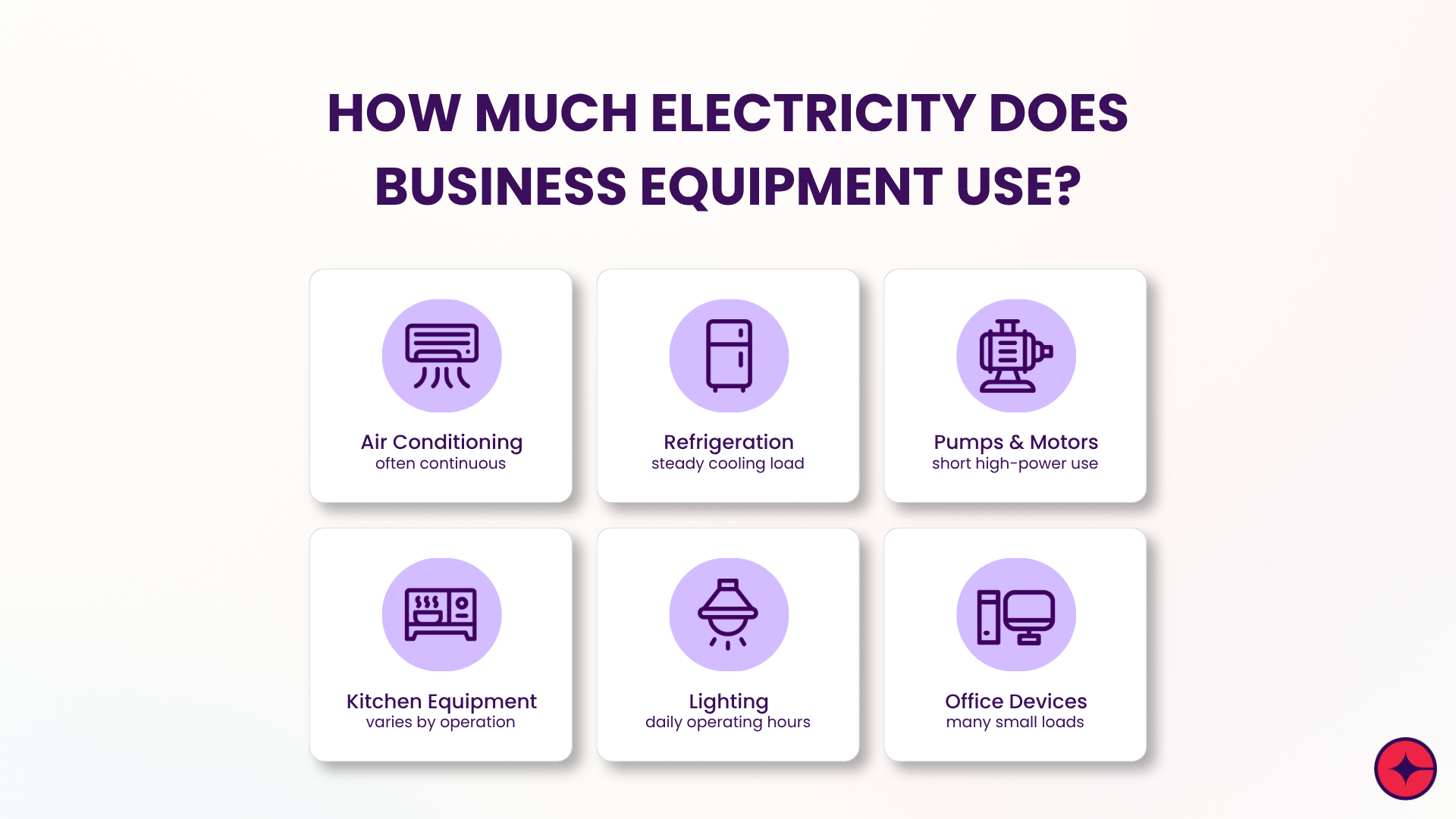
For operations teams, facility managers, and business owners, equipment-level energy use is one of the most useful places to start. Air conditioning, refrigeration, pumps, motors, kitchen equipment, lighting, and office devices all draw electricity differently. Some use a lot of power for short periods. Others use less at any one moment but run almost continuously.
That matters for efficiency and for businesses comparing a retail electricity supplier in the Philippines. Knowing when and how equipment consumes power makes electricity plan discussions much more practical.
Kilowatts (kW) tell you how much power equipment is drawing at a given moment. Kilowatt-hours (kWh) tell you how much energy it uses over time.
A simple estimate is: Equipment power in kW × operating hours = energy use in kWh
A 5 kW pump running for eight hours uses about 40 kWh if it draws 5 kW throughout that period. Over 22 working days, that becomes about 880 kWh. This is the same basic approach used in energy-consumption calculations outlined by Virginia Cooperative Extension.
Actual use can vary with loading, controls, cycling, maintenance, and operating conditions. Refrigeration compressors cycle. Variable-speed motors do not always run at full load. Air-conditioning demand changes throughout the day. So nameplate power is a useful starting point, but measurement is better.
The U.S. Energy Information Administration separates cooling, ventilation, lighting, cooking, refrigeration, computing, and office equipment into distinct commercial-building energy uses. In other words, a business rarely has one “electricity load.” It has several loads behaving differently.
For many Philippine commercial spaces, air conditioning deserves an early look.
Electricity use depends on floor area, occupancy, outdoor temperature, thermostat settings, insulation, equipment efficiency, maintenance, and operating hours.
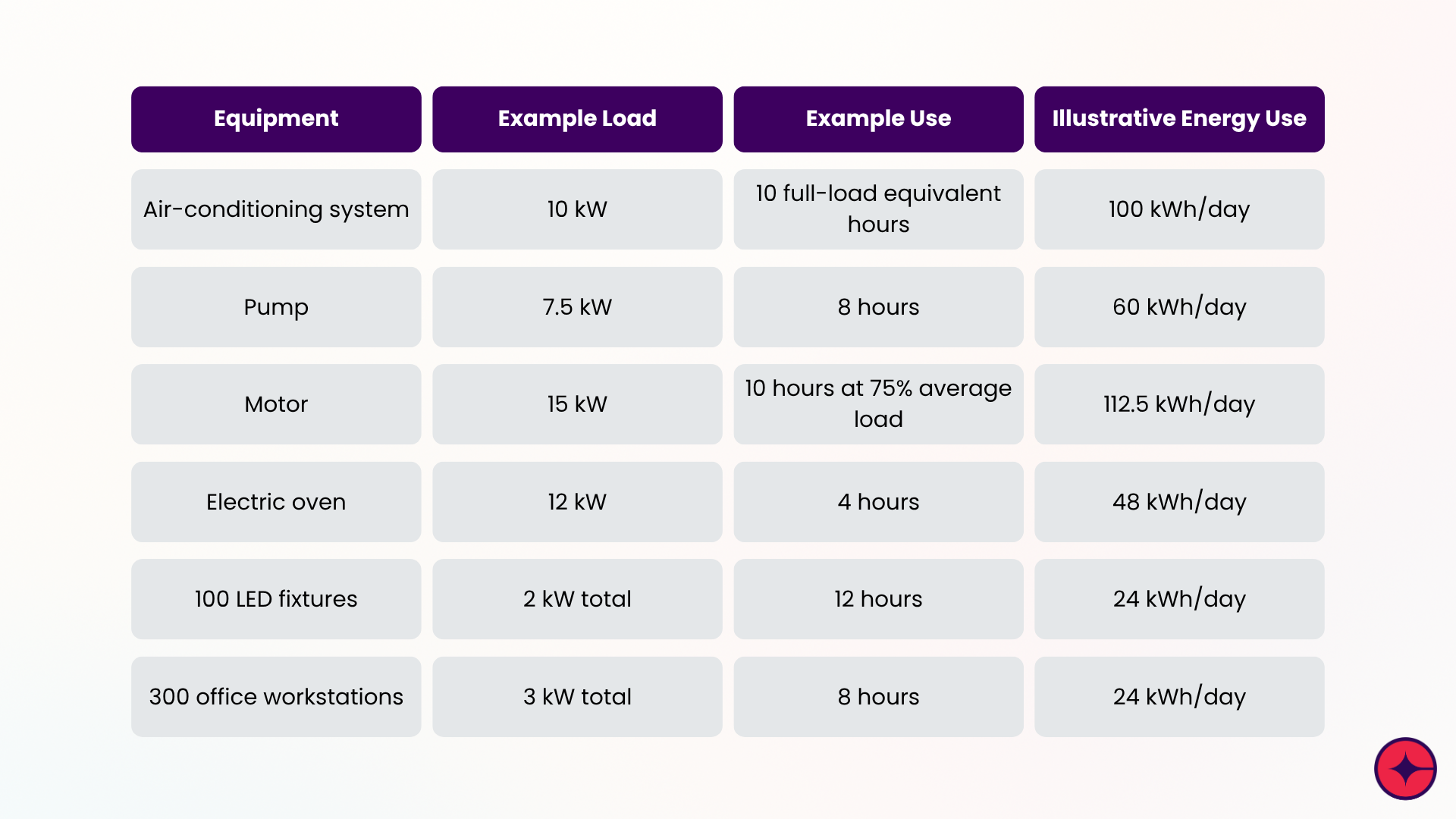
A system with 10 kW of electrical input running at that level for 10 hours would use 100 kWh. In practice, compressors cycle and larger systems may adjust their output, so actual meter or building-management-system data is more useful than a simple nameplate calculation.
Watch for long run times, clogged filters, dirty coils, poor zoning, and cooling in lightly occupied areas. Small inefficiencies can become expensive when they repeat every working day.
Cold storage facilities, supermarkets, restaurants, food processors, and convenience stores face a different challenge: refrigeration rarely gets a day off.
Compressors cycle, but systems must maintain temperature around the clock. Frequent door openings, damaged seals, dirty coils, poor airflow, high ambient temperatures, and incorrect setpoints can all increase runtime.
ENERGY STAR reports that certified commercial refrigerators and freezers are, on average, about 20% more energy efficient than standard models. The practical takeaway is not necessarily to replace equipment immediately. It is to recognize that equipment condition, design, and operating practices can materially affect a 24/7 load.
Motors power pumps, fans, conveyors, compressors, production machinery, and many process systems.
A 15 kW motor running for 10 hours at an average 75% load represents about 112.5 kWh of illustrative energy use before accounting for motor and drive losses. Multiply that across several motors and multiple shifts, and the impact quickly becomes noticeable.
Ask practical questions. Does the equipment need to run this long? Is it oversized for the job? Does the process operate at full output all day? Could speed or schedule controls better match actual demand?
Sometimes the opportunity is not simply a more efficient motor. It is running the existing equipment only as much as the operation actually requires.
Ovens, fryers, steamers, griddles, dishwashers, water heaters, ice makers, and holding cabinets can create significant loads in restaurants, hotels, commissaries, hospitals, and institutional kitchens.
Idle time matters. Equipment may be switched on well before service and left hot between busy periods. ENERGY STAR’s commercial food-service guidance addresses both equipment efficiency and operating practices because preheating, holding, and idle consumption can add up across a working day.
A 12 kW electric oven operating at full input for four hours would use 48 kWh. Actual daily use should consider the full operating cycle, including preheating, cooking, standby, and shutdown periods.
One light fixture may look insignificant. One hundred fixtures running 12 hours a day are not.
For example, 100 LED fixtures rated at 20 watts each create a 2 kW connected load. Over 12 hours, that is 24 kWh per day.
Look at efficient fixtures, operating schedules, occupancy sensors, and zoning. The goal is not simply to use less light. It is to provide the light people need without illuminating empty areas longer than necessary.
Computers, monitors, printers, copiers, network equipment, displays, chargers, and other plug loads are usually modest compared with chillers or industrial motors, but quantity and standby time matter.
Thirty workstations averaging 100 watts each for eight hours represent about 24 kWh per day. Add monitors, printers, meeting-room screens, network hardware, and devices left powered overnight, and the total grows.
Power-management and sleep settings are among the easier places to look for savings. It is recommended that these functions be enabled on computers, printers, copiers, scanners, and multifunction devices to reduce unnecessary consumption when equipment is inactive.
These examples are illustrative, not industry benchmarks. Actual consumption should be verified using equipment specifications and measurements.
To estimate operating cost, multiply the measured or estimated kWh by the applicable electricity cost per kWh. For a more accurate view of electricity for business, use your actual bill and contract structure rather than a generic electricity rate.
Knowing where electricity goes gives your business two advantages.
First, you can find avoidable consumption. Start with the highest-load and longest-running equipment. Review nameplates, schedules, maintenance records, submeters, interval data, and building-management-system readings. If the picture remains unclear, an energy audit can help identify where consumption is concentrated and where practical improvements may exist.
Second, you can understand your load profile. A business that consumes heavily during fixed daytime hours has a different pattern from one that can shift pumping, production, or other flexible loads to different periods.
That matters when choosing an energy provider. Since June 26, 2026, the Energy Regulatory Commission has lowered the RCOA and Retail Aggregation Program eligibility threshold to an average monthly peak demand of at least 100 kW, giving more electricity users access to supplier choice.
When choosing a retail electricity supplier, do not look only at the headline rate. Look at how your equipment actually operates. Predictable loads may value price stability. Flexible operations may be able to consider time-sensitive or customized structures. Businesses comfortable with greater market-price exposure may also evaluate market-linked options.
For companies researching how to switch retail electricity suppliers in the Philippines, equipment-level data makes conversations with electricity suppliers far more useful. It tells you when you use power, how much you use, and which loads can or cannot change.
COREnergy Philippines combines flexible retail electricity plans with technical energy services that can help businesses better understand and manage their consumption.
If you are comparing energy companies in the Philippines or power companies in the Philippines, a good place to begin is inside your own facility.
Know your load. Know your operating pattern. Then choose an electricity plan that fits the way your business actually works.