
For a commercial or industrial business, a high electricity bill rarely has one single cause.
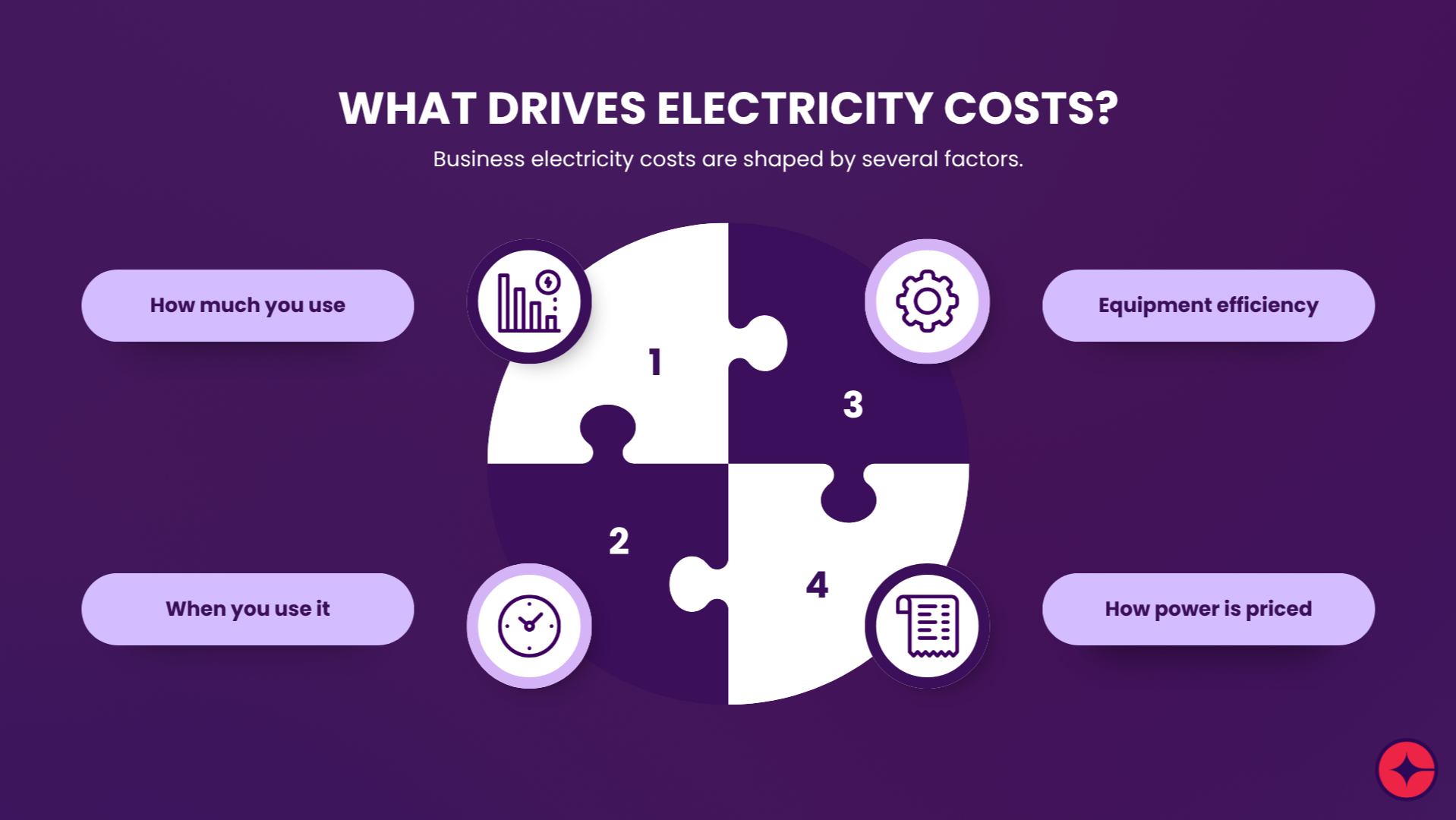
It is usually the result of several factors working together: how much electricity the business uses, how much power it needs at any given time, when equipment is running, how efficiently that equipment operates, and how electricity is priced.
Two facilities with similar monthly consumption can still end up with different electricity costs. Understanding these cost drivers gives business owners, facility managers, and finance teams a better starting point for controlling expenses.
It also makes conversations with an energy provider or retail electricity supplier in the Philippines more useful because you can look beyond the headline rate.
The most familiar driver is electricity consumption, measured in kilowatt-hours (kWh). Every air-conditioning unit, production machine, cold room, lighting system, pump, computer, and other electrical load contributes to the energy consumed over a billing period.
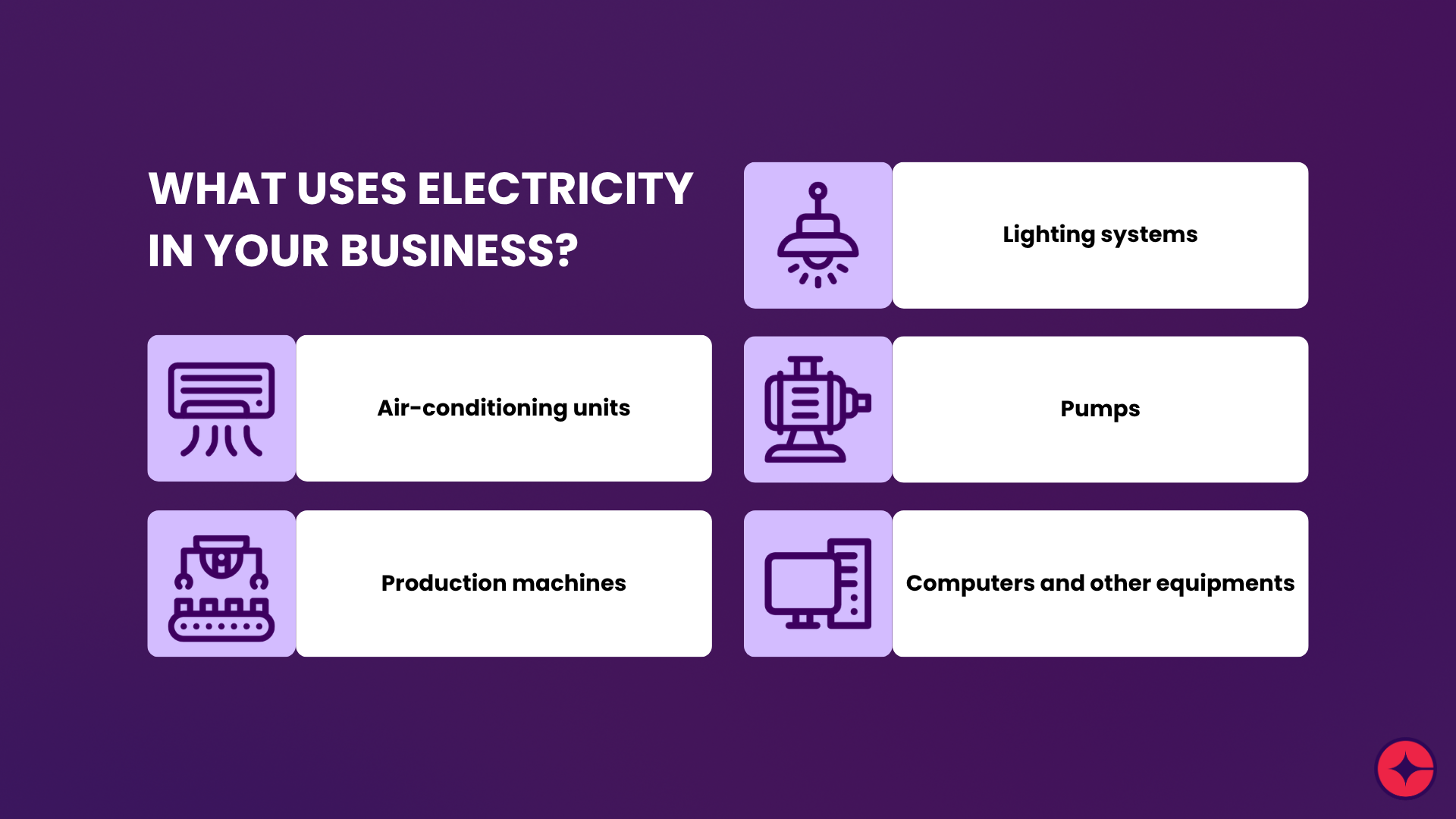
In simple terms, the more equipment you operate and the longer it runs, the more kWh you are likely to use.
Changes in production volume, occupancy, store hours, weather, or operating schedules can therefore show up quickly on the bill.
But consumption is only part of the story. For many businesses, it is equally important to understand how much power the facility requires at its busiest moments.
Demand is commonly measured in kilowatts or kW. While kWh tells you how much electricity was used over time, kW reflects the level of power being drawn at a particular point or interval.
If a facility starts several large motors, chillers, compressors, or production lines at roughly the same time, that simultaneous load can create a higher demand peak.
Depending on the applicable tariff or contract, demand-related charges can influence the total cost of electricity for business. Companies should review both consumption and demand rather than focusing on only one.
Older, poorly maintained, or incorrectly sized equipment can quietly increase electricity use. Motors, pumps, compressors, HVAC systems, and refrigeration equipment may consume more power when poorly maintained or operating under inefficient conditions.
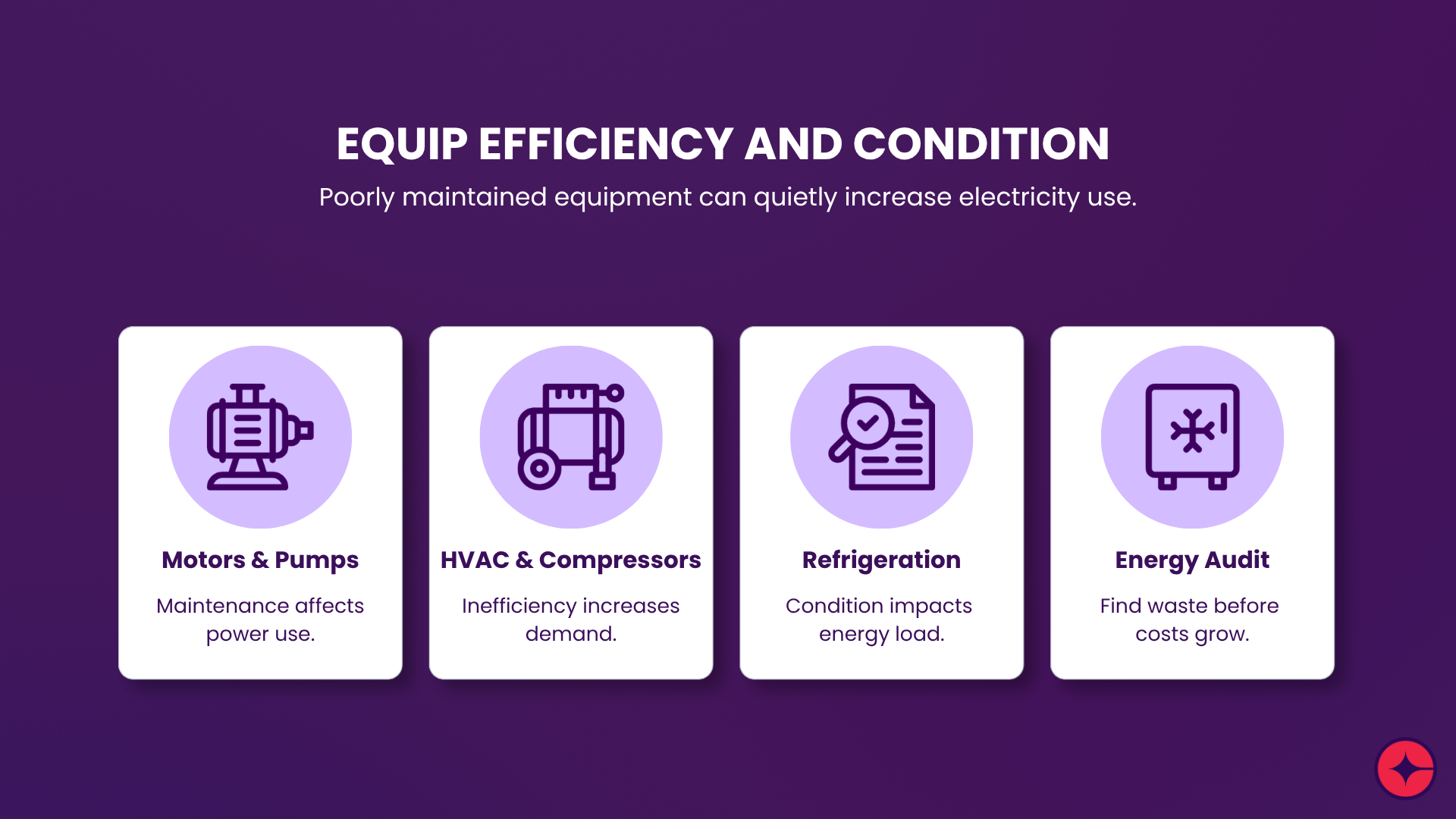
That does not mean every business needs to replace its equipment. Often, the first step is finding out where energy is being used and whether that use makes sense.
An energy audit can help identify inefficient equipment and operating practices. The Department of Energy’s framework under the Energy Efficiency and Conservation Act also promotes structured energy management and efficiency measures.
When your business operates matters almost as much as how long it operates.
A hotel, supermarket, manufacturing plant, office building, and cold-storage facility can all consume significant electricity, but their load patterns are very different.
Some have steady 24-hour demand. Others have sharp daytime peaks. Some can move non-essential processes to different hours, while others need equipment running continuously. This pattern is often called a load profile.
A clear load profile can reveal long periods of high demand, short spikes, or opportunities to shift certain activities. It can also help determine whether a fixed rate, time-based structure, market-linked arrangement, or another supplier option suits the business better.
In the Philippines, cooling deserves special attention. Air-conditioning can be a major load for offices, malls, hotels, schools, restaurants, and commercial buildings.
Refrigeration is even more critical for supermarkets, food processors, warehouses, and cold-storage operators because systems may need to run around the clock.
Temperature settings, equipment efficiency, insulation, maintenance, occupancy, and outdoor heat all affect cooling demand. The DOE has also identified cooling management among the energy-efficiency measures encouraged for designated establishments.
For businesses with large cooling or refrigeration loads, operational improvements may be worth investigating before assuming the problem is purely the electricity rate.
The price per kWh matters, but it does not tell the whole story. Business electricity costs may include generation, transmission, distribution, taxes, and other regulated or pass-through charges. The exact structure depends on the customer, utility, location, and supply arrangement.
For contestable customers, the retail supply contract can also affect how generation costs behave. A fixed-price arrangement may prioritize predictability, while a market-linked arrangement can expose the customer to changes in Wholesale Electricity Spot Market prices. Time-based or customized structures may suit businesses that can control when certain loads operate.
The Wholesale Electricity Spot Market is a centralized market where electricity is traded, and prices respond to supply and demand. A lower-looking rate is therefore not automatically the best fit if the underlying contract creates more price exposure than the business wants.
For eligible businesses, the choice of energy provider is another cost lever. On June 26, 2026, the Energy Regulatory Commission lowered the RCOA and Retail Aggregation Program eligibility threshold to 100 kW average monthly peak demand, expanding access to the competitive retail electricity market.
The ERC announcement on the 100 kW threshold provides regulatory context. That makes choosing a retail electricity supplier increasingly relevant to more commercial and industrial businesses.
When comparing electricity suppliers, look beyond the quoted rate. Ask how the contract is structured, what line items affect the total amount payable, how market movements or fuel price changes are handled, how billing is presented, and what support is available if your consumption pattern changes.
Switching electricity supplier in the Philippines should be treated as a business decision, not simply a hunt for the lowest number on a proposal.
Start with your own data. Review several months of bills and compare consumption, demand, operating hours, and major changes in production or occupancy.
Look for unusual peaks and identify the largest or longest-running loads. If the cause is still unclear, an energy audit can build a more detailed picture. From there, determine whether the main issue is operational, technical, contractual, or a combination of all three.
For businesses eligible for retail competition, the next step may be comparing energy companies in the Philippines and understanding which supplier arrangement fits the company’s load profile and risk tolerance.
Not all power companies in the Philippines offer the same contract structure, service model, or flexibility, so the details matter.
Electricity costs are rarely solved by one change alone. A more efficient chiller may help. Better scheduling may help. Reducing unnecessary demand peaks may help. A more suitable rate structure or supplier arrangement may help as well. The important part is knowing which lever matters most for your business.
COREnergy Philippines works with commercial and industrial customers to understand their electricity requirements, explore flexible retail electricity arrangements, and identify opportunities to use energy more effectively.
If you are considering how to switch retail electricity supplier in the Philippines or simply want a clearer view of what is driving your current costs the best place to begin is with the numbers already in front of you.