
Choosing electricity for business is no longer only about asking, “What rate can you offer?” For qualified businesses exploring the competitive retail market, the better question is: Will my energy provider help me understand what I am paying for, how my business is using electricity, and what I can do with that information?
That is where reporting and visibility matter. A modern retail electricity supplier in the Philippines should not simply send an invoice at the end of the month and leave your team to decode it alone.
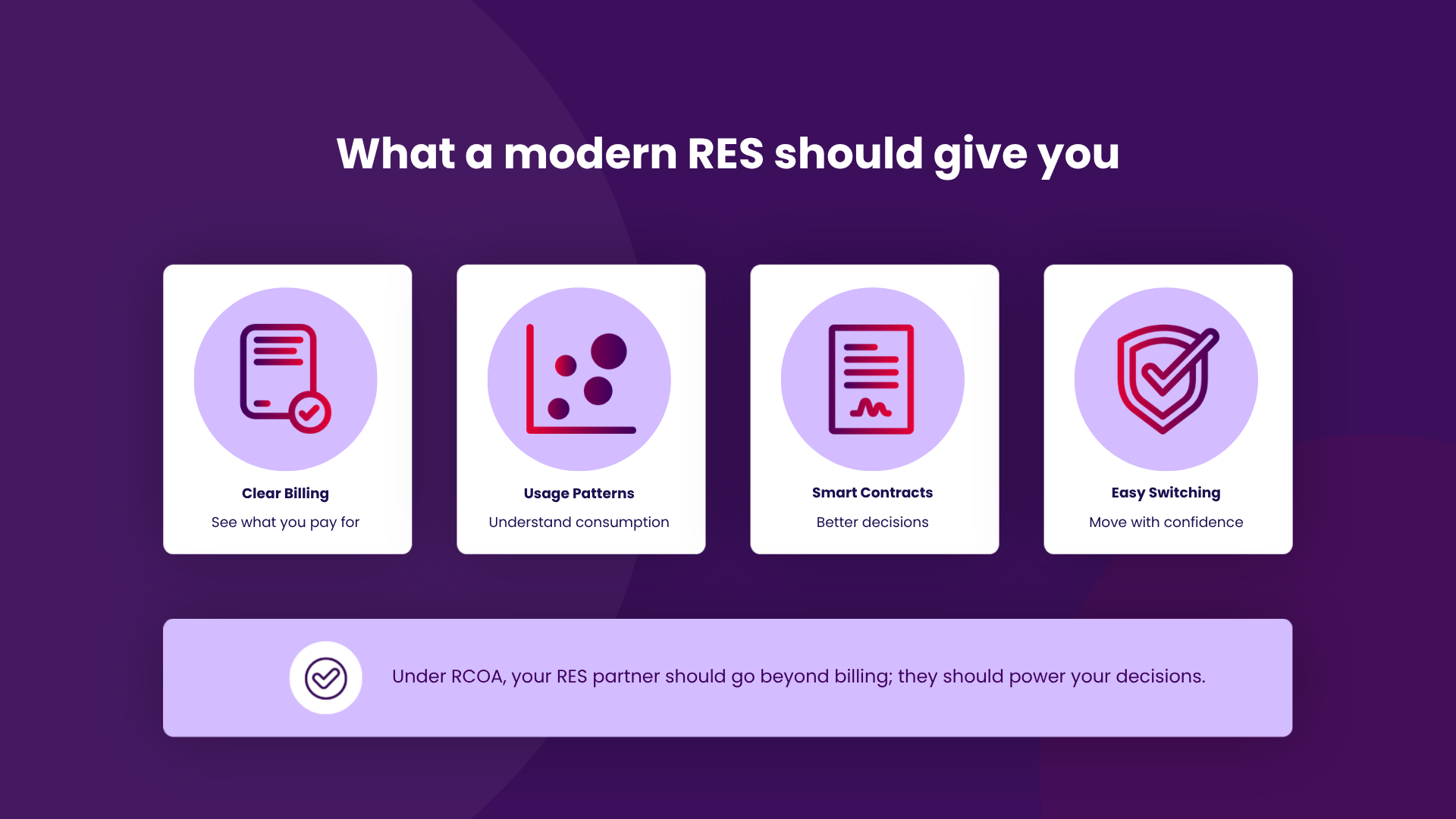
It should help you see your energy costs more clearly, understand your consumption patterns, make better contract decisions, and move through switching with confidence.
Under Retail Competition and Open Access or RCOA, eligible businesses may choose a licensed Retail Electricity Supplier or RES instead of remaining under the default supply arrangement of their local distribution utility.
The Department of Energy reported that RCOA had grown to 2,116 contestable customers supported by 61 licensed retail electricity suppliers in its 45th EPIRA Status Report. More choice is good. But choice becomes more valuable when it comes with clearer information.
Electricity is one of those costs that can feel unavoidable. Your facility operates, your equipment runs, your bill arrives, and payment follows. But for businesses, energy should not be treated as a mysterious expense.
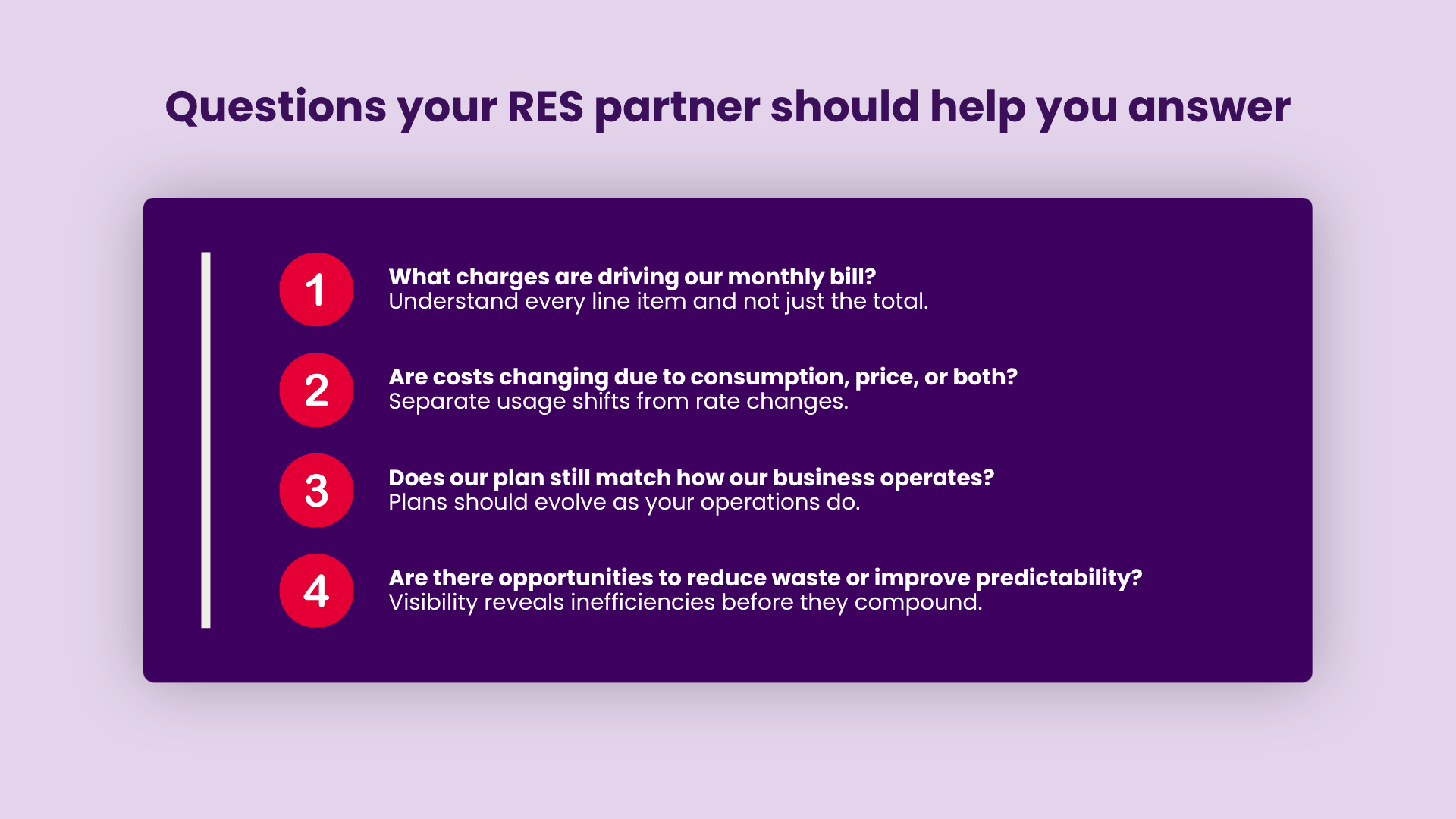
A good RES partner helps your finance, operations, and management teams answer practical questions such as:
This is especially important for businesses comparing energy companies in the Philippines or considering switching electricity suppliers in the Philippines. A competitive price matters, but a rate without visibility can still leave your team uncertain about future costs and operational decisions.
A modern RES partner should make your monthly bill easier to review, not harder. Under RCOA, switching suppliers does not mean that the physical delivery of electricity suddenly changes.
Your local distribution utility remains responsible for the wires and infrastructure that deliver power to your site. Your RES becomes the chosen supplier under your retail supply arrangement.
This means your bill may include supply charges together with applicable transmission, distribution, and other pass-through charges. A responsible RES should help explain what these charges mean and which portion is influenced by your chosen supply contract.
COREnergy provides customers with a single, itemized bill that consolidates relevant charges, including generation cost and pass-through charges for distribution and transmission, as explained in our Frequently Asked Questions.
For a business owner or finance manager, this matters because a bill should help you review costs and plan. It should not force you into a monthly guessing game.
A monthly bill tells you what happened. Better visibility helps you understand why it happened. Businesses should expect access to their electricity consumption and billing information in a format that supports regular monitoring.
This can help identify trends such as higher use during certain operating periods, unexpected increases in demand, or changes that may need further investigation.
For example, a warehouse may notice that electricity use spikes during particular shifts. A hotel may see heavier consumption during periods of high occupancy. A manufacturing facility may want to compare energy movement against production schedules.
This kind of visibility is useful because not every cost increase is caused by the same issue. Sometimes the reason is higher operational demand. Sometimes it is the selected pricing structure. Sometimes it is equipment performance or inefficient usage.
COREnergy customers can access billing and consumption information through the MyPower Platform, a customer portal designed for viewing bills, tracking consumption, and managing account information.
This is the practical difference between receiving electricity and managing it. When your information is accessible, your business can ask better questions and make better decisions.
Not all businesses use electricity in the same way. A company operating predictable hours may have very different priorities from one that runs production lines around the clock.
That is why a modern RES partner should help you understand whether your chosen pricing structure continues to suit your operations.
A fixed rate plan may appeal to businesses that value budget predictability. A WESM-based plan may suit businesses that understand and can manage exposure to market movement. A time-based or customized plan may be useful for operations with clearer consumption patterns and greater flexibility.
The Independent Electricity Market Operator of the Philippines explains that it operates the Wholesale Electricity Spot Market and serves as the Central Registration Body for the retail electricity market under RCOA.
It also tracks retail market transactions and facilitates customer switching. Businesses can learn more about this structure through IEMOP’s overview of its market role.
You do not need to become a market specialist to choose an energy plan. But your RES partner should be able to explain your options plainly, show how each one relates to your operating pattern, and help you review the decision using actual usage information over time.
When businesses think about switching, it is natural to worry about paperwork, coordination, and disruption.
A modern RES partner should provide visibility before the contract begins. That means explaining eligibility, required documents, expected timelines, coordination with the distribution utility, and the responsibilities of each party.
Eligibility rules and thresholds are determined by the Energy Regulatory Commission and may evolve as retail competition expands. Businesses evaluating their options should review the latest issuances through the ERC’s official resolutions and rules page or speak with a licensed RES for guidance.
Legitimacy matters as well. COREnergy was awarded its Retail Electricity Supplier license by the ERC in 2016, as documented in the ERC’s official announcement.
For businesses asking how to switch retail electricity suppliers in the Philippines, the process should feel guided, not intimidating. Good support means your team knows what is needed, what comes next, and who is accountable for helping move the switch forward.
Reporting is not only about billing. It can also help businesses understand how efficiently their facilities are using electricity.
An energy audit can reveal where your business may be wasting power, whether equipment issues are affecting performance, or whether operational improvements may help reduce energy use. Under the Energy Efficiency and Conservation Act, or Republic Act No. 11285, designated establishments have energy reporting and audit responsibilities based on their annual energy consumption.
This is an important distinction: regulatory reporting is a compliance requirement for qualifying establishments, while customer portal reporting and bill visibility help businesses manage their electricity accounts more effectively. Both become easier when your energy partner understands the business side and the technical side of power use.
COREnergy offers energy services that include Energy Audit Levels 1, 2, and 3, as well as power quality measurement, thermal scanning, and medium voltage testing and preventive maintenance. These services are designed to help businesses identify possible inefficiencies, improve operational understanding, and support informed decisions about energy use.
Among the many power companies in the Philippines and electric suppliers serving business customers, the right RES partner should do more than offer a rate.
It should help your business see what you are paying, track how you are consuming electricity, understand whether your plan fits your operations, navigate the switching process clearly, and access support when deeper energy questions come up.
That is what modern energy partnership looks like: not more complexity, but more clarity.
With COREnergy Philippines, businesses gain a partner built around clear billing, accessible consumption information, flexible energy plans, guided switching, and energy services that support smarter operational decisions.
Thinking about switching electricity suppliers in the Philippines? Start by checking your eligibility, reviewing your consumption profile, and asking what reporting and visibility your next RES partner can provide.
Choose clearer energy decisions with COREnergy. Explore COREnergy Energy Plans, learn about its Energy Services, or request a free quote for your business today.