A low electricity rate can get your attention, but before you sign, there is a more important question to ask: Is that the rate you will actually end up paying?
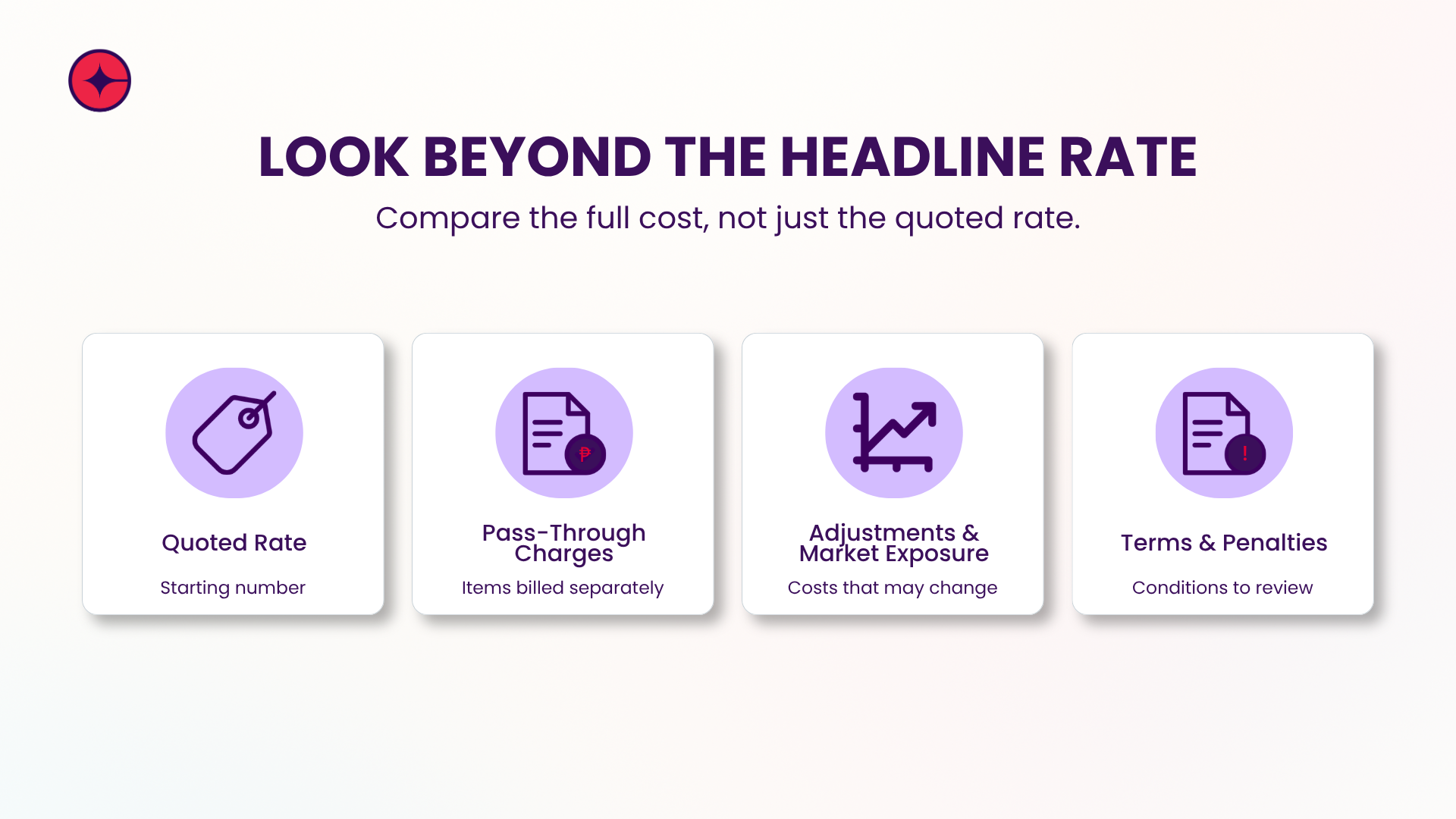
When businesses compare offers from a retail electricity supplier in the Philippines, the headline peso-per-kilowatt-hour figure is usually where the conversation begins. It should not be where the comparison ends.
Some contracts contain additional charges, adjustment mechanisms, penalties, market exposure, or conditions that can change what an apparently attractive offer costs in practice. Others can restrict your flexibility even if they do not immediately increase your monthly bill.
These provisions are not automatically improper simply because they exist. The problem comes when a customer compares offers without understanding how each one works.
So before switching electricity suppliers in the Philippines, read past the big number on the quotation. Here are some of the details worth looking for.
Suppose two electricity suppliers offer rates that appear close to each other. Supplier A quotes a slightly lower generation rate. Supplier B looks a little higher. Easy decision? Not necessarily.
Ask whether the quoted rate includes all supplier-related costs or whether separate fees will appear later.
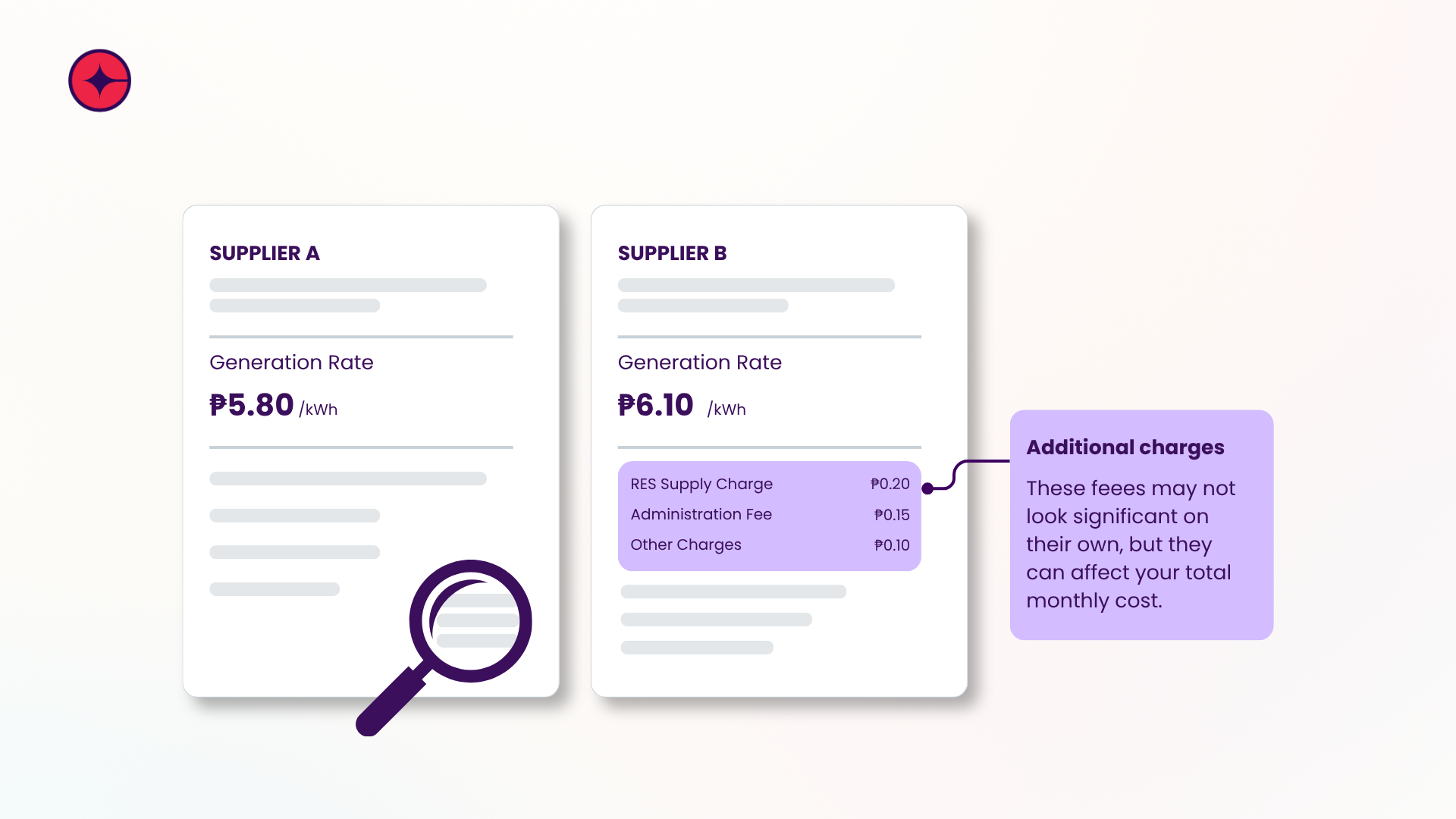
An offer may include an additional RES supply charge or administration fee, for example. Individually, these charges may not look dramatic, but they can change the effective rate you pay each month. This is why comparing electricity offers should be done on a like-for-like basis.
The Energy Regulatory Commission maintains a pro forma Retail Supply Contract and other documentation for the competitive retail market, reinforcing the importance of clearly defined contractual terms between suppliers and customers.
When evaluating an offer, ask your supplier to walk you through every charge, not just the generation rate.
The Wholesale Electricity Spot Market, or WESM, is where electricity is traded according to changing market conditions. That means prices can move.
IEMOP explains that WESM prices are determined by market forces and can reflect factors such as supply, demand, transmission losses, and congestion.
IEMOP's recent market data shows how meaningful those movements can be: during the August 2026 billing period, average prices in the Visayas rose sharply as outages, tighter supply margins, and transmission constraints affected the market.
Market exposure is not necessarily a bad thing. Some businesses deliberately choose market-linked pricing because it matches their risk appetite.
The question is whether you know you have that exposure. Look for terms such as WESM pass-through, market adjustment, or similar provisions. If market prices rise, determine how much of that increase can be passed on to you.
A fixed-looking offer that still passes certain market movements to the customer is not the same as a genuinely fixed price.
Another term businesses may encounter is line rental. In the WESM, electricity prices can differ depending on location because the market accounts for transmission losses and congestion. IEMOP refers to this as locational marginal pricing.
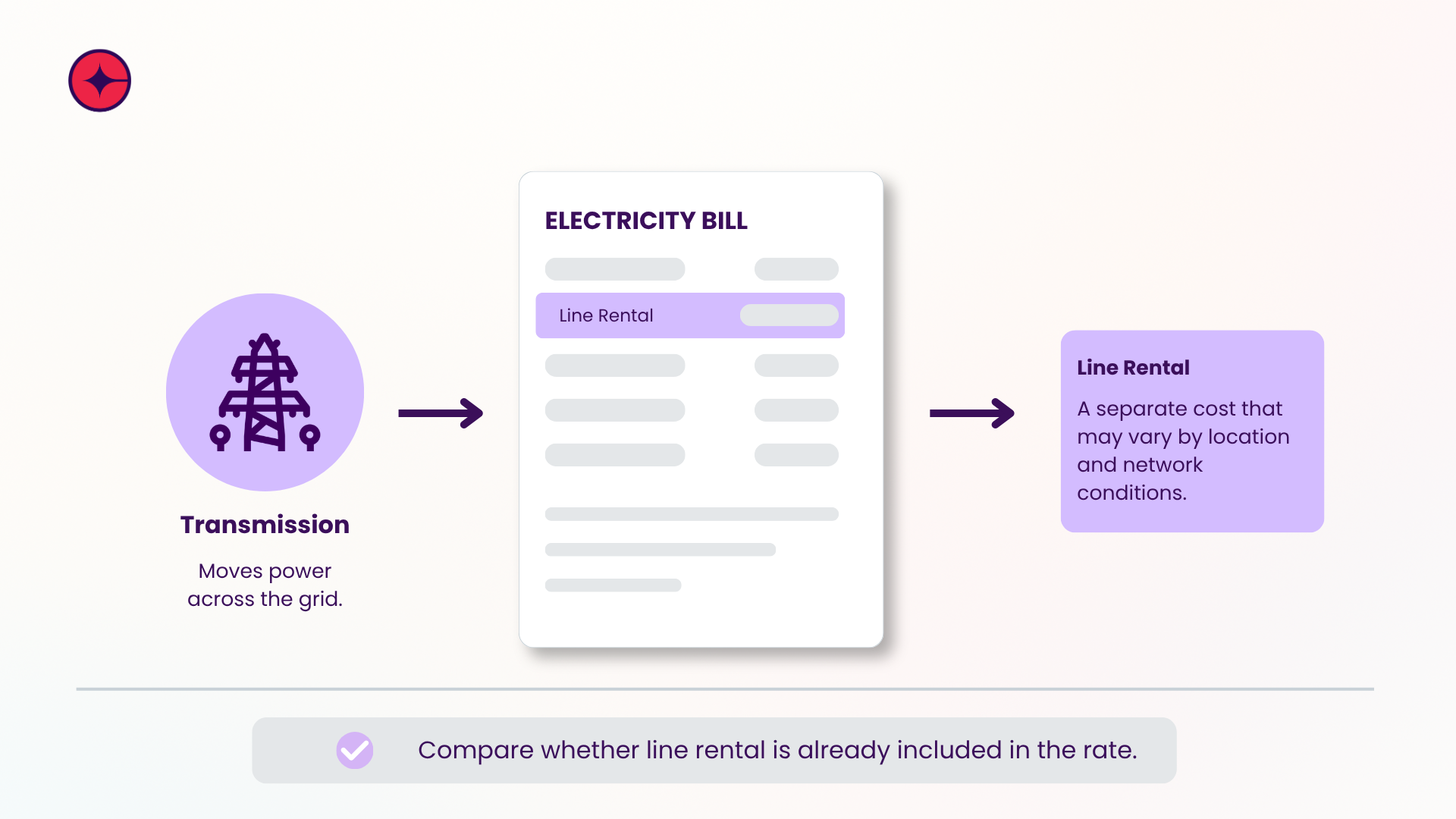
If your proposed contract treats line rental as a separate variable cost, ask how it is calculated and whether it is already included in the price you are comparing.
The principle is simple: Do not compare an inclusive rate from one supplier against a rate from another supplier that excludes a variable component. They may look comparable on paper while producing different bills.
A contract may also contain mechanisms allowing certain costs to be adjusted when underlying fuel prices or other inputs change.
Again, an adjustment mechanism is not automatically a reason to reject an offer. What matters is understanding who carries the risk.
Ask: What triggers the adjustment? How is it calculated? Is there a ceiling? Can the price move both upward and downward? How often can it be changed?
Official RCOA guidance has long emphasized that disclosure statements and Retail Supply Contracts should identify applicable prices and charges, including price-adjustment mechanisms for variable offers.
If the adjustment formula takes several paragraphs to explain, do not be embarrassed to ask for an example using actual numbers. Your supplier should be able to explain it clearly.
Some offers combine contracted pricing with exposure to the spot market. One detail to examine is how gains and losses are shared.
For example, what happens if WESM prices fall below a particular reference level? Does the customer receive the full benefit, part of it, or none of it? Then ask the opposite question: What happens when WESM prices rise?
A structure where the supplier shares in the upside but the customer absorbs most or all of the downside creates a very different risk profile from a straightforward pass-through arrangement.
Do not stop at asking, “Can I benefit when WESM prices are low?” Ask, “What exactly happens in both directions?” That one question can reveal a lot.
Your electricity consumption will rarely be identical every month. Production changes. Weather changes. New equipment is commissioned. A branch closes for renovation. Orders increase unexpectedly.
Some contracts may contain tolerance bands, imbalance penalties, or a minimum off-take requirement.
A minimum off-take clause can require the customer to pay based on a minimum contracted quantity even when actual consumption falls below it. An imbalance provision may impose additional costs when demand moves outside an agreed range.
These terms can be particularly important for businesses with seasonal or unpredictable operations.
When choosing a retail electricity supplier, ask how much flexibility you have if your actual consumption differs from your forecast. A great rate based on a consumption profile your business cannot realistically maintain may not be a great deal after all.
Not every clause that costs you flexibility appears on the electricity bill. Pay attention to automatic renewal provisions, notice periods, termination terms, and account-transfer provisions.
An auto-renewal clause, for example, may extend your contract unless notice is given within a specific window. A lengthy notice period could make it harder to change suppliers when another contract opportunity comes along.
This matters even more now that the Philippine retail electricity market is open to more customers. Since June 26, 2026, the RCOA and Retail Aggregation Program threshold has been lowered to an average monthly peak demand of at least 100 kW, expanding supplier choice to more businesses.
Having a choice is valuable. Your contract should not make exercising that choice unnecessarily difficult later.
Whether you are comparing energy companies in the Philippines, power companies in the Philippines, or different electricity suppliers, a lower quoted rate does not automatically mean a lower total cost.
Before signing, ask for a clear explanation of:
That is a much stronger comparison than simply putting two headline rates side by side.
COREnergy Philippines takes a straightforward approach to electricity for business: flexible plans, competitive rates, and transparent contracts without hidden supplier charges.
The goal is to make energy easier to understand, so businesses know what they are agreeing to before they make the switch.
If improving consumption is part of the bigger picture, services such as an energy audit can also help identify where electricity is being used and where opportunities for greater efficiency may exist.
The cheapest-looking offer is not always the cheapest offer. Look beyond the rate. Understand the contract. And choose an energy provider that makes the numbers clear before you sign.