
For many growing businesses, electricity use is not concentrated in just one place. Individually, each location may not look like a large power user. But together, the electricity demand can be significant.
A property group may have several buildings. A restaurant operator may manage different branches. A school may have separate meters for classrooms, offices, dormitories, and facilities. A clinic group may run multiple sites across one service area.
This is where many businesses ask an important question: Can multiple business locations qualify together for retail electricity?
In the Philippines, the answer may be yes through the Retail Aggregation Program, or RAP. This allows qualified end-users to combine electricity demand and participate in the retail electricity market as an aggregated group, subject to the applicable rules and eligibility requirements.
For businesses exploring a retail electricity supplier in the Philippines, this can be a practical way to access supplier choice, better contract options, and more control over electricity for business.
Retail electricity is part of Retail Competition and Open Access, or RCOA. Under the Electric Power Industry Reform Act of 2001, retail competition and open access allow qualified electricity end-users to choose their supplier, instead of being limited to the default supply arrangement of their distribution utility.
Republic Act No. 9136 provides the legal basis for retail competition and open access in the Philippine power sector.
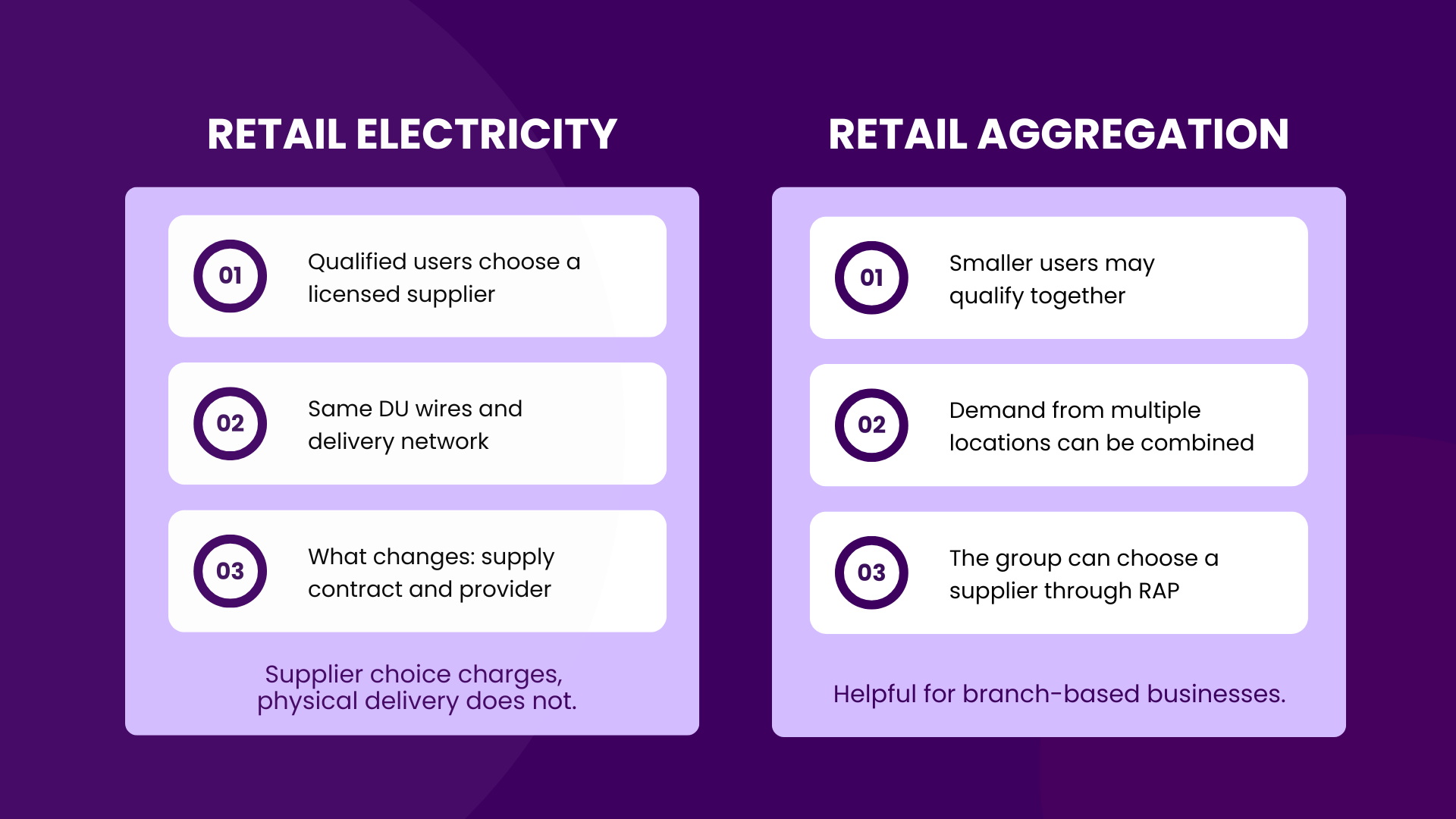
In simple terms, qualified businesses can choose from licensed electric suppliers and enter into a retail supply contract that fits their needs. The distribution utility still delivers power through the same poles, wires, and local network. The changes are the supply arrangement and the energy provider you contract with.
That distinction matters. Switching electricity supplier in the Philippines does not mean your building suddenly connects to a different power line. It means your business gains the ability to choose who supplies the electricity portion of your power needs, based on your contract, pricing structure, service expectations, and operational profile.
Retail aggregation is designed for end-users who may not qualify individually, but can qualify together.
Under the Retail Aggregation Program, multiple end-users may combine their electricity demand and participate as an aggregated group. The Philippine News Agency reported that the Energy Regulatory Commission’s RAP allows power consumers to apply to aggregate their consumption, even in separate locations, and choose their supplier.
Think of it like this: one branch may be too small to qualify on its own. But five branches under the same business may have enough combined demand to meet the required threshold. Instead of looking at each meter in isolation, aggregation looks at the group.
This can be helpful for businesses that grew branch by branch. Their total power use may already be sizable, but because it is split across multiple meters, they may not have realized they had a path toward retail electricity.
The retail electricity market has become more accessible.
The ERC approved the lowering of the eligibility threshold for RCOA and the Retail Aggregation Program from 500 kW to 100 kW average monthly peak demand, with the new threshold taking effect starting last June 26, 2026.
This is a big shift for medium-sized businesses. Before, many companies with several locations were simply too small to participate. Now, more businesses may be able to qualify either as a single site or as an aggregated group.
In practical terms, this means a multi-site business should no longer assume, “We are too small for RCOA.” The better question is: “What is our combined average monthly peak demand?”
Retail aggregation can be especially relevant for companies with several stores or locations that operate under one business group, franchise structure, campus, property, or service area.
A property group, for example, may have several buildings under one portfolio. One building may not reach the threshold, but the total demand across several sites may. For real estate operators, aggregation can make electricity procurement more strategic instead of treating every meter as a separate concern.
Retail chains may also benefit. A restaurant group with several branches, a supermarket operator with multiple outlets, or a convenience store franchise with several stores may have moderate demand per branch. But taken together, refrigeration, lighting, kitchen equipment, air-conditioning, and operating hours can add up.
Schools and universities are another good example. A campus may have separate meters for academic buildings, administrative offices, dormitories, sports facilities, or auxiliary services. Individually, each meter may seem modest. Collectively, the school’s demand may tell a different story.
Clinics and healthcare groups may also want to review their numbers. Medical equipment, air-conditioning, refrigeration, lighting, and extended operating hours can create steady consumption across several sites.
The same applies to logistics companies, warehouses, business districts, mixed-use developments, and food service operators. If electricity is a recurring operational cost across many locations, aggregation is worth exploring.
Let’s say a restaurant group operates five branches within the same distribution utility franchise area.
Branch A averages 22 kW
Branch B averages 18 kW
Branch C averages 24 kW
Branch D averages 20 kW
Branch E averages 19 kW
On their own, none of the branches reaches 100 kW. But together, the group averages 103 kW.
That combined demand may open a path to retail aggregation, subject to the applicable RAP rules and validation. The business can then explore offers from energy companies in the Philippines and compare retail supply options more strategically.
Here is another example.
A private school has four metered accounts: classrooms, administration, dormitory, and gym. Each account is below 100 kW. But the school’s combined demand reaches the threshold. Instead of treating each meter as separate, the school can ask whether those accounts can be reviewed as an aggregated group.
The keyword is “review.” Aggregation is not automatic. The business still needs to confirm eligibility, grouping rules, metering requirements, and the process with the chosen RES and relevant utility parties.
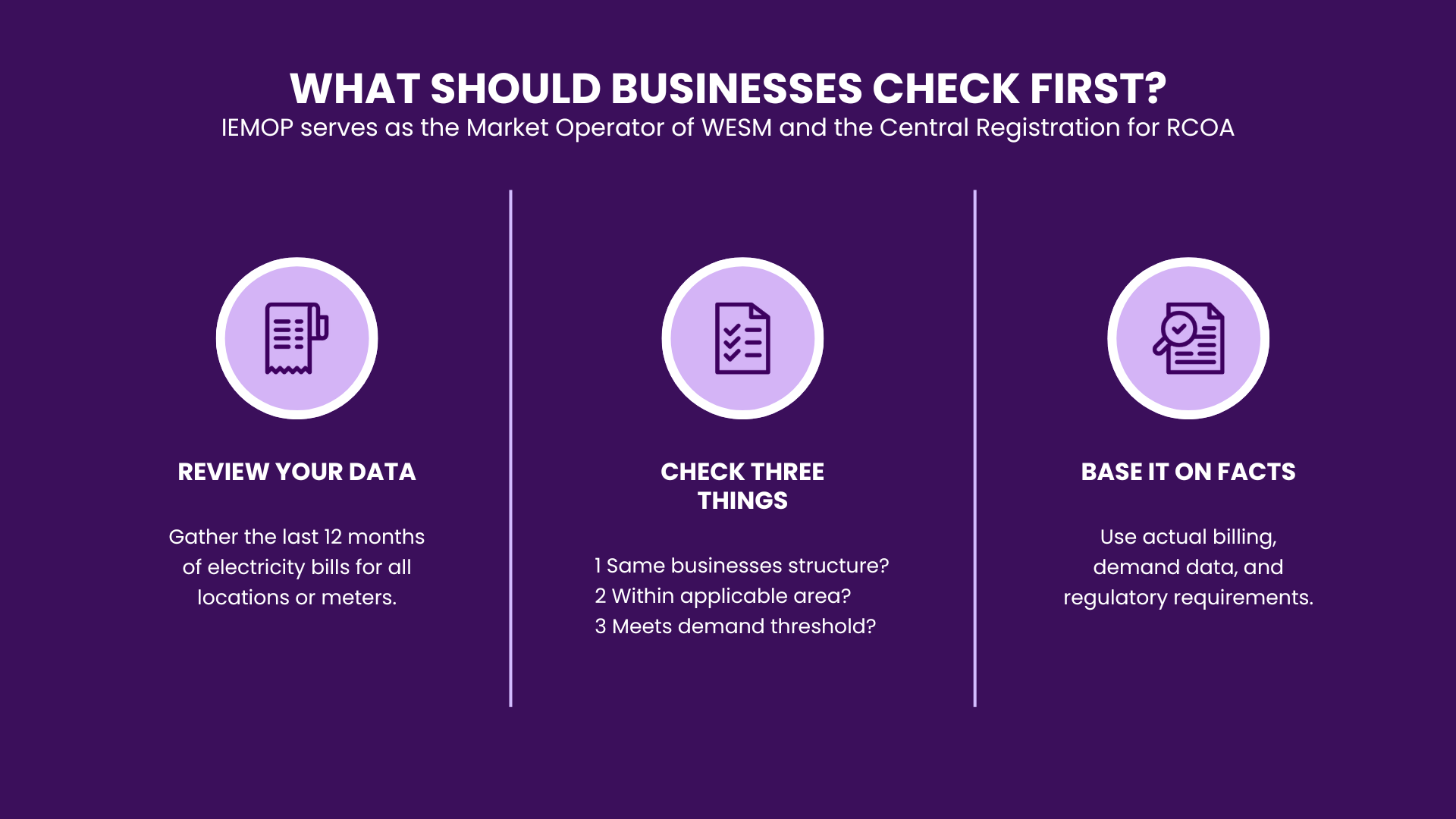
The best starting point is your electricity data. Gather the last 12 months of electricity bills for all possible locations or meters.
Create a simple list that includes the service address, account number, meter number, average monthly consumption, and any available demand information. If you have multiple branches, group them by distribution utility or franchise area.
Then ask three practical questions.
First, are the meters connected to the same business, owner, franchise, property group, or qualified aggregation structure?
Second, are the sites within the applicable area allowed under RAP rules?
Third, does the combined average monthly peak demand meet the current threshold?
The Independent Electricity Market Operator of the Philippines, or IEMOP, serves as the Market Operator of WESM and the Central Registration Body for RCOA. Its customer information requirements show that distribution utilities submit customer information relevant to demand thresholds and contestability.
This is why documentation matters. A good review should not rely on guesses. It should be based on actual billing history, demand data, and regulatory requirements.
For multi-site businesses, aggregation is not just about qualifying. It can also help management see electricity more clearly.
Many businesses review power costs branch by branch, only when a bill looks unusually high. Aggregation encourages a more complete view. It helps finance and operations teams see how electricity behaves across the whole business.
That can lead to better conversations, such as:
Which branches consume the most power?
Which meters have unusual demand spikes?
Which operating hours drive higher usage?
Which sites may benefit from an energy audit?
Which retail supply structure fits the group’s load profile?
This is where choosing a retail electricity supplier becomes important. The right supplier should not only give you a rate. It should help you understand the numbers behind the rate.
Some businesses may prefer a more stable contract for budgeting. Others may have flexible operations and want a structure that reflects their usage pattern. Some may need engineering support, power quality checks, or an energy audit to identify avoidable waste across locations.
For businesses asking how to switch retail electricity suppliers in the Philippines, the process usually starts with an assessment. A RES will review your bills, demand profile, site list, and possible aggregation structure.
If the business appears qualified, the next steps may include preparing documents, coordinating with the distribution utility or relevant network service provider, confirming metering requirements, and completing the required market registration or switching procedures.
It can sound technical, especially for businesses doing this for the first time. But it does not have to feel overwhelming. A capable energy provider should guide the process, explain what each document means, and help your team understand the timeline.
That support is especially helpful for multi-site businesses because there are more details to organize: more meters, more bills, more locations, and sometimes more decision-makers.
Many businesses assume they cannot access retail electricity because no single branch or meter looks “big enough.” With retail aggregation, that assumption may no longer be true.
If your company has several locations, meters, buildings, or branches, it may be time to look at your electricity demand as a group. The opportunity may not be sitting in one large facility. It may be spread across the places where your business operates every day.
COREnergy Philippines helps businesses review their eligibility, understand aggregation options, and explore retail electricity solutions that fit their operations.
For property groups, retail chains, schools, clinics, restaurants, and other multi-site businesses, the first step is simple: gather your bills, map your meters, and start the conversation.